
Roles and Functions of Fats in the Body
1. Most lipids are the building blocks of the human body. (The concept of lipid is a broad concept that includes fats, oils, fatty acids, phospholipids and steroids. For detailed information on lipids, see Lipids; Classification, Fatty Acids, Fats, and Oils)
2. Fats are the body’s energy reserves. Excess calories ingested are stored as fat. For example, if the calories taken from the daily diet are insufficient for the energy the body needs, the missing energy is obtained by using stored fats to cover caloric needs.
3. Fats provide thermal insulation and protect the body against cold.
4. The subcutaneous fat tissue protects the body against impacts, while the adipose tissue surrounding the organs protects the organs against sudden physical effects.
5. Eating healthy fats supports brain health. An association has been reported between the consumption of healthy fats and a lower risk of Alzheimer’s disease.
6. Vitamins A, D, E and K are fat-soluble. Therefore, fat must be consumed to take these vitamins into the body. Likewise, the transport of these vitamins in the body is provided by fats.
7. Since fats stay in the stomach longer than proteins and carbohydrates, they provide a feeling of satiety for a more extended period.
Fats and Nutrition
It is recommended that a healthy adult consume about 70 grams of fat daily. Each person should therefore know the fat content of the foods they eat. Knowing how much fat is present in prepared foods and cooked meals also helps determine how much fat to consume at breakfast.
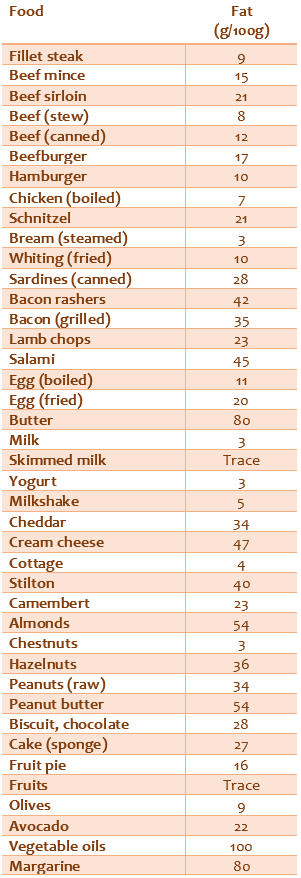
In case of overweight, completely eliminating fats from the diet is not a logical solution. Because it is necessary to consume at least a small amount of fats in order to obtain fatty acids such as linoleic acid, linolenic acid and arachidonic acid, which cannot be produced in the human body but are essential for the structure and functioning of the organism. From this perspective, instead of completely eliminating fats from the diet, it can be recommended to consume foods rich in these fatty acids, such as fish and butter, even if in small quantities.
Fat consumption is also necessary for the intake of fat-soluble vitamins A, D, E and K. Although these vitamins can be stored in the body, if fat is not consumed for a long time, the body will be deprived of these vitamins.
On the other hand, foods produced by deep frying cause the individual to ingest high levels of fat. Therefore, caution should be taken in the consumption of such foods. It may be logical to minimize the consumption of foods cooked by frying.
It has been suggested that erucic acid, a fatty acid, causes fat accumulation in the heart. For this reason, the consumption of rapeseed oil with a high erucic acid content is not recommended.
Trans fatty acids are isomers of unsaturated fatty acids. Unsaturated fatty acids are usually present in foods in cis form. Fatty acids in trans form have a 25-30°C higher melting point than their isomers, cis forms and their solubility is lower than in the cis form. Trans fatty acids generally increase as a result of intensive food processing, especially high heat treatment.
Importance of Cholesterol for Health and Nutrition
Another important issue in fat consumption is cholesterol intake. Cholesterol is a lipid found only in animal fats.
Cholesterol has very important vital functions in the body;
- It is responsible for the digestion of fats in the body,
- It participates in the structure of nerve cells; About 17% of the dry matter weight of brain tissue is cholesterol.
- It participates in the structure of the cell wall in other tissues.
Cholesterol is also produced in the human body. A healthy individual’s body makes 1 to 4 grams of cholesterol per day and there are constantly 10 to 12 grams of cholesterol in the blood. The total amount in the body of an adult individual is about 150 grams.
Not having enough cholesterol in the body causes problems in the digestion of fats and deterioration of the cellular structure in tissues, especially nerve tissue.
The negative effect of cholesterol on health is that it causes cardiovascular diseases. The melting point of cholesterol is 159°C. It is found in the blood bound to proteins. This is why LDL (Low-Density Lipoprotein) and HDL (High-Density Lipoprotein) levels are detected in blood cholesterol measurement.
The cholesterol level in the blood is highly dependent on factors such as genetic predisposition, obesity and stress.
Over time, the accumulation of cholesterol and many other molecules in the arteries can lead to serious conditions such as atherosclerosis, chest pain and heart attack. In this sense, high cholesterol intake does not show any immediate or daily symptoms; it shows signs of post-accumulation over the years. Therefore, regularly and routinely measuring the level of cholesterol in the blood is extremely important to prevent diseases that may be caused by cholesterol in the future.
Cholesterol Level in the Blood
For a healthy adult individual, the total cholesterol level in the blood is expected to be 200 mg/dL and below. A total cholesterol level of 200 – 239 mg/dL is accepted as a limit value. 240 mg/dL and above are considered high values.
Blood LDL levels should be below 100 mg/dL. A level of 100–129 mg/dL is acceptable for people without health problems, but requires particular attention in those with cardiovascular disease or risk factors such as excess weight, stress or a genetic predisposition. Levels of 130–159 mg/dL are considered borderline high, 160–190 mg/dL high, and 190 mg/dL or above very high.
HDL levels should be kept high. HDL values lower than 40 mg/dL are considered a significant risk factor for heart disease. Values between 41 and 59 mg/dL are considered borderline low. An HDL level of 60 mg/dL and above is the desired condition.
The acceptable total cholesterol level for children is below 170 mg/dL. Levels of 170–190 mg/dL are considered borderline high, while 200 mg/dL or above is very high. LDL levels in children should be below 110 mg/dL.
Cholesterol and Nutrition
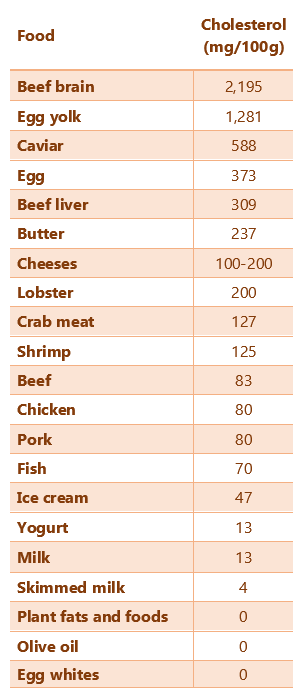
Cholesterol intake with food is recommended to be a maximum of 300 mg per day. As mentioned before, no plant food contains cholesterol. Foods that can be considered risky in terms of cholesterol are eggs and liver.
One hundred grams of beef contains about 83 mg of cholesterol, one egg about 200 mg, and 100 grams of beef liver about 300 mg.
Butter, a food whose cholesterol content warrants attention, contains approximately 250 mg of cholesterol per 100 grams. If a person consumes 10–20 grams of butter a day, this provides about 25–50 mg of cholesterol. However, only about 50–60% of dietary cholesterol can be absorbed.
Finally, it can be said that cholesterol is a necessary and important molecule for life; however, excess cholesterol entering the body due to incorrect eating habits has the potential to cause cardiovascular diseases. When incorrect and faulty nutritional habits are combined with other risk factors such as genetic predisposition, obesity and stress, the individual’s likelihood of suffering from cardiovascular diseases increases.
To keep this situation under control, it is necessary to measure the level of cholesterol in the blood at regular intervals. When high cholesterol levels are detected, it is useful to follow the doctor’s recommendations and the treatment process and to be careful about the consumption of foods considered to be risky.
It is not reasonable for a healthy person to exclude all foods of animal origin from their diet for fear of cholesterol. A healthy person should not consume excessive amounts of any food; a balanced and moderate diet is essential.
Note: This article is intended solely for general informational purposes. It does not constitute medical advice or personalized nutritional guidance. Nutritional needs may vary from person to person. Always consult a healthcare professional or a registered dietitian before making any dietary changes.
References
Raymond, J. L., & Morrow, K. (2023). Krause ve Mahan Besin ve Beslenme Bakım Süreci (16. baskı; G. Akbulut, Çev. Ed.). Nobel Tıp Kitabevleri.
Aksoy, M. (Ed.). (2022). Beslenme Biyokimyası (7. baskı). Ankara Nobel Tıp Kitabevleri.
Sencer, E., & Orhan, Y. (2005). Beslenme. İstanbul Medikal Yayıncılık.
Gökalp, H. Y., Nas, S., & Certel, M. (2002). Biyokimya-I: Temel Yapılar ve Kavramlar. Pamukkale Üniversitesi Mühendislik Fakültesi.
Food and Agriculture Organization of the United Nations. (2010). Fats and fatty acids in human nutrition: Report of an expert consultation. FAO. FAO Food and Nutrition Paper, 91.
World Health Organization. (2023). Saturated fatty acid and trans-fatty acid intake for adults and children: WHO guideline.
National Heart, Lung, and Blood Institute. (2024). Blood Cholesterol: Diagnosis.
Morris, M. C., Evans, D. A., Bienias, J. L., Tangney, C. C., Bennett, D. A., Aggarwal, N., Schneider, J., & Wilson, R. S. (2003). Dietary fats and the risk of incident Alzheimer disease. Archives of Neurology, 60(2), 194–200.
Here’s an article that might interest you: Lipids; Classification, Fatty Acids, Fats and Oils

Halil İbrahim Akgül
Halil Ibrahim Akgul, Ph.D., is an Assistant Professor of Food Engineering at Bayburt University, where he works in the Division of Food Sciences within the Faculty of Engineering. He received his B.Sc. in Food Engineering from Akdeniz University in 2010, followed by an M.Sc. and a Ph.D. in Food Engineering from Atatürk University in 2015 and 2020, respectively. His formally recognised academic fields are Food Sciences and Engineering, Food Technologies, Dairy and Dairy Products Technology, and Food Microbiology.
Dr. Akgul has more than fifteen years of professional, research, and academic experience in food science. Between 2011 and 2013, he worked as the food engineer responsible for operations at the Pilot Dairy and Bread Factory of Atatürk University’s Directorate of Agricultural Enterprises. This industrial experience, combined with his subsequent academic research, gave him extensive practical and scientific knowledge of milk processing, dairy production, food quality, hygiene, and product development.
His research is primarily focused on milk and dairy products, dairy microbiology, starter cultures, lactic acid bacteria, exopolysaccharides, butter technology, and the physicochemical, microbiological, sensory, and nutritional properties of foods. His studies have examined the quality and fatty-acid composition of traditional butter, aroma formation in butter produced with different starter cultures, raw-milk quality, the characterisation and antioxidant activity of bacterial exopolysaccharides, traditional dairy products such as çökelek and karın kaymağı, colostrum powder, and the use of fruit-derived ingredients in ice cream production.
His academic record includes peer-reviewed research articles published in national and international journals, including Mljekarstvo, Acta Scientiarum Technology, the Journal of Food Safety and Food Quality, the International Journal of Food Engineering, the Atatürk University Journal of Agricultural Faculty, and ATA Food Journal. Four of the research articles currently listed in his university profile were published in SCI-Expanded-indexed journals. He has also contributed to twelve national and international conference papers and presentations covering dairy products, food microbiology, butter quality, fatty-acid composition, starter cultures, exopolysaccharide-producing bacteria, colostrum, traditional foods, and functional ice-cream formulations.
Dr. Akgul has participated as a researcher or adviser in eleven completed scientific and applied research projects. These projects have addressed the modernisation of pilot dairy-processing facilities; the production and quality characteristics of colostrum powder; the physicochemical and microbiological quality of butter and raw milk; the identification of exopolysaccharide-producing lactic acid bacteria; the development and production optimisation of starter cultures for mould-ripened cheese; the standardisation of traditional dairy products; and the use of sloe berry and persimmon fibre in ice-cream production.
His teaching experience spans undergraduate, associate-degree, and graduate education. The courses he has taught include Food Chemistry, Analytical Chemistry, General Chemistry, Organic Chemistry, Fermented Dairy Products Technology, Butter Production and Processing Technology, Healthy Living and Nutrition, Organic Agriculture and Food, Popular Science, Digital Literacy, and Information Technologies. Through these courses, he combines fundamental food chemistry and engineering principles with dairy technology, nutrition, scientific literacy, and the practical communication of scientific knowledge.
He is the founder and Editor-in-Chief of Gıda ve Sağlık, a multilingual digital publication devoted to food, nutrition, health, food chemistry, food microbiology, and culinary science. Through this platform, he draws upon his academic background, teaching experience, research activity, and practical knowledge of food production to present scientifically grounded information in a detailed and accessible form for an international readership.