
Before discussing fats, it is useful to clarify what the term means in food chemistry. The word “fat” is used differently in everyday language and in chemistry.
Although “fat” is often used in everyday language to refer to fats and similar substances, in food chemistry fats are molecules within the broader group called “lipids”.
To explain this difference, we first need to look at the chemical group to which fats belong.
Classification of Lipids
There is no universally agreed classification of lipids in the scientific community. However, they are generally divided into three classes.
1) Simple Lipids
a) Fats and Oils; Fats are molecules formed due to the ester bond between a glycerin molecule and three fatty acids. These molecules are also called “triglycerides”. More detailed information is given below.
b) Waxes; are lipids formed due to the combination of long-chain fatty acids and alcohols.
c) Color waxes; are lipids formed by combining fatty acids with double bonds and alcohols with double bonds.
d) Sterol esters; are lipids formed by the combination of fatty acids and sterols. Cholesterol is an example of such a lipid.
e) Triterpenic alcohol esters; are lipids formed by combining triterpenic alcohols and fatty acids.
2) Compound Lipids
a) Phosphorus and nitrogen-containing lipids; Lecithin, cephalin, acetal phosphatides and sphingomyelins are examples of this group of lipids.
b) Carbohydrate-containing lipids; Cerebroglycosides, cerebrogalactosides, gangliosides and sulfatides are examples of this group of lipids.
c) Protein-containing lipids; They are lipoproteins formed due to the combination of lipids and proteins of different structures.
3) Lipid-like Substances
Fatty acids, hydrocarbons, fat-soluble vitamins and colorants, antioxidants, higher alcohols, flavor and aroma compounds are classified as lipid-like substances.
Fats and Oils (Triglycerides)
In chemical terminology, fats are organic molecules called “triglycerides”, formed by combining glycerol, a trihydric alcohol, with fatty acids.
In everyday language, however, “fat” covers both solid fats and liquid oils used for cooking or at the table. Sunflower oil, for example, consists mainly of triglycerides but also contains other types of lipids; it is not made up exclusively of triglycerides.
Butter likewise contains several types of lipids, mainly triglycerides. It also contains about 18% water, some protein, lactose and minerals.
In short, in food chemistry “fat” refers to triglycerides, whereas in everyday language it refers to foods containing a high proportion of lipid molecules.
Having clarified this distinction, we can now turn to triglycerides, the subject of this article.
Fat molecules are made up of carbon (C), hydrogen (H) and oxygen (O). They are insoluble in water and dissolve in most organic solvents.
A triglyceride containing only one type of fatty acid is called a “simple triglyceride”; one containing two or three different types is called a “mixed triglyceride”.

Molecules formed by attaching only one fatty acid to glycerin are called “monoglycerides”; molecules formed when two fatty acids are attached are called “diglycerides.”
Foods consumed as fats generally contain about 98% triglycerides and 1–1.5% mono- and diglycerides. The digestion of mono- and diglycerides in the body does not differ from that of triglycerides. However, mono and diglycerides show emulsifying properties. Due to these properties, they are food additives used extensively in the food industry to create emulsions.
Triglycerides can be found in solid or liquid form at room temperature. The fatty acid profile determines whether a fat is solid or liquid and how firm it is when solid. A high proportion of saturated fatty acids makes a fat solid at room temperature, whereas a high proportion of unsaturated fatty acids makes it liquid.
A higher proportion of short-chain fatty acids lowers the melting point, whereas a higher proportion of long-chain fatty acids raises it.
Taking butter as an example, The high amount of saturated fatty acids it contains ensures that butter is solid at room temperature. However, the fatty acid profile of butter is variable.
Generally, butter’s unsaturated fatty acid content increases in spring and summer. This makes the butter produced in the spring and summer months softer and more spreadable. At the same time, the decrease in the amount of unsaturated fatty acids in the winter and autumn seasons causes the butter to have a firmer texture.
The physical, chemical and physiological properties of triglycerides are determined by the “fatty acids”, the building blocks they contain.
Fatty acids
Fatty acids are organic molecules, usually straight-chain, containing an alkyl group and a carboxyl group (-COOH). Over 500 different fatty acids have been identified in nature and it’s known that they include at least two and at most 26 carbons. However, fatty acids containing between 4 and 22 carbons are found in foods and are important in food chemistry.
Milk fat and butter are the fats with the greatest diversity of fatty acids. So far, over 400 different fatty acids have been identified in milk fat. However, while 15 of these fatty acids constitute 99% of the fatty acid content, others are in trace amounts. Approximately 30 different fatty acids form 99% of the fatty acid profile in all fats and oils consumed as food.
These fatty acids are listed in the table:
| Common name | Systematic name | Molecular formula | Melting point (oC) | Info |
| Butyric acid | Butanoic acid | C4H8O2 | -8,0 | Saturation; Saturated Food sources: Milk, Butter |
| Caproic acid | Hexanoic acid | C6H12O2 | -3,4 | Saturation; Saturated Food sources: Milk, Butter |
| Caprylic acid | Octanoic acid | C8H16O2 | 16,0 | Saturation; Saturated Food sources: Milk, Butter and Coconut oil |
| Capric acid | Decanoic acid | C10H20O2 | 31,3 | Saturation; Saturated Food sources: Milk, Butter, Coconut oil and Palm oil |
| Caproleic acid | Dec-9-enoic acid | C10H18O2 | – | Saturation; Monounsaturated, a double bond Food sources: Milk, Butter |
| Lauric acid | Dodecanoic acid | C12H24O2 | 43,5 | Saturation; Saturated Food sources: Milk, Butter, Laurel oil, Coconut oil and Palm oil |
| Lauroleic acid | (Z)-dodec-9-enoic acid | C12H22O2 | – | Saturation; Monounsaturated, a double bond Food sources: Milk, Butter |
| Myristic acid | Tetradecanoic acid | C14H28O2 | 54,4 | Saturation; Saturated Food sources: Most vegetable oils and animal fats |
| Myristoleic acid | (Z)-tetradec-9-enoic acid | C14H26O2 | -4,5 | Saturation; Monounsaturated, a double bond Food sources: Milk, Butter, Fish oil |
| Palmitic acid | Hexadecanoic acid | C16H32O2 | 62,9 | Saturation; Saturated Food sources: Most vegetable oils and animal fats |
| Palmitoleic acid isomer cis7,cis9 | (Z)-hexadec-9-enoic acid, (Z)-hexadec-7-enoic acid, | C16H30O2 | 0-5 | Saturation; Monounsaturated, a double bond Food sources: Fish oil, Milk and Butter |
| Margaric acid | Heptadecanoic acid | C17H34O2 | – | Saturation; Saturated Food sources: Milk, Butter and Meat |
| Stearic acid | Octadecanoic acid | C18H36O2 | 69,6 | Saturation; Saturated Food sources: Most vegetable oils and animal fats |
| Oleic acid | (Z)-octadec-9-enoic acid | C18H34O2 | 16,3 | Saturation; Monounsaturated, a double bond Food sources: All vegetable oils and animal fats |
| Petroselaidic acid | (E)-octadec-6-enoic acid | C18H34O2 | 32,5 | Saturation; Monounsaturated, a double bond Food sources: Parsley seeds |
| Vaccenic acid | (E)-octadec-11-enoic acid | C18H34O2 | 39,0 | Saturation; Monounsaturated, a double bond Food sources: Animal fats |
| Linoleic acid | (9Z,12Z)-octadeca-9,12-dienoic acid | C18H32O2 | -5,2 | Essential fatty acid Saturation; Polyunsaturated, two double bond Food sources: Milk, Butter and Vegetable oils |
| Conjugated linoleic acids (CLA) (9,11 and 10,12) | Cis9,tr11-CLA and tr10,cis12-CLA | C18H32O2 | – | Saturation; Polyunsaturated, two double bonds Food sources: Milk, Butter, Cheese and Animal fats |
| Linolenic acid | (9Z,12Z,15Z)-octadeca-9,12,15-trienoic acid | C18H30O2 | -11 | Essential fatty acid Saturation; Polyunsaturated, three double bonds Food sources: Fish oil, Soybean and Rapeseed oil |
| γ- Linolenic acid | (6Z,9Z,12Z)-octadeca- 6,9,12-trienoic acid | C18H30O2 | – | Essential fatty acid Saturation; Polyunsaturated, three double bonds Food sources: Fish oil, Soybean and Rapeseed oil |
| Arachidic acid | Icosanoic acid | C20H40O2 | 75,4 | Saturation; Saturated Food sources: Peanut |
| Gadoleic acid | (Z)-icos-9-enoic acid | C20H38O2 | 23,5 | Saturation; Monounsaturated, a double bond Food sources: Some fish oils |
| Arachidonic acid | (5Z,8Z,11Z,14Z)-icosa-5,8,11,14-tetraenoic acid | C20H32O2 | -49,5 | Essential fatty acid Saturation; Polyunsaturated, four double bonds Food sources: Offal, Milk and Butter |
| Behenic acid | Docosanoic acid | C22H44O2 | 79,9 | Saturation; Saturated Food sources: Peanut and Rapeseed oil |
| Erucic acid | (Z)-docos-13-enoic acid | C22H42O2 | 33,5 | Saturation; Monounsaturated, a double bond |
| Lignoceric acid | Tetracosanoic acid | C24H48O2 | 84,2 | Saturation; Saturated Food sources: Peanut and Rapeseed oil |
| Selacholeic acid | (15E)-tetracos-15-enoic acid | C24H46O2 | 39 | Saturation; Monounsaturated, a double bond Food sources: Fish oil |
| Cerotic acid | Hexacosanoic acid | C26H52O2 | 87,7 | Saturation; Saturated Food sources: Trace in vegetable oils |
Classification of fatty acids
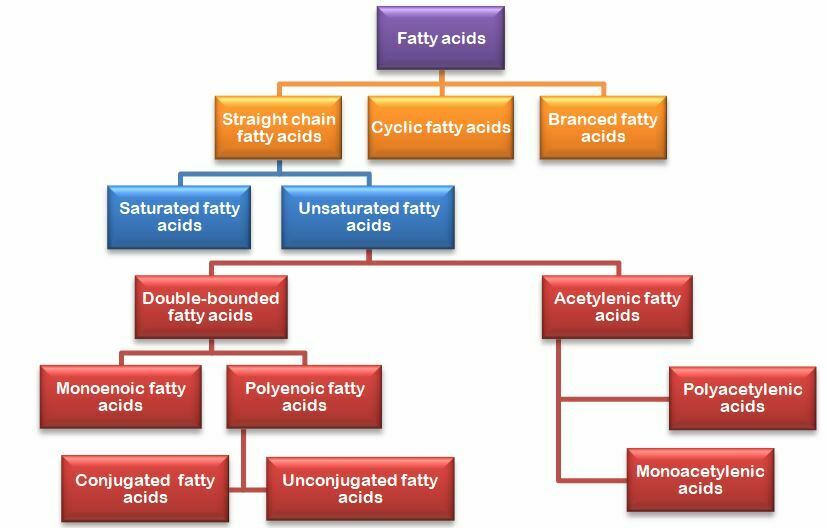
Fatty acids are divided into three classes; straight chain, branched and cyclic. However, most fatty acids have a straight-chain structure. As far as is known, branched and cyclic fatty acids are produced only by microorganisms and are included in the structure of the cell walls of microorganisms.
Branched and cyclic fatty acids secreted by microorganisms living in the digestive system of mammals can be found in an animal’s milk and in butter made from that milk.
These branched and cyclic fatty acids can be found in some tissues of people who consume milk and dairy products. In this way, some of the branched fatty acids are even used as indicators to determine whether humans consume dairy products.
Straight chain fatty acids are the most important class of fatty acids. The shortest chain fatty acid found in foods is the 4-carbon butyric acid. Fatty acids with 4-8 carbons are mostly found in milk and dairy products.
Straight chain fatty acids are divided into two classes as saturated and unsaturated fatty acids. Saturated fatty acids are fatty acids that do not have double or triple bonds in their structure. Unsaturated fatty acids have at least one double or triple bond in their structure.
Fatty acids are classified according to their molecular structures as follows;
References
Akgül, H. İ. (2015). Trabzon tereyağlarının bazı kalite parametrelerinin belirlenmesi. Atatürk Üniversitesi, Fen Bilimleri Enstitüsü.
Saldamlı, İ. (Ed.). (2021). Gıda Kimyası. Hacettepe Üniversitesi Yayınları.
Bilişli, A. (2012). Gıda Kimyası. Sidas Medya.
Gökalp, H. Y., Nas, S., & Certel, M. (2002). Biyokimya-I: Temel Yapılar ve Kavramlar. Pamukkale Üniversitesi Mühendislik Fakültesi.
Aksoy, M. (Ed.). (2022). Beslenme Biyokimyası (7. baskı). Ankara Nobel Tıp Kitabevleri.
Raymond, J. L., & Morrow, K. (2023). Krause ve Mahan Besin ve Beslenme Bakım Süreci (16. baskı; G. Akbulut, Çev. Ed.). Nobel Tıp Kitabevleri.
International Union of Pure and Applied Chemistry (IUPAC). (2025). lipids. IUPAC Compendium of Chemical Terminology (Gold Book) (5th ed., online version 5.0.0). IUPAC.
International Union of Pure and Applied Chemistry (IUPAC). (2025). fatty acids. IUPAC Compendium of Chemical Terminology (Gold Book) (5th ed., online version 5.0.0). IUPAC.
Here’s an article that might interest you; Fats and Oils; Functions in the Body and Daily Needs

Halil İbrahim Akgül
Halil Ibrahim Akgul, Ph.D., is an Assistant Professor of Food Engineering at Bayburt University, where he works in the Division of Food Sciences within the Faculty of Engineering. He received his B.Sc. in Food Engineering from Akdeniz University in 2010, followed by an M.Sc. and a Ph.D. in Food Engineering from Atatürk University in 2015 and 2020, respectively. His formally recognised academic fields are Food Sciences and Engineering, Food Technologies, Dairy and Dairy Products Technology, and Food Microbiology.
Dr. Akgul has more than fifteen years of professional, research, and academic experience in food science. Between 2011 and 2013, he worked as the food engineer responsible for operations at the Pilot Dairy and Bread Factory of Atatürk University’s Directorate of Agricultural Enterprises. This industrial experience, combined with his subsequent academic research, gave him extensive practical and scientific knowledge of milk processing, dairy production, food quality, hygiene, and product development.
His research is primarily focused on milk and dairy products, dairy microbiology, starter cultures, lactic acid bacteria, exopolysaccharides, butter technology, and the physicochemical, microbiological, sensory, and nutritional properties of foods. His studies have examined the quality and fatty-acid composition of traditional butter, aroma formation in butter produced with different starter cultures, raw-milk quality, the characterisation and antioxidant activity of bacterial exopolysaccharides, traditional dairy products such as çökelek and karın kaymağı, colostrum powder, and the use of fruit-derived ingredients in ice cream production.
His academic record includes peer-reviewed research articles published in national and international journals, including Mljekarstvo, Acta Scientiarum Technology, the Journal of Food Safety and Food Quality, the International Journal of Food Engineering, the Atatürk University Journal of Agricultural Faculty, and ATA Food Journal. Four of the research articles currently listed in his university profile were published in SCI-Expanded-indexed journals. He has also contributed to twelve national and international conference papers and presentations covering dairy products, food microbiology, butter quality, fatty-acid composition, starter cultures, exopolysaccharide-producing bacteria, colostrum, traditional foods, and functional ice-cream formulations.
Dr. Akgul has participated as a researcher or adviser in eleven completed scientific and applied research projects. These projects have addressed the modernisation of pilot dairy-processing facilities; the production and quality characteristics of colostrum powder; the physicochemical and microbiological quality of butter and raw milk; the identification of exopolysaccharide-producing lactic acid bacteria; the development and production optimisation of starter cultures for mould-ripened cheese; the standardisation of traditional dairy products; and the use of sloe berry and persimmon fibre in ice-cream production.
His teaching experience spans undergraduate, associate-degree, and graduate education. The courses he has taught include Food Chemistry, Analytical Chemistry, General Chemistry, Organic Chemistry, Fermented Dairy Products Technology, Butter Production and Processing Technology, Healthy Living and Nutrition, Organic Agriculture and Food, Popular Science, Digital Literacy, and Information Technologies. Through these courses, he combines fundamental food chemistry and engineering principles with dairy technology, nutrition, scientific literacy, and the practical communication of scientific knowledge.
He is the founder and Editor-in-Chief of Gıda ve Sağlık, a multilingual digital publication devoted to food, nutrition, health, food chemistry, food microbiology, and culinary science. Through this platform, he draws upon his academic background, teaching experience, research activity, and practical knowledge of food production to present scientifically grounded information in a detailed and accessible form for an international readership.