
Bread is a broad group of foods prepared by combining cereals or other starchy raw materials with water to make a dough or batter and then cooking it. Wheat loaves, rye bread, corn tortillas, teff-based injera and steamed mantou are different members of this group. As the composition of the raw material, milling, fermentation and cooking method change, so do the resulting product’s texture, aroma and nutritional qualities.
The history of bread extends further back than the establishment of agriculture. Approximately 14,400-year-old charred remains found at Shubayqa 1 in northeastern Jordan have shown that hunter-gatherer communities processed wild cereals and some tuberous plants to prepare bread-like foods. Gathering the grains, removing their husks, grinding them, combining them with water and cooking them form a successive chain of knowledge and labour. These findings reveal that people could transform plants to this extent even before they began cultivating fields. (Arranz-Otaegui et al., 2018)
As cereal cultivation spread, bread became a product connecting millers, bakers, farmers and consumers. The relationship between grain that could be stored and bread that had to be prepared daily or at intervals influenced the division of labour in households and the organisation of production in settlements. The degree to which flour was sifted, and its whiteness, also served as indicators of social status in different periods. The contrast between the value placed on wholemeal bread in some countries today and the historical preference for white flour invites reflection on how nutritional knowledge and social tastes change over time. (Rubel, 2011) (Canadian Museum of History, n.d.)
Bread also occupies a notable place in religious life. Exodus 12:15 in the Torah prescribes eating unleavened bread during Passover. In Matthew 6:11, the request for daily bread expresses sustenance in the language of prayer; in Luke 22:19, Jesus breaking bread and giving it to his disciples is associated with remembrance. In the Qur’an, verse 36 of Surah Yusuf recounts the dream of a prisoner who carries bread on his head while birds eat from it. Bread thus appears in sacred texts in different contexts, including ritual, livelihood and everyday life. (Torah, n.d.) (Bible, n.d.) (Bible, n.d.) (Diyanet İşleri Başkanlığı, n.d.)
Nutritionally, starch is bread’s principal source of energy. Bread also provides protein, dietary fibre, B vitamins and minerals. Retaining the bran and germ is particularly important for fibre, magnesium, zinc and certain vitamins. Enriching flour with iron or folic acid changes its nutrient composition by another route. Bread’s nutritional qualities therefore relate both to the cereal used and to the processing of the flour and preparation of the dough. (Garzon; NMSU, 2018) (Public Health England, 2021) (ANSES Ciqual, 2025)
The diversity of bread around the world can be seen in the forms these basic relationships take under local conditions. The same wheat becomes thin lavash in one place, a moist country loaf in another and soft sandwich bread elsewhere. Across the 17 countries covered by this atlas, this diversity can be explored through ingredients, production methods, uses at the table, cultural meanings and nutrient composition.
United States; sandwich bread, sourdough and regional identities
In the United States, soft, evenly sliced sandwich bread is closely associated with portable meals and large-scale production. Tin baking ensures slices of similar size. Fat and sugar added to the dough, together with control of mixing and fermentation, influence the soft crumb. The bread appears in everyday life through uses ranging from breakfast toast to lunchtime sandwiches. (Tucker; Campden BRI, 2019) (USDA FoodData Central, 2019)
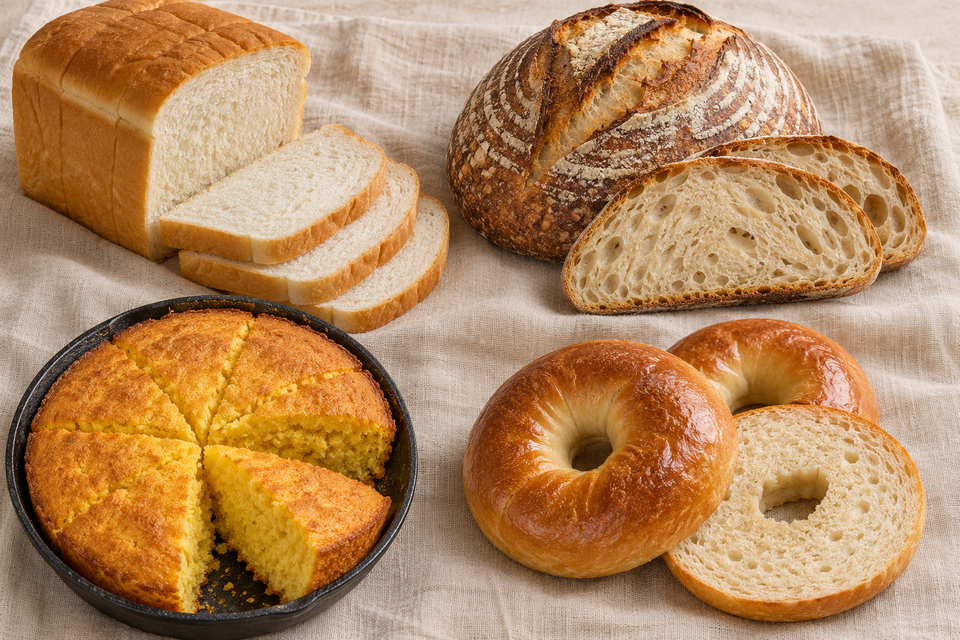
Sourdough breads form a different tradition of production and aroma. Alongside the round loaves associated with San Francisco, sourdough also featured in foods of the gold rush era in Alaska and the Northwest. The US National Park Service’s record of Klondike cooking describes travelling prospectors using starter cultures to raise breads and griddle products. Feeding a portion again for subsequent batches provided a reusable source of leavening under these conditions. (National Park Service, n.d.)
Cornmeal is central to cornbread in Southern cuisines, although wheat flour, dairy products, eggs and fat may also be included. These ingredients complement corn’s flavour and more crumbly structure in different ways. Smithsonian events on Southern food also discuss cornbread’s relationship with regional identity and family meals. Variation within the same country, from thin, unsweetened skillet bread to richer, softer examples, demonstrates the importance of regional recipes. (Smithsonian, 2018)
The bagel represents another tradition with its ring shape and firmer, chewy texture. Brandeis University historian Jonathan Sarna discusses its transformation from a food of particular immigrant communities to a widespread American product through migration, entrepreneurship and mass production. A bread’s cultural identity is therefore shaped by changes in a new home as well as by its region of origin. (BrandeisNOW, 2018)
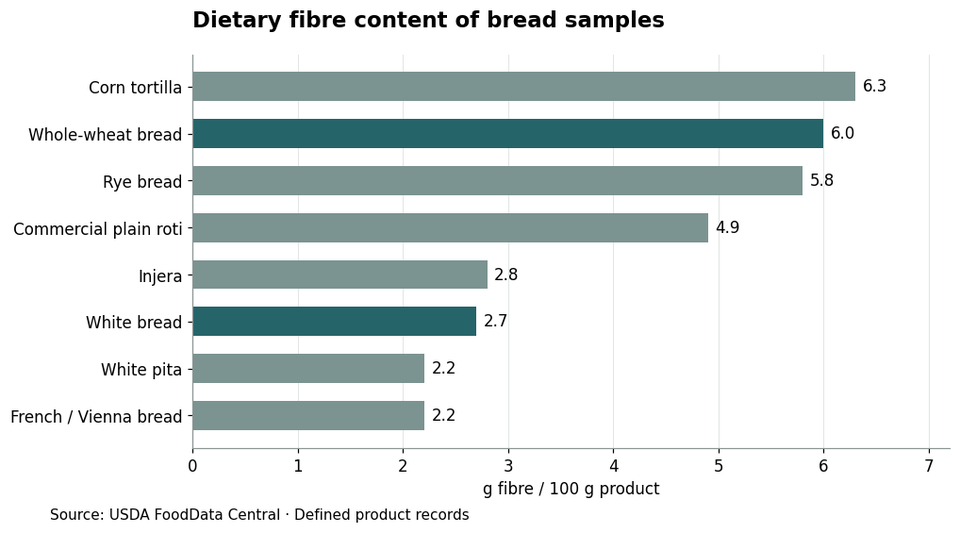
USDA’s commercial bread records clearly show the different effects of wholegrain use and enrichment. Whole-wheat bread contains 6 grams of fibre, 75 milligrams of magnesium and 1.77 milligrams of zinc per 100 grams, compared with 2.7 grams, 23 milligrams and 0.74 milligrams in commercial white bread. The white bread record contains 3.61 milligrams of iron and 111 micrograms of total folate, of which 86 micrograms are added folic acid. Wholegrain bread’s advantages in fibre and certain minerals should therefore be assessed separately from the addition of specific nutrients to white flour. (USDA FoodData Central, 2019) (USDA FoodData Central, 2019)
United Kingdom; regional breads and the transformation of industrial production
The United Kingdom’s bread culture includes distinctive regional products alongside white sliced bread. England’s cottage loaf is recognised by a smaller piece of dough placed on a larger round one. The two pieces rising and baking together create the bread’s characteristic appearance. Paul Hollywood’s recipe uses strong white flour, water, yeast, salt and lard. Shaping is one of the principal elements of this bread’s identity. (Hollywood, n.d.)
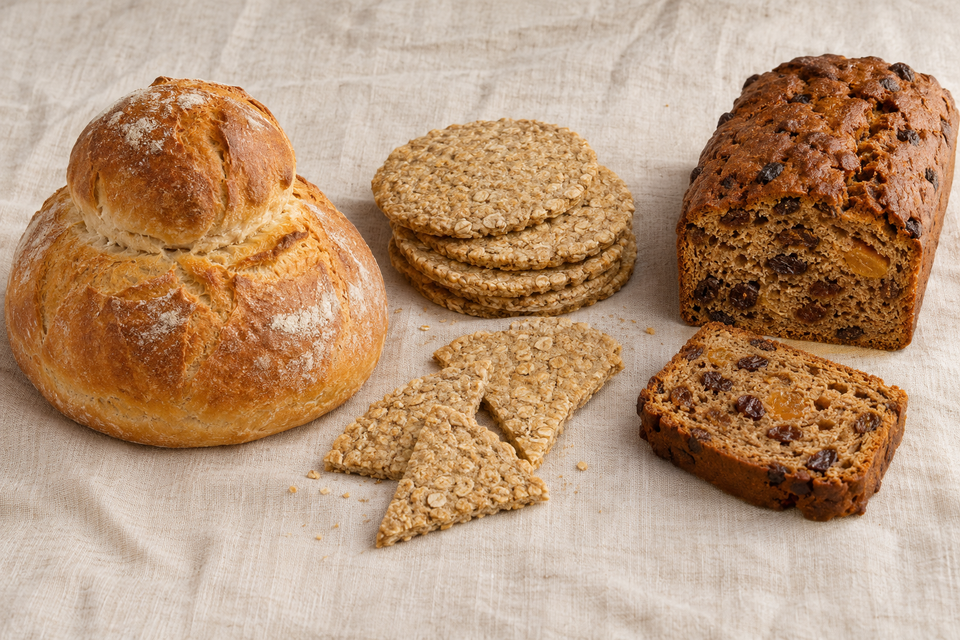
Oats are central to Scottish oatcakes. Thinner, firm and crisp examples are eaten with cheese, soup or smoked fish. Welsh bara brith takes another direction, with raisins and other dried fruit, sugar and spices added to the dough. A yeasted recipe collected in Bala by Amgueddfa Cymru also contains butter, eggs, milk and treacle. This composition turns bara brith into a richer fruit bread than a plain everyday loaf. The regional diversity shows how much cereals and additional ingredients can vary within one country. (VisitScotland, n.d.) (Amgueddfa Cymru – Museum Wales, n.d.)
One major technical change in breadmaking was the Chorleywood process, developed in 1961. Campden BRI explains that intensive mechanical mixing plays a central role in developing the dough quickly. Ingredients such as ascorbic acid, small amounts of fat and emulsifiers also help regulate dough structure. A faster development process replaces prolonged bulk fermentation, while the final proof, in which yeast remains active, continues. The method has been important in the development of large-scale production of soft, consistently sliceable bread. (Tucker; Campden BRI, 2019) (For more detailed information about these ingredients, see Food Additives; Definition, Classification and E Codes)
The UK’s CoFID 2021 tables list 2.9 grams of fibre per 100 grams for average white bread and 7 grams for wholemeal bread. Magnesium rises from 22 to 66 milligrams and zinc from 0.7 to 1.6 milligrams. Calcium, however, is 155 milligrams in the white bread record and 106 milligrams in the wholemeal record. This example clearly shows that fibre and minerals need not change in the same direction for every nutrient. Additions to flour or the product influence nutrient calculations alongside wholegrain use. (Public Health England, 2021)
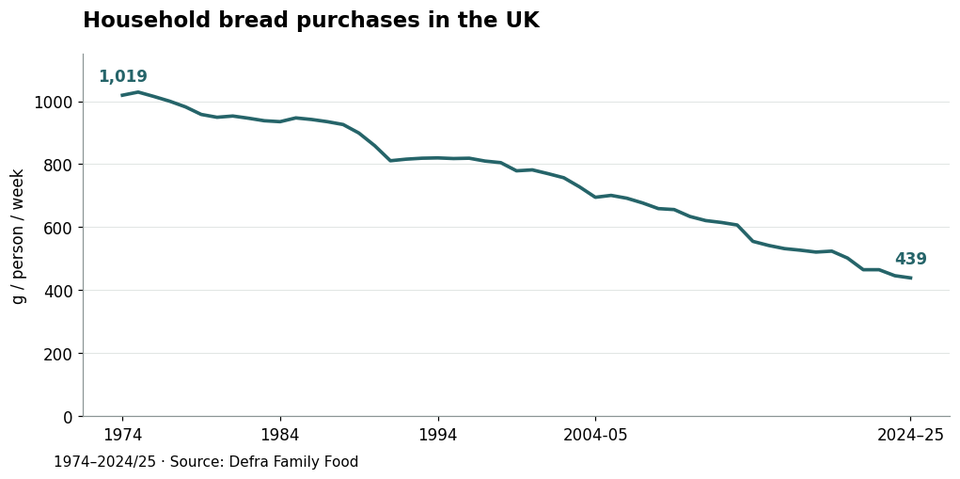
Defra’s Family Food series shows weekly household bread purchases per person falling from 1,019 grams in 1974 to 439 grams in the financial year ending in March 2025. This decline of approximately 57% reveals a substantial long-term change in bread’s share of household food purchases. The series records 502 grams in 2021 and 446 grams in 2024. The accompanying report’s reference to long-term increases in rice and pasta purchases suggests that this change in bread takes place within a broader transformation of meals. (Defra, 2026) (Defra, 2026)
Canada; bannock, Montreal bagels and home-baked bread traditions
Canadian bread culture brings together production methods from different communities. Bannock is a clear example. A recipe presented by Parks Canada as part of Métis heritage uses flour, water, baking powder and fat. The dough is prepared without prolonged yeast fermentation and cooked in a hot cast-iron pan. Its few ingredients and simple cooking equipment give bannock a preparation pattern different from tin bread. (Parks Canada, 2025)
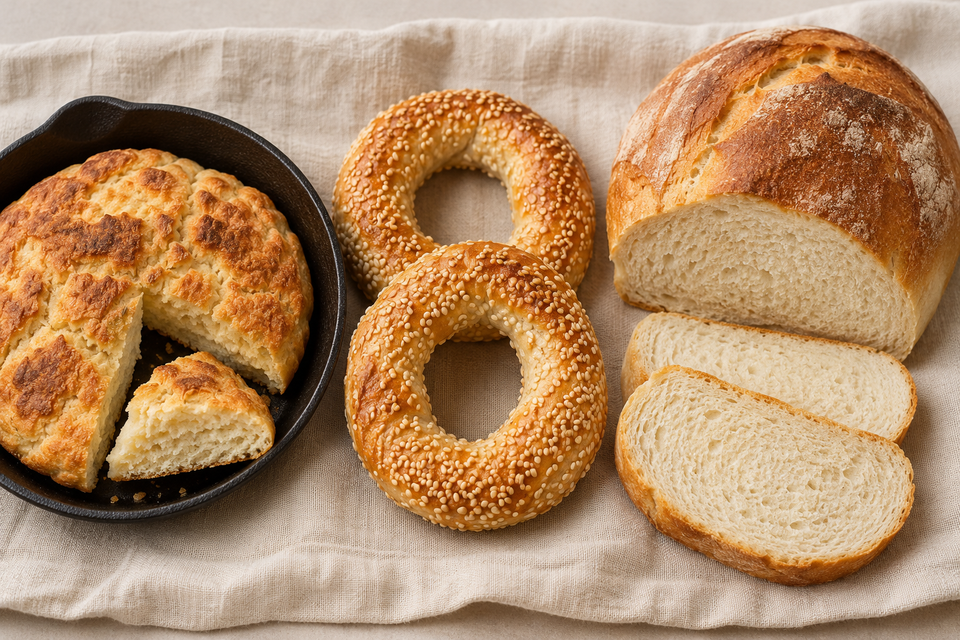
The Montreal bagel has a distinct identity associated with the city’s Jewish community. The University of British Columbia’s dictionary of Canadian English describes it as thinner, lighter and sweeter than other bagels. Its large central hole and sesame-covered surface make it recognisable. A bread developed in a city becoming a symbol associated with the whole country, and Quebec in particular, demonstrates the cultural influence of local bakeries. (University of British Columbia, n.d.)
Quebec’s home breads known as pain de ménage are associated with larger wheat loaves and domestic production. A Canadian Museum of History account of food in New France describes bread’s central place at the historical table and the importance attached to flour sifting. Kneading and baking at home made these breads part of household work organisation as well as a product. Within today’s diversity, these home loaves join urban bakery bagels and bannock in the same broad bread culture. (Canadian Museum of History, n.d.)
Flour enrichment plays an important role in nutrient composition. The Canadian Food Inspection Agency’s explanation of the white flour standard includes added thiamine, riboflavin, niacin, folic acid and iron. Wholegrain flour, meanwhile, retains fibre and nutrients from the grain’s outer parts. Because the fat added to bannock, the bagel formulation and the flour chosen for home loaves differ, so do these products’ energy, fibre and micronutrient profiles. (Canadian Food Inspection Agency, n.d.)
Agriculture and Agri-Food Canada’s market report lists bread retail sales volume at 989.3 thousand tonnes in 2020 and 1,102.5 thousand tonnes in 2024. Dividing these quantities by the population figures in the report gives annual retail sales of approximately 26.0 and 26.7 kilograms per person. The more limited increase per person compared with total volume shows why population change matters when assessing market size. (Agriculture and Agri-Food Canada, 2025)
Turkey; from everyday loaves to Anatolia’s regional breads
One familiar example of everyday bread in Turkey is the loaf made from wheat flour, water, salt and yeast. The dough structure formed during kneading retains the gas produced during fermentation, creating a porous crumb. The amount of water added, the flour used and the duration of fermentation influence the loaf’s volume, crust and chewing characteristics. In pide, bazlama, yufka and lavash, dough thickness and the cooking surface differ. The same basic ingredients therefore become products that serve different purposes at the table. (Kundu et al., 2019) (T.C. Kültür ve Turizm Bakanlığı, n.d.)
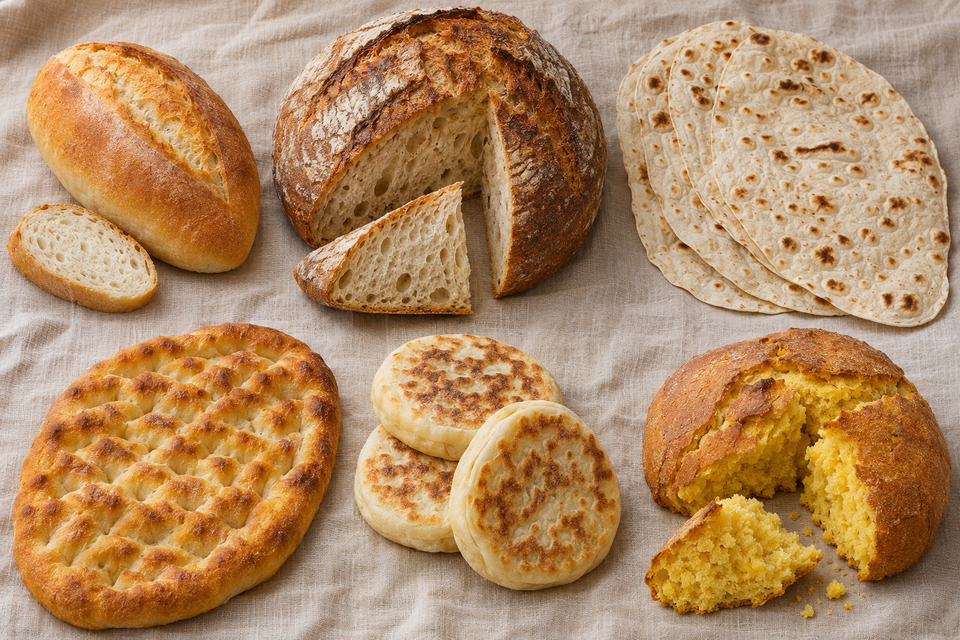
Vakfıkebir bread from Trabzon is a prominent example of sourdough production. Its geographical indication specification defines it by its large size, thick crust, open crumb and baking in a wood-fired stone oven. Adding sourdough reserved from the previous batch transfers microorganisms from one production cycle to the next. Larger loaves require a longer baking schedule to cook through. The registration document also connects the development of this bread with transhumance and the need for bread that would keep during long journeys. The loaf’s size thus goes beyond appearance to become a response to the needs of local life. (Türk Patent ve Marka Kurumu, 2018)
In southeastern Anatolia’s tırnaklı breads, the baker’s handling of the dough directly shapes the product’s appearance. For Şanlıurfa tırnaklı bread, the soft dough is stretched; after a flour mixture is applied to the surface, the fingertips leave distinct impressions. Brief baking at a high temperature in a wood-fired, stone-bottomed oven produces a thin crust and soft crumb. Although sourdough is prominent in Şanlıurfa’s product specification, commercial yeast is also included. The division of the tasks of marking the dough and loading the oven between bakers shows that this bread also embodies a professional skill. (T.C. Kültür ve Turizm Bakanlığı, n.d.)
Lavash and yufka are different expressions of the thin-bread tradition. The Ministry of Culture and Tourism’s account emphasises lavash made from leavened dough in a tandoor and yufka made from unleavened dough on a sac griddle. Rolling yufka thinly helps it lose considerable moisture during cooking and makes it suitable for drying and storage. Moistening it before eating restores flexibility, separating the day of preparation from the day of consumption. Bazlama is a flatbread made from thicker dough; cooking it on a sac or a similar hot surface gives it a more substantial crumb than yufka. (T.C. Kültür ve Turizm Bakanlığı, n.d.) (Karhan, 2024)
In many parts of Anatolia, breadmaking has extended beyond a kitchen task completed by one person. The division of labour between those who knead, portion, roll and cook yufka is a tangible form of mutual help among neighbours. The flatbread-making and sharing culture inscribed by UNESCO in 2016 encompasses this shared tradition of production and transmission in Turkey, Azerbaijan, Iran, Kazakhstan and Kyrgyzstan. At weddings, festivals, funerals and in relations between neighbours, bread gains meaning through sharing as much as through its preparation. (UNESCO, 2016) (Karhan, 2024)
Turkish expressions reveal this importance from another angle. “Bread door” refers to a source of work and livelihood, “having one’s hands earn bread” means earning one’s own living, and the “struggle for bread” describes the struggle to sustain life. “Bread is in the lion’s mouth” conveys the difficulty of earning a living, while “Throw bread at whoever throws stones at you” expresses kindness and reciprocity. Regarding bread as a blessing, treating bread that has fallen to the ground with respect and valuing sharing should be considered alongside these linguistic meanings. Karhan’s sociological study of yufka also addresses this relationship between production, belonging and solidarity. (Karhan, 2024)
Nutritionally, everyday white loaves and whole-wheat bread differ because of the degree of milling. Whole-wheat flour that retains bran and germ helps preserve magnesium, zinc and B vitamins as well as fibre. The acidity and enzyme activity that develop in sourdough can affect the breakdown of cereal phytate. The presence of a mineral in bread and its availability during digestion are thus connected through production methods. Regional breads that combine wheat and corn flour also have a different cereal composition. (ANSES Ciqual, 2025) (Brune et al., 1992) (For more detailed information about the microorganisms involved in sourdough fermentation, see Lactic Acid Bacteria; Definition, Classification and Characteristics)
Consumption surveys also show bread’s importance in daily diets. Research conducted for the Turkish Grain Board reported daily bread consumption of 331 grams per person in 2008 and 319 grams in 2012. For a product consumed so regularly, flour quality, salt content and reducing waste together become important for household nutrition. (Toprak Mahsulleri Ofisi, 2013)
France; baguettes, country loaves and daily life around the bakery
In France, the baguette is recognised for both its shape and the skill involved in making it. Dough consisting of flour, water, salt and yeast or sourdough goes through mixing, fermentation, dividing, lengthening, final proofing, scoring and baking. Its long, thin shape increases the ratio of crust to crumb. The crisp crust and light crumb experienced when eating a baguette therefore depend on shaping and baking as well as on flour. (UNESCO, 2022)
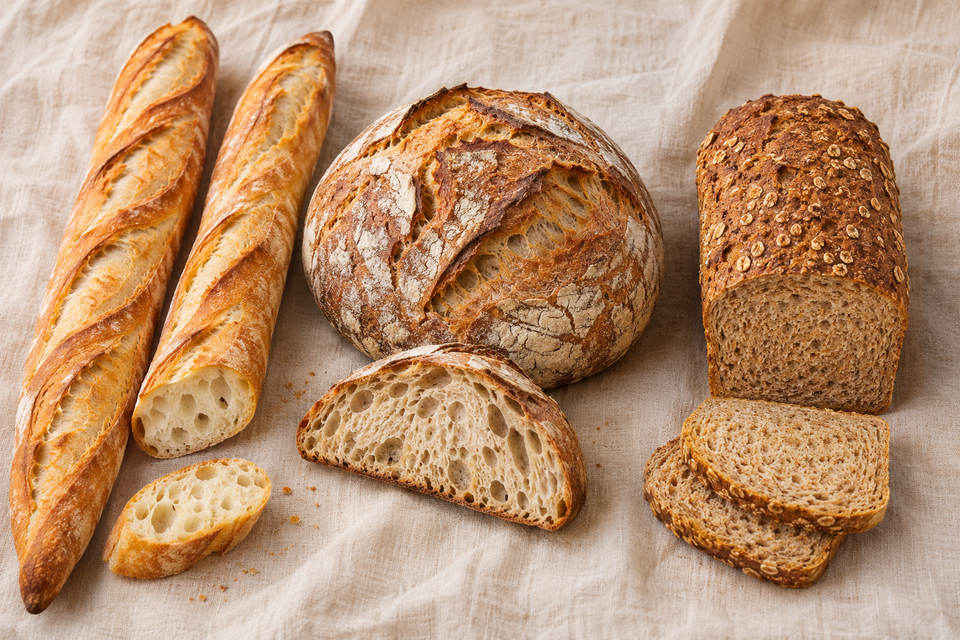
Alongside baguettes, country breads known as pain de campagne are recognised by their larger, often round loaves. Some combine wheat and rye flours and are made with sourdough. Pain complet is distinguished by its wholegrain flour. Whereas the names country bread and sourdough bread describe production traditions, wholegrain bread emphasises the flour’s composition. The separate records for white, sourdough and wholemeal breads in France’s Ciqual database show how this diversity is reflected in nutrient calculations. (ANSES Ciqual, 2025)
The baguette heritage inscribed by UNESCO in 2022 encompasses the baker’s knowledge and skills, apprenticeship and bread’s role in daily shopping, alongside the recipe. Baking small batches throughout the day is connected with customers’ regular visits to neighbourhood bakeries. This relationship makes bread part of a recurring encounter in the neighbourhood as well as a food that is purchased. (UNESCO, 2022)
The differences in nutrient composition are clear in the Ciqual 2025 records. The white bread record contains 2.7 grams of fibre and 23 milligrams of magnesium per 100 grams, compared with 7.3 grams and 54.2 milligrams in the wholemeal bread made with T150 flour. Zinc is 0.73 and 1.2 milligrams respectively, and folate is 26.8 and 35.6 micrograms. Retaining the outer layers of the grain explains the differences in fibre and minerals in particular. Meanwhile, the water retained by the dough and the moisture remaining after baking also change energy density per 100 grams. (ANSES Ciqual, 2025)
In ANSES’s 2014–2015 INCA 3 survey, adults aged 18–79 consumed a daily average of 108.1 grams from the regular bread and dry bread products group. The wholegrain and semi-wholegrain bread and dry bread products group contributed another 6.3 grams. The combined 114.4 grams demonstrates bread’s regular place in daily diets while revealing the smaller contribution of wholegrain products to consumption. (ANSES, 2017)
Spain; from Galician loaves to Catalonia and Andalusia
Spain’s breads can be understood by considering the large loaves of the northwest alongside the soft breakfast breads of the south. Geographically protected Pan Gallego from Galicia uses wheat flour, water, sourdough and salt. Flour from local wheat varieties must account for at least 25% of the total flour. The highly hydrated dough develops through long resting and slow fermentation; hand shaping and baking on a stone hearth create an irregular open crumb and pronounced crust. Its forms include hogaza, rings and elongated loaves. (Axencia Galega da Calidade Alimentaria, n.d.)
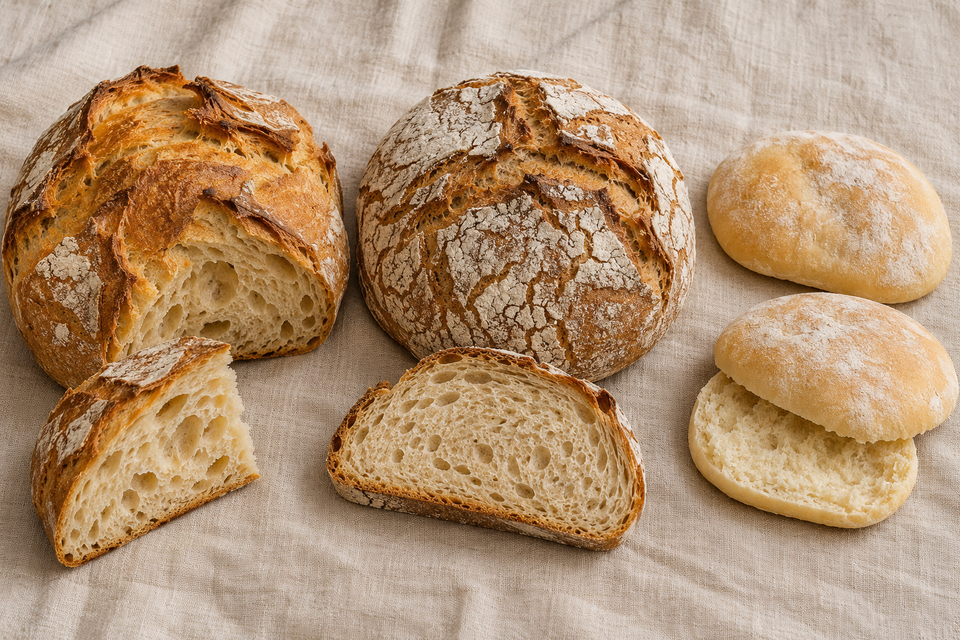
Handwork and slow production also define Catalonia’s Pa de Pagès Català. Shaping the sourdough into a round loaf creates a contrast between a crisp crust and a soft, moist crumb. Slicing the large loaf allows bread to appear at different stages of a meal. Its character is established through dough resting and the use of heat from the oven floor as well as through its ingredient list. (Generalitat de Catalunya, n.d.)
Andalusia’s Mollete de Antequera differs from these loaves in its less browned surface, soft texture and flattened oval shape. Wheat flour, water, yeast and salt are the basic ingredients, and sourdough may also be used. The lighter crust results from its particular baking process rather than from underbaking. Its soft structure, suitable for splitting and reheating, gives this bread uses different from those of a crusty Galician loaf. (MAPA, 2020)
One determining factor in the nutritional qualities of these breads is whether the flour is wholegrain. The Spanish Ministry of Agriculture’s page on wholemeal bread composition specifically addresses the contribution of fibre, minerals and vitamins from the bran and germ. The emphasis on vitamin B1, niacin, iron, magnesium and zinc in wheat bread is therefore meaningful. Sourdough use is a separate fermentation characteristic; retaining the grain’s outer parts and managing fermentation affect nutritional value through different mechanisms. (MAPA, n.d.) (Brune et al., 1992)
MAPA’s household panel reports 27.45 kilograms of bread per person for home consumption in 2024, compared with 27.51 kilograms in 2023. Of the 2024 total, regular fresh bread accounted for 18.84 kilograms and fresh wholegrain bread for 2.68 kilograms. Thus, even in a country with strong regional bread traditions, most daily purchases fall within the regular fresh bread group. (MAPA, 2024)
Germany; rye, pumpernickel and meals built around bread
Germany’s bread tradition uses wheat, rye and spelt in different proportions, giving rise to numerous products. In mixed-grain loaves, colour, aroma and crumb change as the cereal proportions vary. Rye-rich dough does not form as elastic a gluten network as wheat dough; the behaviour of starch and other water-binding grain components becomes more prominent. Sourdough also plays an important role in developing this structure and aroma. (Deutsche UNESCO-Kommission, 2014) (Pasqualone et al., 2022)
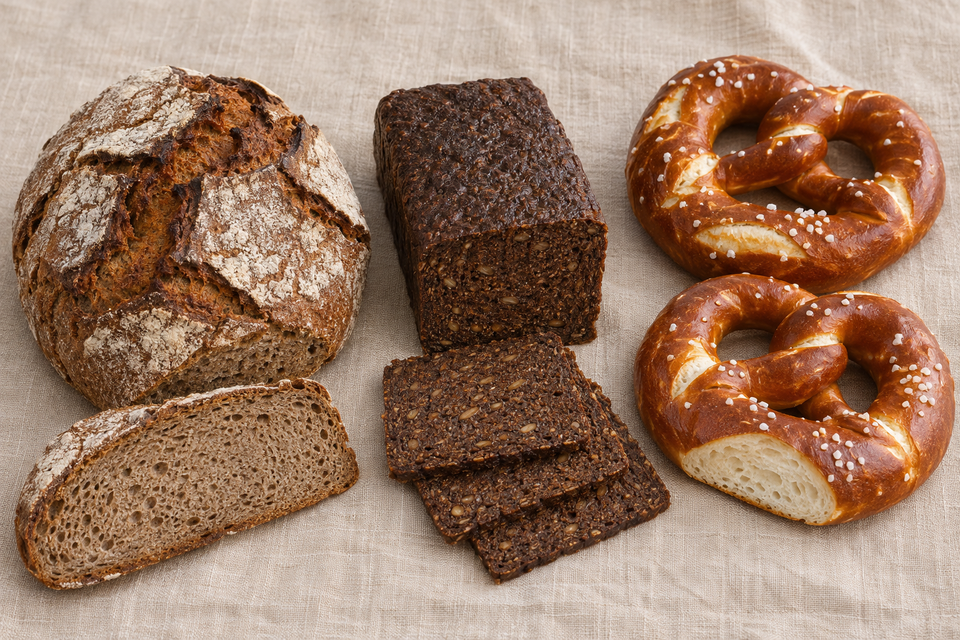
Westphalian pumpernickel is notable for its moist, dense crumb, in which coarsely ground rye can be seen. Prolonged baking contributes to the development of its dark colour and characteristic aroma. Its dense structure is associated with serving it in thinner slices. The grain’s particle structure is retained, creating a chewing sensation very different from that of a familiar light wheat loaf. (European Union, 2014)
The southern pretzel, or Brezel, is distinguished by its knotted shape and shiny brown surface. The geographical indication specification for Bavarian pretzels identifies alkaline surface treatment and baking among the product’s defining features. This treatment affects browning and aroma in the crust. Its place alongside local snacks and Bavaria’s tradition of communal eating also explains its cultural role beyond the bakery counter. (European Union, 2013)
Bread has entered the names of meals in German. In expressions such as Abendbrot and Brotzeit, bread organises the table together with cheese, cold meats and other accompaniments. German bread culture’s inclusion in the national inventory of intangible cultural heritage in 2014 encompasses diversity, the transmission of skills and these forms of sharing. In such a meal, bread is both a slice on which food is placed and a familiar setting for people to come together. (Deutsche UNESCO-Kommission, 2014)
Wholegrain rye and wheat breads are important for their contributions of fibre, magnesium and zinc. Retaining the grain’s outer parts produces bread containing more of these components; long fermentation can also act on phytate, which affects mineral availability. Results for 2005–2006 based on the Max Rubner Institute’s NVS II survey report daily bread consumption among people aged 14–80 of 184 grams for men and 136 grams for women. In a meal pattern where bread is eaten regularly, flour choice also influences daily nutrient intake. (Heuer et al., 2015) (Brune et al., 1992)
Finland; sourdough starters, rye and northern storage traditions
Finnish rye bread brings cereal choice and cultural continuity together. Ruisleipä includes rye breads of different shapes and firmness. Juuri, the term used for a sourdough starter, describes dough reserved from one batch and fed again for the next. Passing this living culture, which gives bread acidity and aroma, between families also transmits production knowledge. (ThisisFINLAND, n.d.)
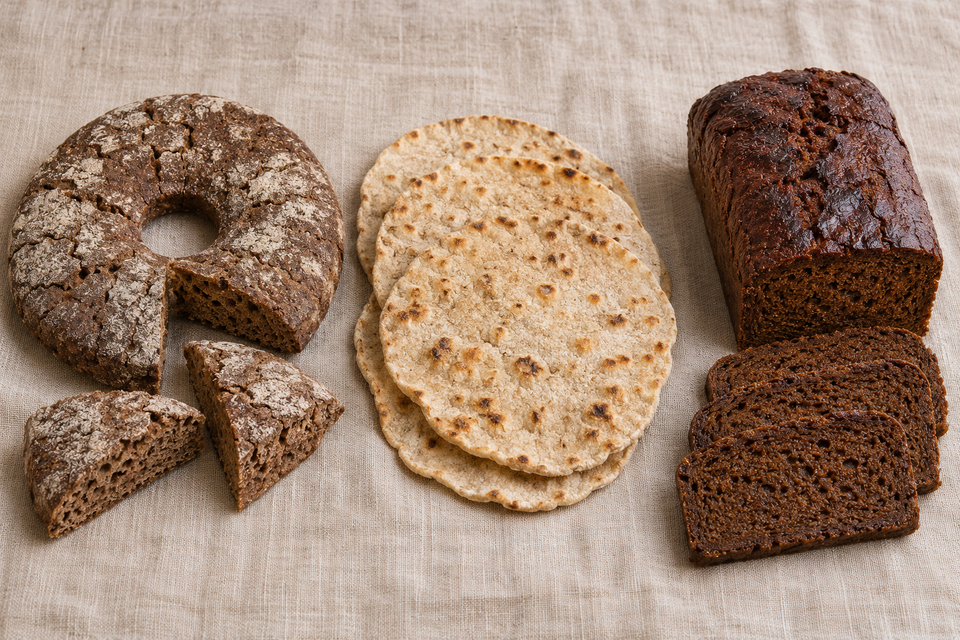
Reikäleipä, with a hole in the centre, demonstrates the relationship between shape and storage. Hanging these flat rings on poles near the ceiling historically allowed them to dry for storage. The hole therefore represents a practical solution in everyday life rather than decoration. Rye bread’s selection as Finland’s national food in a public vote in 2017 also shows how an ordinary food can become part of a sense of belonging. (ThisisFINLAND, n.d.)
Alongside rye, there are flatbreads such as rieska made with barley. Prepared more quickly, these breads have a different texture from thick, sour rye loaves. In dark saaristolaisleipä associated with the archipelago, malt and syrup give a sweetish character. Finland’s bread diversity thus encompasses sour, dense rye alongside softer or sweeter regional examples. (Lepistö; ThisisFINLAND, n.d.) (Lepistö; ThisisFINLAND, n.d.)
Wholegrain rye’s fibre contribution is particularly notable nutritionally. The grain’s outer layers also carry magnesium, iron and zinc. However, a mineral’s total amount and its release during digestion are different processes; phytate breakdown affects the latter. Human studies using rye bread have shown that sourdough fermentation applied to reduce phytate can increase iron absorption. Wholegrain flour and properly managed fermentation are therefore complementary production characteristics. (Hoppe et al., 2025) (For more detailed information about directing fermentation, see Starter Cultures; Definition, Types and Characteristics)
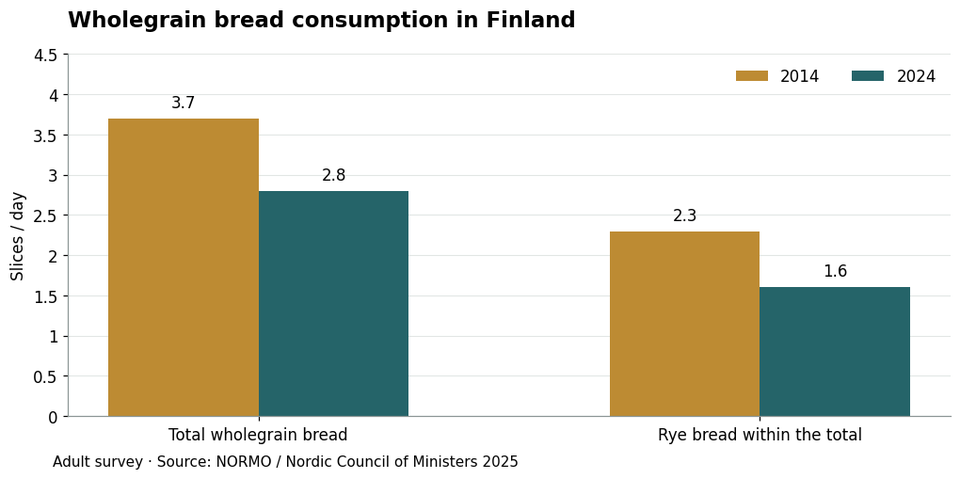
In the NORMO survey, Finnish adults’ total wholegrain bread consumption was 3.7 slices per day in 2014 and 2.8 slices in 2024. Rye bread within that total declined from 2.3 to 1.6 slices over the same period. That everyday consumption can change while rye bread retains its strong cultural place shows that tradition and dietary behaviour do not always move at the same pace. (Nordic Council of Ministers, 2025)
Iran; stone ovens, thin breads and different dough structures
Iran’s sangak is an example of an oven’s cooking surface becoming part of a product’s identity. Soft dough placed in an oven floored with small stones becomes a long, flat bread. Irregular marks left by the stones can be seen on its underside. The production method documented by FAO uses wheat flours of different extraction rates, water and salt; a piece reserved from the previous dough initiates fermentation. The baker shapes it by spreading it on a peel and transferring it to the stone bed. Sesame or other seeds may also be added to the surface. (FAO, n.d.)
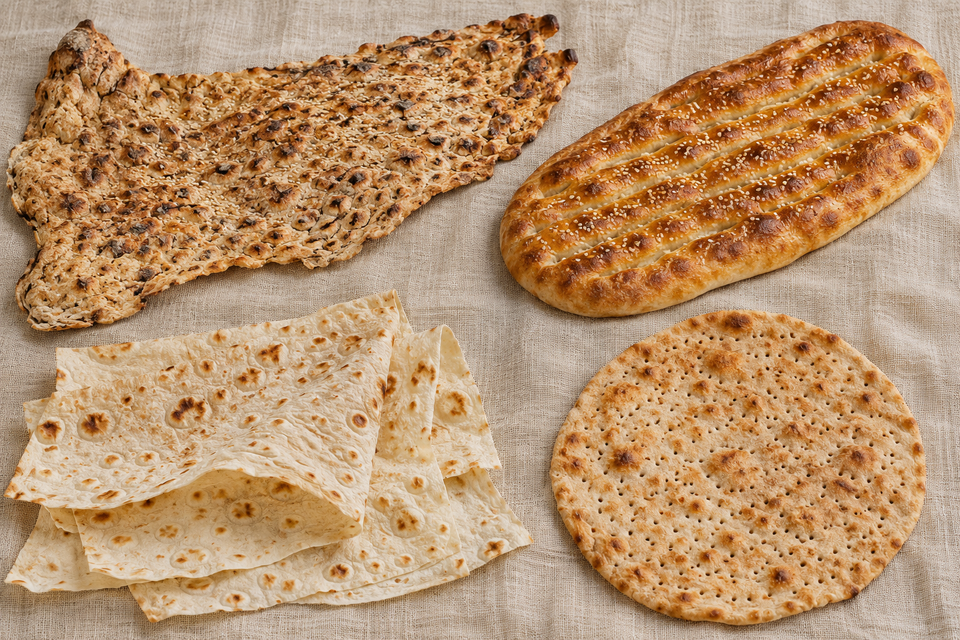
Barbari is thicker and elongated, with recognisable parallel grooves on its surface. Very thin lavash is suitable for folding and wrapping food. Taftoon joins these varieties with its round, thin form. As dough thickness, contact with the oven and cooking time change, the same wheat flour develops different chewing characteristics. The difference between thick barbari and thin lavash also affects how bread is divided at the table and which foods accompany it. (Encyclopaedia Iranica, n.d.)
Iran is also included in UNESCO’s multinational inscription of flatbread-making and sharing culture. The transmission within families of skills ranging from preparing the dough to baking, and serving bread together, are prominent aspects of this tradition. Bread thus forms part of family relationships and shared production as well as daily meals. A thick oven loaf and a thin tandoor bread require different working arrangements, further diversifying production knowledge. (UNESCO, 2016)
Flour extraction rate is an important distinction in nutrient composition. Flour retaining more of the grain’s outer parts also preserves more fibre and minerals. Bread’s widespread consumption is one reason behind Iran’s flour enrichment initiatives using iron and folic acid. A Flour Fortification Initiative case study cites average daily bread consumption of 320 grams per person, based on the 2000–2003 national household survey. Enriching a regularly eaten food can therefore turn small additions into a meaningful contribution to everyday nutrition. (Flour Fortification Initiative, n.d.)
Added folic acid should be considered alongside naturally occurring grain folate. Preserving the grain’s own nutrients and adding specific vitamins during production are different practices. Iran illustrates how bread can be both a traditional food produced through local craftsmanship and a vehicle for population-level nutrition programmes. (Flour Fortification Initiative, n.d.) (For more detailed information about folate, folic acid and other vitamins, see All Vitamins; Functions, Daily Requirements and Food Sources)
Egypt; baladi, sun-risen bread and the connection with life
Egyptian baladi is a round bread made from wheat flour, water, salt and yeast, often forming an internal pocket. FAO’s assessment of Egypt specifies flour with an 82% extraction rate for baladi. A higher extraction rate is associated with more components from the grain’s outer parts entering the flour. When the dough is rolled out and baked at a high temperature, steam separates its two surfaces. The resulting pocket makes the bread suitable for filling or for tearing off pieces. (FAO, 2020) (Pasqualone et al., 2022)
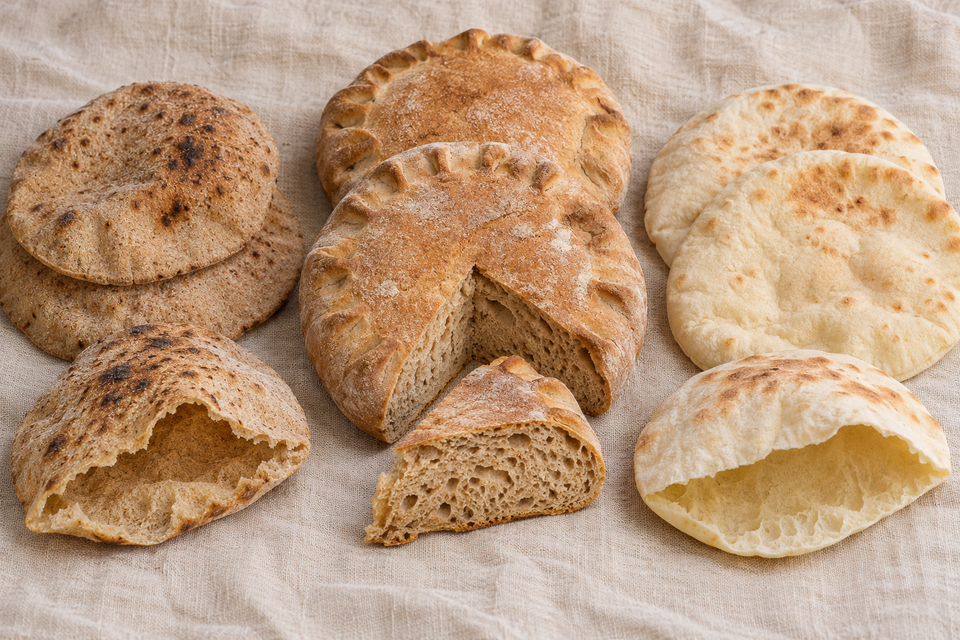
Lighter-coloured shami-type pocket breads and baladi’s darker, more pronounced cereal character represent two expressions of milling in bread. The fraction of baladi flour derived from the outer grain layers is important for fibre, B vitamins and minerals. In lighter breads made with refined flour, a soft crumb and more neutral aroma predominate. Flour choice is thus an element of both sensory qualities and nutrient composition. (Pasqualone et al., 2022) (Garzon; NMSU, 2018)
Upper Egypt’s shamsy, or sun bread, demonstrates another production pattern. A starter retained from the previous dough is refreshed in rural households; dough kneaded from flour, water and salt is shaped into thick discs. Leaving the dough to rise in the sun is the distinctive stage, with cooking completed later in the oven. The iHERITAGE field record considers women’s skills, the length of the stages and preparation for storage together. Baladi’s thin pocket and shamsy’s thick crumb are two responses to different consumption and storage needs within the same country. (iHERITAGE, n.d.)
The connection between the Egyptian word for bread, eish, and life makes this food’s everyday importance visible in language. Bread prices and accessibility concern public food policy as well as household kitchens. An IDSC bulletin dated 20 August 2024 described a daily entitlement under the subsidised programme of five loaves per person, each weighing 90 grams. Such a support system demonstrates the significance of access to staple foods in the country’s social life. (FAO, 2020) (Information and Decision Support Center, 2024)
Nutritionally, plain baladi differs in composition from baked products with added fat or sugar. Most of its energy comes from starch, and its protein comes from wheat. Higher-extraction flour helps preserve the grain’s contributions of magnesium, zinc and B vitamins. Eating bread with legume dishes and vegetables also turns the composition provided by bread alone into a more varied meal. (Garzon; NMSU, 2018) (FAO, 2020)
Morocco; khobz, griddle breads and sourdough knowledge in the home
Round breads known as khobz are among the staple accompaniments to Moroccan meals. Crust, crumb and aroma change with wheat flour fineness, wholegrain use and fermentation method. Dividing the loaf into pieces to accompany food connects bread with the meal as a whole. The Moroccan National Tourism Office mentions white, wholegrain and sourdough varieties together, emphasising bread’s daily place at the table. (Office National Marocain du Tourisme, n.d.)
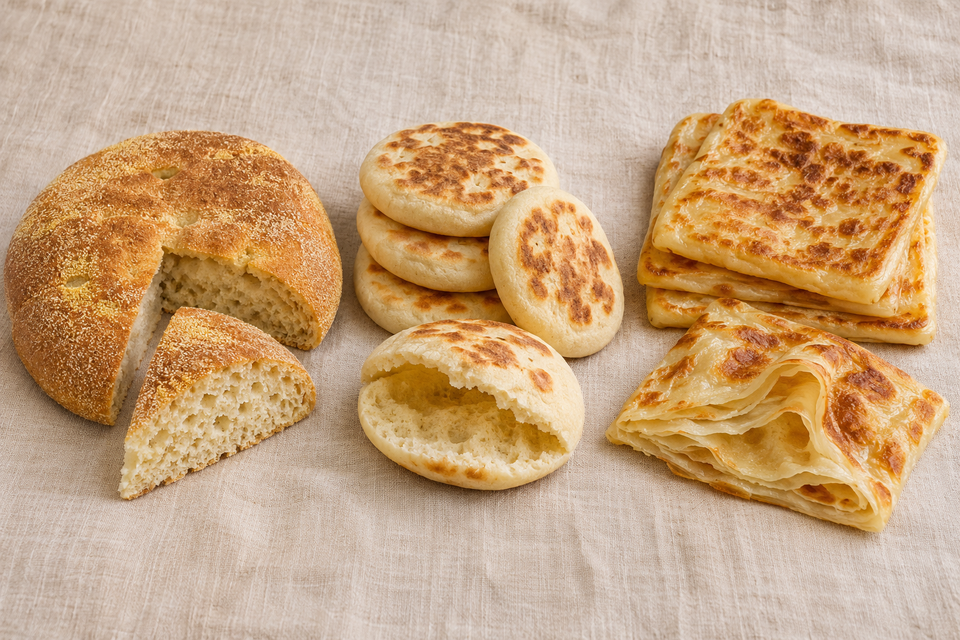
Batbout is a smaller, flat bread cooked on a hot surface. Expansion during cooking can create a hollow interior. Msemen has a more layered structure, prepared by rolling and folding the dough. Fat between the layers and the cooking method create crispness and a mouthfeel different from a plain loaf. The local culinary record from the Meknes tourism organisation includes batbout and msemen among the region’s well-known dough products. (Conseil Préfectoral du Tourisme de Meknès, n.d.)
Sourdough knowledge in Morocco also remains part of home production, independently of commercial yeast. A field study published in 2023 in the Figuig region interviewed one hundred rural women and recorded 17 different recipes for preparing sourdough. In some recipes, fermented dairy products or plant ingredients accompany flour and water. The starter thus represents both a source of microorganisms and preparation knowledge passed from home to home. (Moujabbir et al., 2023)
This diversity also appears nutritionally. Wholegrain khobz can carry more fibre and magnesium, zinc and iron from the grain’s outer parts. Msemen with fat added between its layers has a different energy density from plain flour-and-water dough. The acidity developing during sourdough fermentation can influence the enzymes that break down cereal phytate, helping release minerals during digestion. Each property depends on a different production decision: flour choice, fat use and fermentation management. (Moujabbir et al., 2023) (Rodriguez-Ramiro et al., 2017)
Frequent bread consumption also makes salt content important. A study published in 2017 that examined white bread samples collected from 80 Casablanca bakeries in 2011 reported an average salt content of 17.37 grams per kilogram in its conclusion, equivalent to approximately 1.74 grams per 100 grams. The research provides a concrete example of why bread attracts attention in salt-reduction efforts because of its widespread place in daily diets. Nutritional assessment needs to consider salt added during production alongside fibre and minerals. (Jafri, El-Kardi & Derouiche, 2017)
India; roti, naan, paratha and cereal diversity
India’s bread culture shows considerable diversity in cereals and cooking surfaces. Chapati, or roti, is among the best-known thin breads made with whole-wheat flour called atta. Dough kneaded from flour and water is rested, divided into small portions, rolled out and cooked on a hot surface called a tawa. Steam forming at the final stage can separate the two surfaces of the thin dough, making it puff up. This produces a puffed, flexible bread through a process different from the long fermentation of a yeasted loaf. (Kundu et al., 2019) (Bhabha Atomic Research Centre, n.d.)
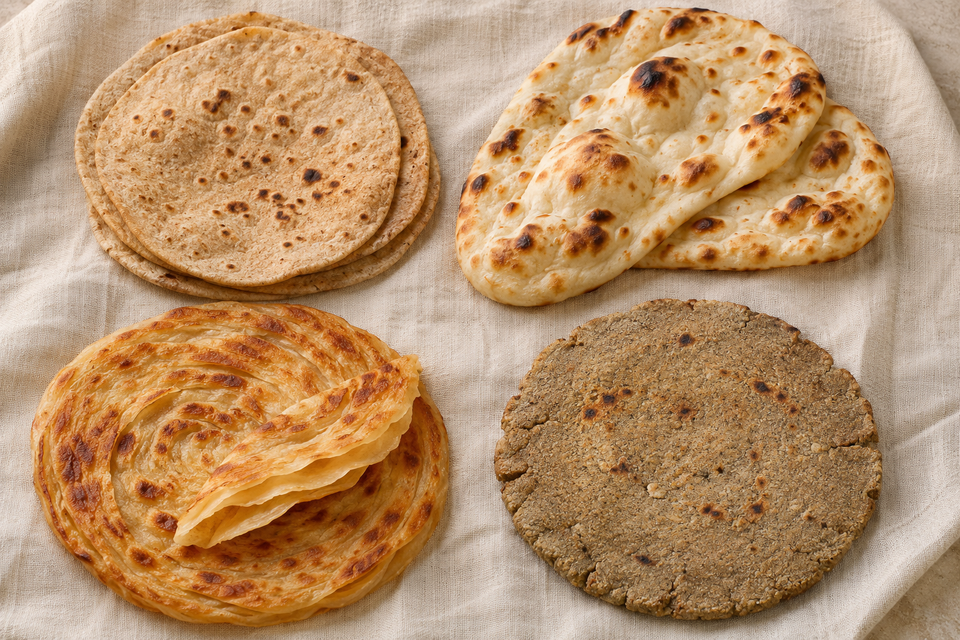
Naan exemplifies thicker, risen breads cooked in a tandoor or a similarly hot oven. Paratha develops layers through rolling, folding and cooking with fat; varieties may contain potato, vegetable or legume fillings. Delhi’s local culinary record describes different paratha fillings together with the food’s place in street and market culture. While roti can be a plain meal accompaniment, a filled paratha becomes a richer food in its own right. (Ministry of Tourism, Government of India, n.d.) (Pasqualone et al., 2022)
Millets are used alongside wheat in breadmaking. For example, the cuisine of Kurukshetra in Haryana includes bajra roti made from pearl millet alongside wheat roti. Changing the cereal affects water absorption, flexibility and the texture of the cooked bread. Kundu and colleagues’ study of twenty wheat varieties also shows that chapati quality is influenced by flour characteristics and dough behaviour as well as the amount of water. (Ministry of Tourism, Government of India, n.d.) (Kundu et al., 2019)
Roti also has a place in communal dining. In Amritsar’s langar kitchen, bread is served free of charge with legume dishes and other foods. Preparing food together, serving others and sitting at the same table connect the meal with social equality and solidarity. Bread’s significance here can be understood through who shares it and how, as well as the number of pieces cooked. (Ministry of Tourism, Government of India, n.d.)
Nutritionally, retaining the bran and germ in atta is important for fibre, magnesium, zinc and B vitamins. A roti prepared without added fat differs in fat and energy content from a paratha with fat spread between its layers. Eating it with legumes adds protein and fibre to the meal. Considering the cereal, fat used and accompanying dish together provides a better explanation of this cuisine’s dietary pattern. (Kundu et al., 2019) (Garzon; NMSU, 2018) (For more detailed information about cereal and legume proteins, see Proteins; Functions in the Body, Quality and Daily Needs)
China; steamed bread, sesame oven breads and dough artistry
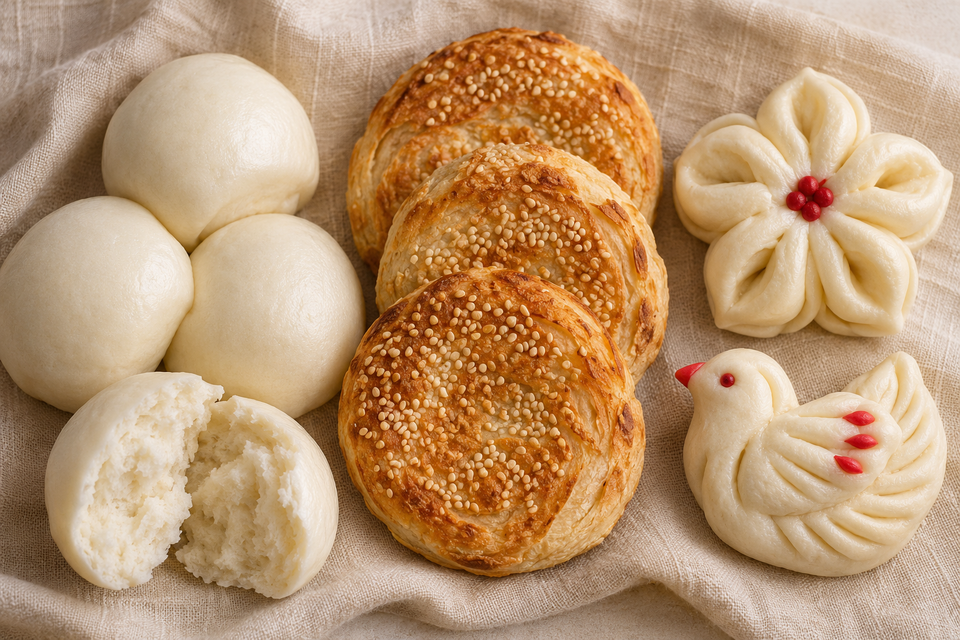
China’s mantou is a prominent example showing that bread does not necessarily have to be baked in an oven. Dough made from wheat flour and water is fermented with yeast or sourdough, shaped and steamed. Instead of the thick, browned crust produced by a dry oven, a pale, soft surface forms. In northern China’s wheat-based food tradition, mantou serves as a starchy staple alongside vegetable and meat dishes. (Gao et al., 2022)
The control recipe in a 2022 study of mantou production used a total of 600 millilitres of water and 10 grams of yeast for 1,000 grams of flour. After shaping and fermentation, the dough was steamed at 100 °C under atmospheric pressure. Because its surface is not exposed to the hot, dry air of an oven, crust characteristics develop differently. Water remains a fundamental ingredient for dough development and the transformation of starch during cooking. (Gao et al., 2022)
Shaobing is among the oven-baked flatbreads that vary from region to region. Sesame surfaces, crisp crusts and, in some varieties, layered interiors are distinctive features. Beijing’s sesame shaobing and examples from Jinyun in Zhejiang show that different forms can share the same name. Contact with an oven wall or the hot oven environment creates an aroma and texture different from mantou’s soft surface. (Zhao & Chen, 2026)
Shaped steamed breads called huamo combine food with handicraft. Fermented wheat dough is formed into flowers, birds, fish or other figures. Serving them at weddings, birthdays and festivals in northern China, sometimes giving them to newlyweds and using them in ancestor remembrance, gives dough a symbolic function. Beijing’s cultural record describes the transmission of this skill across generations in Shanxi, Shandong and Shaanxi. (Beijing Municipal Culture and Tourism, n.d.)
Nutritionally, plain mantou mainly provides wheat starch and protein. Whole-wheat flour helps retain vitamins and minerals from the grain’s outer parts together with fibre. Fat and sesame used in shaobing can change fat content and energy density compared with plain steamed bread. Filled or sweetened examples further broaden the composition. Steaming, baking and ingredients added to the dough are therefore production characteristics that need to be considered separately. (Gao et al., 2022) (Garzon; NMSU, 2018)
Ethiopia; injera, fermentation and bread at the communal table
Injera is a thin, flexible, fermented bread made from teff flour and water, with numerous small pores. Mixtures using sorghum, wheat, barley or corn also exist. The batter is fluid enough to spread on a hot surface rather than firm enough to shape by hand like a loaf. Following fermentation, it is poured onto a broad cooking surface and cooked on one side, creating its porous structure. (FAO, n.d.)
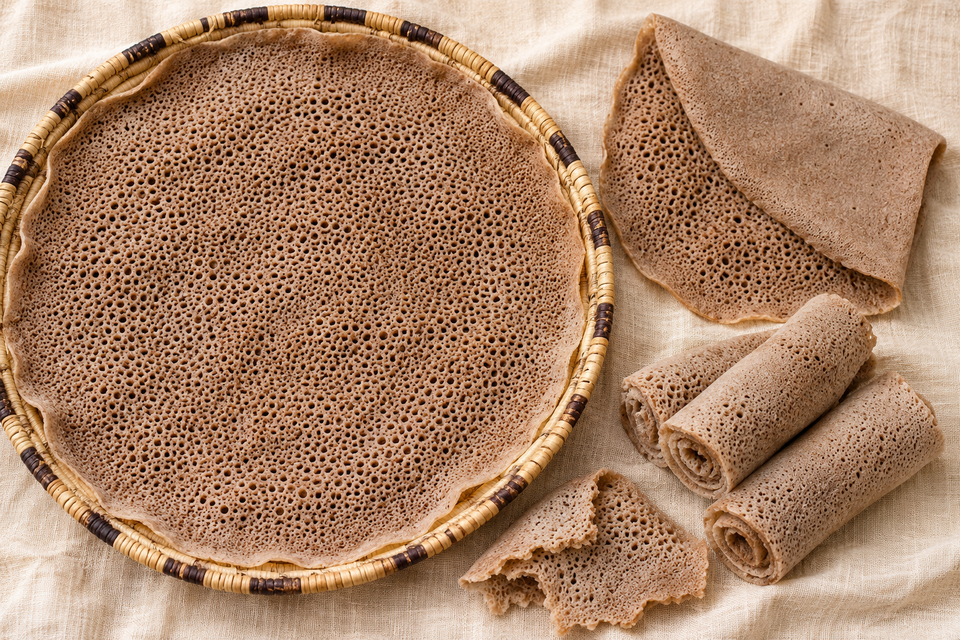
In some traditional practices, a portion of the mixture is cooked beforehand and added back to the main batter. This stage contributes to changes in starch and batter consistency. Fermentation microorganisms produce aroma and acidity, while gas and steam during cooking help form the surface pores. The result is a bread that can be folded and hold sauce, rather than a thick loaf. (FAO, n.d.)
Injera’s role at the table fits this structure. Meat, lentil, pea or vegetable dishes are placed on a large injera, and small pieces are torn off to pick up food. In shared-plate dining, bread provides both the starchy basis of the meal and the piece used to carry food to the mouth. Ethiopian cultural presentations specifically describe this way of eating together. Plant-based foods during Orthodox fasting periods provide further examples of meals built around injera. (Embassy of Ethiopia in Brussels, n.d.)
Nutritionally, water remaining in the cooked product matters alongside the proportions of teff and other grains. USDA’s defined injera record contains approximately 76 grams of water, 2.8 grams of fibre, 43 milligrams of magnesium and 29 micrograms of total folate per 100 grams. In a more moist bread, water accounts for a larger share of 100 grams, diluting cereal-derived energy and nutrients on a weight basis. (USDA FoodData Central, 2024) (For more detailed information about water’s role in food structure, see Water in Foods; Forms, Properties and Importance)
A study published by Verger and colleagues in 2025 examined dietary records collected from women in Butajira in 2013. Mean injera intake was 170 grams per day across the entire sample and 442 grams among those who consumed injera on the recording days. The researchers also modelled how vitamin changes during fermentation affected nutrient intake calculations. Understanding this bread therefore requires considering cereal type, fermentation, meal quantity and accompanying foods together. (Verger et al., 2025)
Mexico; tortillas, wheat breads and tables of remembrance
For Mexican corn tortillas, breadmaking begins before the grain is milled. During nixtamalisation, dry corn is cooked and steeped in alkaline water containing food-grade calcium hydroxide. After draining and washing, the kernels are ground into a dough called masa. Small portions are rolled or pressed into thin rounds and cooked on a hot surface called a comal. The tortilla obtained is flexible enough to hold in the hand. (CIMMYT, n.d.)
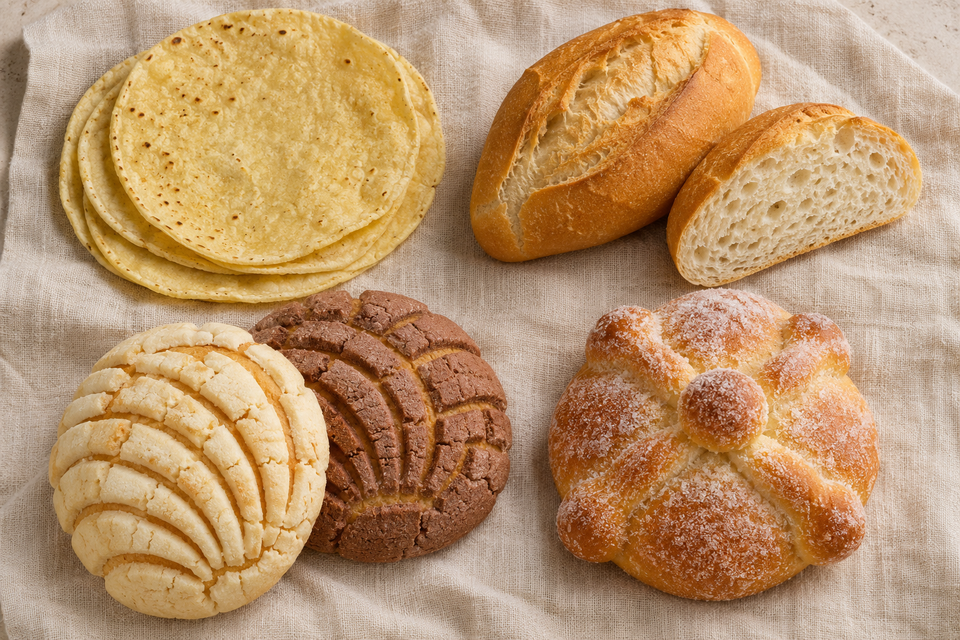
This process also changes corn’s nutritional properties. Contact with calcium hydroxide can increase the product’s calcium content, and niacin availability improves through nixtamalisation. USDA’s corn tortilla record contains 81 milligrams of calcium, 72 milligrams of magnesium and 6.3 grams of fibre per 100 grams. This composition shows that corn needs to be assessed through its processing method as well as its milling. (CIMMYT, n.d.) (USDA FoodData Central, 2024) (For more detailed information about calcium and other minerals, see Minerals and Nutrition; Functions, Daily Requirements and Food Sources)
Combining tortillas with beans, peppers and other foods is part of Mexican cuisine’s system extending from agriculture to the table. UNESCO’s 2010 inscription of traditional Mexican cuisine considers corn cultivation, processing, communal food preparation and sharing within the community together. Tortillas serve both as everyday food and as part of ceremonial offerings. An El Colegio de México report from 2016 calculated tortilla consumption from 2014 household data at approximately 66 kilograms per person per year. (UNESCO, 2010) (Nuñez Melgoza & Sempere Campello, 2016)
Wheat breads also occupy an important place in the country’s bakery culture. Bolillo is an oval bread with a crisp crust and light crumb that can be used for sandwiches. Concha is one of the sweet breads recognised by a shell-shaped sugary pattern on top. Plain everyday breads and sweet baked goods grouped as pan dulce have thus developed different uses. Sweet doughs containing fat, sugar or eggs also differ in composition from plain tortillas and bolillos. (UNAM; Profeco, n.d.) (Profeco, 2002)
Pan de muerto makes bread’s role in remembrance visible. In a common form of this sweet wheat bread prepared for the Day of the Dead, dough strips resembling bones and a small knob decorate a round loaf. Placing it on altars forms part of families’ remembrance of loved ones who have died. The Mexican Ministry of Agriculture’s cultural account also describes regional differences in shape and preparation. Here, bread brings cereal, skill, family memory and sharing together in one food. (Secretaría de Agricultura y Desarrollo Rural, 2025)
Japan; shokupan, anpan and breads adapted to local tastes
Japanese shokupan is recognised by its soft crumb and evenly sliceable tin-baked form. Milk, fat or sugar may be added to a dough based on flour, water, yeast and salt. The square shape baked in a lidded tin is suitable for toast and sandwiches. Web Japan’s examples show how attention to flour and milk selection, and presenting certain loaves as gifts, give an everyday product different meanings in consumption. (Web Japan, 2021)
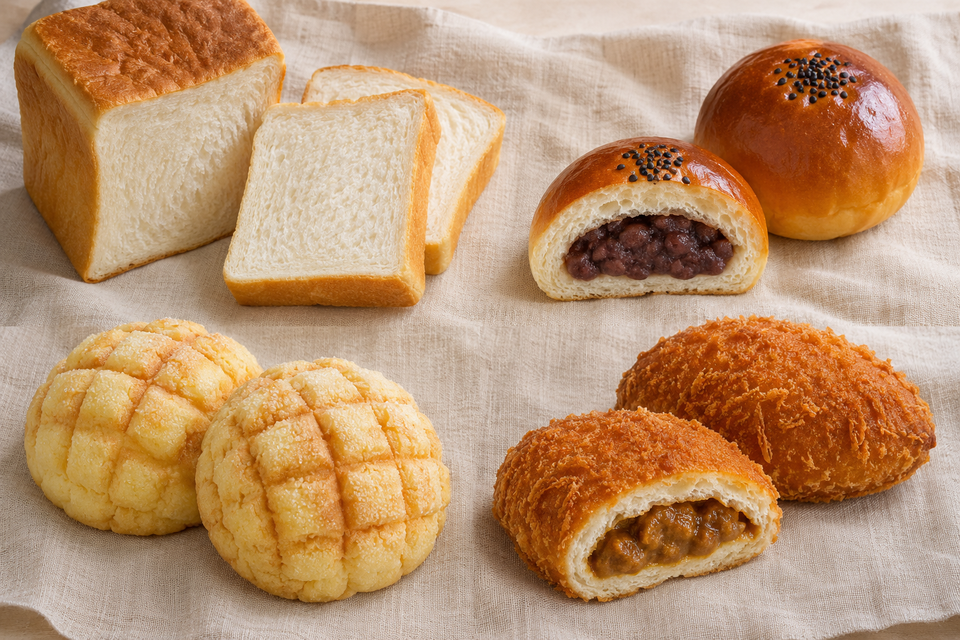
Anpan combines Japan’s sweet bean-paste tradition with yeasted bread. According to Japan’s cultural centre in Singapore, the bread was developed in 1874, drawing inspiration from the bean-filled dough product manju. Cream-, jam- and curry-filled varieties later joined bakery culture. Curry-filled kare-pan is one of the savoury examples of this diversification. A production technique introduced from abroad has thus been adapted to local tastes and everyday eating habits. (Japan Creative Centre, 2023)
Melonpan is distinguished by a thin cookie-dough coating over soft yeasted dough. The scored pattern and crisp layer formed during baking offer two contrasting textures together with the soft interior. Namiko Hirasawa Chen’s recipe prepares the two doughs separately before combining them. Because the outer layer contains sugar and fat, this product differs in composition from plain shokupan. Including both staple meal products and sweet snacks under the name of bread is a distinctive feature of Japanese bakeries. (Hirasawa Chen, 2023)
Japan’s official food composition database lists 248 kilocalories of energy, 8.9 grams of protein, 4.1 grams of fat and 4.2 grams of fibre per 100 grams of square shokupan. The same record contains 0.07 milligrams of vitamin B1, 1.1 milligrams of niacin and 30 micrograms of folate. Calcium is listed at 22 milligrams and magnesium at 18 milligrams. These values show that a soft white tin loaf contributes protein and some micronutrients, with the amount depending on the formulation. (MEXT, n.d.)
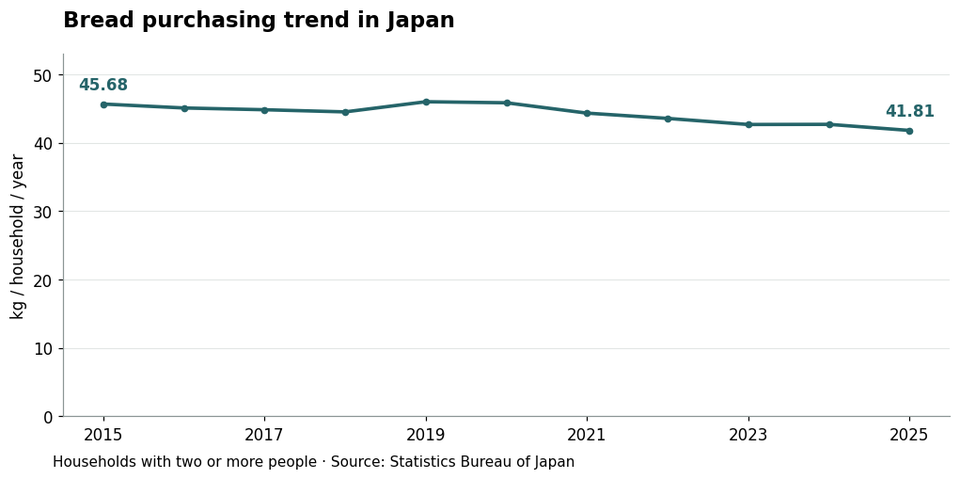
The Statistics Bureau’s survey of households with two or more people records annual bread purchases of 45.68 kilograms in 2015 and 41.81 kilograms in 2025. Over the same period, shokupan purchases changed from 19.61 to 19.29 kilograms. The more limited change in shokupan compared with the approximately 8.5% decrease in total bread purchases shows that bread types do not change in the same direction or at the same pace. (Statistics Bureau of Japan, 2025)
Brazil; pão francês, cheese bread and cassava starch
Brazilian pão francês has a prominent place among everyday breads, with its small size, scored crust and light crumb. Dough made from wheat flour, water, salt and yeast is divided into small portions, shaped, proofed and baked. The small loaf’s crust-to-crumb ratio provides an eating sensation different from that of a large tin loaf. Wheat-based pão de forma offers another everyday choice, with more regular slices and a soft structure suitable for sandwiches. (Torrezan et al., n.d.) (NEPA–UNICAMP, 2011)
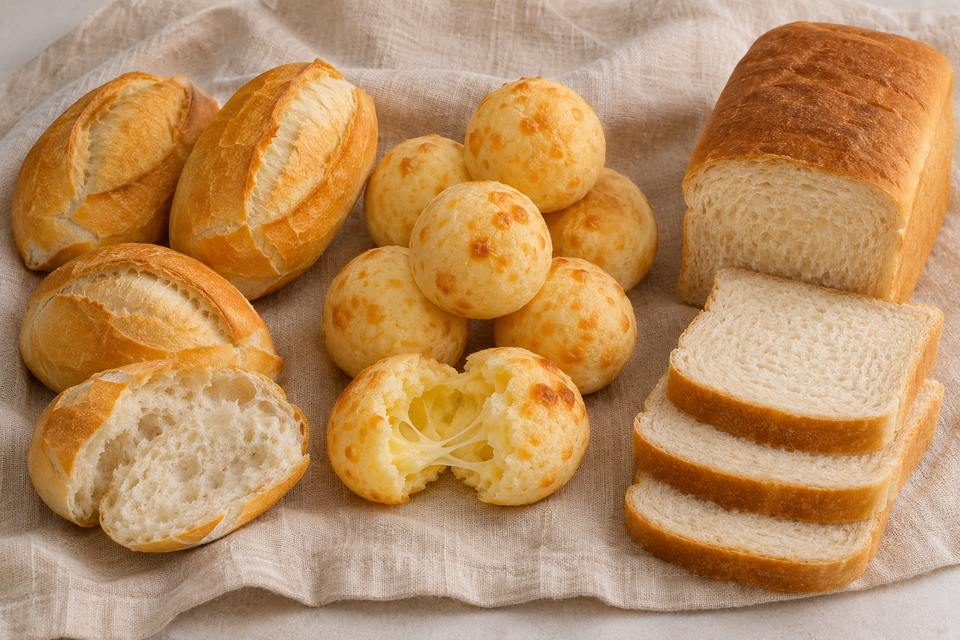
Pão de queijo, associated with Minas Gerais, shows that wheat is not essential in breadmaking. Its principal starch source is polvilho obtained from cassava. Cheese and, depending on the recipe, milk, fat and eggs are also used. The behaviour of sweet or fermented sour cassava starch affects dough expansion and crumb formation. Instead of the gluten network in wheat bread, the heat-induced transformations of starch and other ingredients become central. Embrapa’s research on this product also examines how different cassava starches affect bread structure. (Embrapa, 2024)
The name cheese bread does not mean its nutrient composition is the same as plain bread. Brazil’s TACO table lists 363 kilocalories of energy, 24.6 grams of fat and 102 milligrams of calcium per 100 grams of baked pão de queijo. The pão francês record contains 300 kilocalories, 3.1 grams of fat and 16 milligrams of calcium. Cheese and fat use markedly change the first product’s fat and calcium content. (NEPA–UNICAMP, 2011)
Comparison with whole-wheat tin bread reveals another difference. Its 100-gram TACO record contains 6.9 grams of fibre and 60 milligrams of magnesium, compared with 2.3 grams and 25 milligrams in pão francês. Products made from cassava starch, refined wheat flour and wholegrain flour therefore differ technologically and nutritionally. Retaining the outer parts of the grain and adding cheese to dough change nutritional qualities in different ways. (NEPA–UNICAMP, 2011)
IBGE’s 2017–2018 individual dietary survey reports an average daily consumption of 49.4 grams in the pão de sal group among people aged 10 and above. The corresponding amount for wholegrain bread is 1.8 grams. The substantial place of plain small loaves in daily consumption also reveals the importance of traditional bakery products in nutrient intake. (Instituto Brasileiro de Geografia e Estatística, 2020)
Which characteristics determine bread’s nutritional qualities?
Assessing bread’s nutrient composition begins with its raw material. Wheat, rye, oats, barley, corn and teff differ in starch, protein, fibre and mineral composition. Which parts of the grain enter the flour is also decisive. Wholegrain flour retains bran, germ and endosperm together, whereas more thoroughly sifted flour has a higher proportion of the starch-rich interior. This changes fibre and micronutrient density as well as bread colour. (Garzon; NMSU, 2018) (ANSES Ciqual, 2025)
Dietary fibre includes carbohydrate components that digestive enzymes do not fully break down. Different fibres from cereal cell walls are important for intestinal function and microbial fermentation. WHO recommends at least 25 grams of naturally occurring dietary fibre per day for adults and highlights whole grains, legumes, vegetables and fruit as carbohydrate sources. Choosing wholegrain bread is one practice that can contribute to this total intake. (WHO, 2023) (For more detailed information about dietary fibre and other carbohydrates, see Carbohydrates; Monosaccharides, Disaccharides and Polysaccharides)
Bread’s protein comes largely from the cereal used. Gluten-forming wheat proteins help dough retain gas, while breads made from rye, corn or teff develop structure through the combined behaviour of different components. Nutritionally, protein quantity is considered alongside amino acid composition and other protein sources in the meal. Adding ingredients such as milk, eggs, cheese or legumes can change both dough properties and bread’s protein contribution. (Mesta-Corral et al., 2024)
Energy and basic nutrient composition of bread samples
| Product and record | Energy kcal | Protein g | Fat g | Carbohydrate g | Fibre g | Water g |
|---|---|---|---|---|---|---|
| Commercial white bread USDA 174924 | 266 | 8.9 | 3.3 | 49.4 | 2.7 | 36.4 |
| Commercial whole-wheat bread USDA 172688 | 252 | 12.4 | 3.5 | 42.7 | 6.0 | 39.0 |
| Rye bread USDA 172684 | 259 | 8.5 | 3.3 | 48.3 | 5.8 | 37.3 |
| French or Vienna bread USDA 172675 | 272 | 10.8 | 2.4 | 51.9 | 2.2 | 33.0 |
| Enriched white pita USDA 174915 | 275 | 9.1 | 1.2 | 55.7 | 2.2 | 32.1 |
| Commercial plain chapati or roti USDA 171844 | 297 | 11.2 | 7.5 | 46.4 | 4.9 | 33.0 |
| Corn tortilla USDA 2707823 | 218 | 5.7 | 2.9 | 44.6 | 6.3 | 45.9 |
| Injera USDA 2707796 | 93 | 2.6 | 0.7 | 19.4 | 2.8 | 76.3 |
Per 100 grams of edible product; USDA FoodData Central. Carbohydrate is the total determined by difference; the fibre shown is included in this total. SR Legacy and FNDDS product records; quantities rounded to one decimal place.
Among B vitamins, thiamine, riboflavin, niacin and folate deserve particular attention. Milling, flour enrichment, fermentation and baking affect them in different ways. The fact that much of the total folate in the commercial white bread record in the table comes from added folic acid shows that whiteness alone cannot determine vitamin content. Wholegrain flour, meanwhile, is one of the principal ways of preserving the grain’s own vitamins and minerals. (USDA FoodData Central, 2019) (ANSES Ciqual, 2025) (Canadian Food Inspection Agency, n.d.)
B vitamins and folate in bread samples
| Product and record | B1 mg | B2 mg | Niacin mg | Total folate µg |
|---|---|---|---|---|
| Commercial white bread USDA 174924 | 0.53 | 0.24 | 4.78 | 111 |
| Commercial whole-wheat bread USDA 172688 | 0.39 | 0.17 | 4.44 | 42 |
| Rye bread USDA 172684 | 0.43 | 0.34 | 3.80 | 110 |
| French or Vienna bread USDA 172675 | 0.71 | 0.43 | 4.82 | 123 |
| Enriched white pita USDA 174915 | 0.60 | 0.33 | 4.63 | 107 |
| Commercial plain chapati or roti USDA 171844 | 0.55 | 0.20 | 6.78 | 61 |
| Corn tortilla USDA 2707823 | 0.09 | 0.07 | 1.50 | 5 |
| Injera USDA 2707796 | 0.14 | 0.07 | 1.19 | 29 |
Per 100 grams of edible product; USDA FoodData Central. The folate column combines naturally occurring folate and added folic acid; it is not dietary folate equivalents (DFE). Of the 111 µg of total folate in white bread, 86 µg is added folic acid.
The total amount of minerals in bread and their availability in the body are distinct stages. Bran and germ carry iron, magnesium and zinc, while cereal phytate can bind certain minerals. Acidity and phytase activity during fermentation can break this compound down. In Hoppe and colleagues’ 2025 human study, mean iron absorption from an 80-gram wholegrain rye bread meal was 7.0% for the high-phytate sample and 19.1% for the reduced-phytate sourdough sample. This comparison involving eight women provides a concrete example of how production methods can change the utilisation of iron from the same cereal. (Hoppe et al., 2025)
Mineral content of bread samples
| Product and record | Calcium mg | Iron mg | Magnesium mg | Zinc mg |
|---|---|---|---|---|
| Commercial white bread USDA 174924 | 144 | 3.61 | 23 | 0.74 |
| Commercial whole-wheat bread USDA 172688 | 161 | 2.47 | 75 | 1.77 |
| Rye bread USDA 172684 | 73 | 2.83 | 40 | 1.14 |
| French or Vienna bread USDA 172675 | 52 | 3.91 | 32 | 1.04 |
| Enriched white pita USDA 174915 | 86 | 2.62 | 26 | 0.84 |
| Commercial plain chapati or roti USDA 171844 | 93 | 3.01 | 62 | 1.57 |
| Corn tortilla USDA 2707823 | 81 | 1.23 | 72 | 1.31 |
| Injera USDA 2707796 | 11 | 0.98 | 43 | 0.51 |
Per 100 grams of edible product; USDA FoodData Central. Full product names and record identifiers are available through the source links. Iron and zinc are shown to two decimal places.
The water content of cooked bread is also important in comparison. Cereal solids are concentrated in thin, dried bread, while water makes up more of each 100 grams of a more moist bread. Additions such as fat, sugar, cheese and eggs also change total energy and nutrient distribution. The characteristics explaining a bread’s nutritional qualities therefore result from the combined effects of grain quality, flour processing, recipe ingredients and production methods. (Mesta-Corral et al., 2024)
How is bread consumption changing?
Bread’s strong cultural importance does not require consumption to remain constant. The long-term decline in UK household bread purchases, the fall in wholegrain bread slices in Finland and the faster decrease in total bread purchases than shokupan in Japan represent different aspects of change. In Canada, total sales volume rose while retail quantities per person increased more modestly. The table below brings together the bread data in the country sections with their measurement periods and scope. (Defra, 2026) (Nordic Council of Ministers, 2025) (Statistics Bureau of Japan, 2025) (Agriculture and Agri-Food Canada, 2025)
Bread consumption and purchasing indicators by country
| Country | Period, scope and source | Quantity |
|---|---|---|
| Turkey | 2008 → 2012; daily bread consumption per person (Toprak Mahsulleri Ofisi, 2013) | 331 → 319 g/day |
| France | 2014–2015; ages 18–79; bread and dry bread products, total of two groups (ANSES, 2017) | 114.4 g/day |
| Spain | 2023 → 2024; household panel, bread for home consumption per person (MAPA, 2024) | 27.51 → 27.45 kg/year |
| United Kingdom | 1974 → 2024/25; weekly household bread purchases per person (Defra, 2026) | 1,019 → 439 g/week |
| Germany | 2005–2006; ages 14–80; daily bread consumption (Heuer et al., 2015) | Men 184; women 136 g/day |
| Finland | 2014 → 2024; wholegrain bread among adults (Nordic Council of Ministers, 2025) | 3.7 → 2.8 slices/day |
| Iran | 2000–2003; national household food consumption survey, bread (Flour Fortification Initiative, n.d.) | 320 g/person/day |
| Ethiopia | 2013; women in Butajira; injera (Verger et al., 2025) | Entire sample 170; consumers 442 g/day |
| Mexico | 2014; tortilla per person based on household survey (Nuñez Melgoza & Sempere Campello, 2016) | Approximately 66 kg/year |
| Japan | 2015 → 2025; annual bread purchases, households with at least two people (Statistics Bureau of Japan, 2025) | 45.68 → 41.81 kg/household |
| Canada | 2020 → 2024; bread retail sales volume (Agriculture and Agri-Food Canada, 2025) | 989.3 → 1,102.5 thousand tonnes |
| Brazil | 2017–2018; ages 10 and above; daily pão de sal consumption (Instituto Brasileiro de Geografia e Estatística, 2020) | 49.4 g/day |
Consumption, household purchasing and retail sales indicators are given with their respective periods and measurement units.
Across societies, bread can be an everyday loaf, a shared plate, food for a journey or part of a table of remembrance. Flour made from wheat, rye, corn or teff combines with water and takes different forms through local knowledge. Their nutritional qualities, within this cultural diversity, are understood through the concrete characteristics of the raw materials and production methods.
References
Arranz-Otaegui et al. (2018). Archaeobotanical evidence reveals the origins of bread 14,400 years ago in northeastern Jordan.
Rubel. (2011). Bread: A Global History.
Canadian Museum of History. (n.d.). Foodways: New France.
Torah. (n.d.). Exodus 12:15.
Bible. (n.d.). Matthew 6:11.
Bible. (n.d.). Luke 22:19.
Diyanet İşleri Başkanlığı. (n.d.). Yûsuf Suresi 36. Ayet ve Tefsiri.
Garzon; New Mexico State University. (2018). MyPlate: The Grain Group (E-142).
Public Health England. (2021). McCance and Widdowson’s Composition of Foods Integrated Dataset.
ANSES. (2025). Table de composition nutritionnelle des aliments Ciqual 2025.
Kundu, Khatkar, Gulia & Kumar. (2019). Functional characterization of whole wheat flours for chapatti quality and acceptability.
T.C. Kültür ve Turizm Bakanlığı. (n.d.). İnce Ekmek Yapma ve Paylaşma Kültürü: Lavaş, Katırma, Jupka, Yufka.
Türk Patent ve Marka Kurumu. (2018). Vakfıkebir Ekmeği: Coğrafi İşaret Tescil Belgesi No. 372.
T.C. Kültür ve Turizm Bakanlığı. (n.d.). Şanlıurfa Tırnaklı Ekmeği.
Karhan. (2024). Oklavadan Sofraya Türklerin Kültürel Mirası Yufka Ekmeğinin Sosyotarihsel ve Kültürel Anlamı.
UNESCO. (2016). Flatbread making and sharing culture: Lavash, Katyrma, Jupka, Yufka.
Brune et al. (1992). Iron absorption from bread in humans: inhibiting effects of cereal fiber, phytate and inositol phosphates.
Toprak Mahsulleri Ofisi. (2013). Türkiye’de Ekmek İsrafı Araştırması.
UNESCO. (2022). Artisanal know-how and culture of baguette bread.
ANSES. (2017). Étude individuelle nationale des consommations alimentaires 3 (INCA 3).
Axencia Galega da Calidade Alimentaria. (n.d.). IGP Pan Gallego.
Generalitat de Catalunya. (n.d.). IGP Pa de Pagès Català.
Ministerio de Agricultura, Pesca y Alimentación. (2020). Mollete de Antequera: Indicación Geográfica Protegida.
Ministerio de Agricultura, Pesca y Alimentación. (n.d.). Pan integral.
Ministerio de Agricultura, Pesca y Alimentación. (2024). Informe del consumo alimentario en España 2024.
Hollywood. (n.d.). Paul Hollywood’s Classic Cottage Loaf.
VisitScotland. (n.d.). Traditional Scottish food.
Amgueddfa Cymru – Museum Wales. (n.d.). Bara Brith: Currant Bread.
Tucker; Campden BRI. (2019). Chorleywood Bread Process: how it’s changed industry.
Department for Environment, Food & Rural Affairs. (2026). Family Food FYE 2025.
Department for Environment, Food & Rural Affairs. (2026). Family food datasets: UK household purchases, 1974–2024/25.
Deutsche UNESCO-Kommission. (2014). Deutsche Brotkultur.
Pasqualone et al. (2022). The Large and Diverse Family of Mediterranean Flat Breads: A Database.
European Union. (2014). Westfälischer Pumpernickel.
European Union. (2013). Bayerische Breze.
Heuer, T., Krems, C., Moon, K., Brombach, C., & Hoffmann, I. (2015). Food consumption of adults in Germany: results of the German National Nutrition Survey II based on diet history interviews. British Journal of Nutrition, 113(10), 1603–1614.
ThisisFINLAND. (n.d.). The root of Finnish rye bread.
Lepistö; ThisisFINLAND. (n.d.). Northern Finnish recipes.
Lepistö; ThisisFINLAND. (n.d.). Baking Finnish cakes and breads.
Hoppe, Sandberg & Hulthén. (2025). Influence of Sourdough Fermentation-Induced Dephytinization on Iron Absorption from Whole Grain Rye Bread.
Nordic Council of Ministers. (2025). NORMO: Diet 2014–2024.
Food and Agriculture Organization of the United Nations. (n.d.). Food composition tables for the Near East: Sangak bread.
Encyclopaedia Iranica. (n.d.). Bread: Persian nān.
Flour Fortification Initiative. (n.d.). Flour Fortification in the Islamic Republic of Iran: Sustainable Route to Improved Health.
Food and Agriculture Organization of the United Nations. (2020). Growing Egypt’s wheat supply.
iHERITAGE. (n.d.). Shamsy Bread (Sun Bread).
Information and Decision Support Center. (2024). Newsletter No. 870 (20 August 2024).
Office National Marocain du Tourisme. (n.d.). Food and drinks.
Conseil Préfectoral du Tourisme de Meknès. (n.d.). Gastronomie.
Moujabbir et al. (2023). Sourdoughs Used in the Preparation of Traditional Bread in the Province of Figuig in Eastern Morocco.
Rodriguez-Ramiro et al. (2017). Assessment of iron bioavailability from different bread making processes using an in vitro intestinal cell model.
Jafri, El-Kardi & Derouiche. (2017). Sodium chloride composition of commercial white bread in Morocco.
Bhabha Atomic Research Centre. (n.d.). Chapati.
Ministry of Tourism, Government of India. (n.d.). Delhi: Food and Cuisine.
Ministry of Tourism, Government of India. (n.d.). Kurukshetra: Food and Cuisine.
Ministry of Tourism, Government of India. (n.d.). Amritsar: Travel and Food Guide.
Gao, Y., Liu, T., Su, C., Li, Q., & Yu, X. (2022). Fortification of Chinese steamed bread with flaxseed flour and evaluation of its physicochemical and sensory properties. Food Chemistry: X, 13, 100267.
Zhao & Chen. (2026). China’s shaobing has turned into a hot commodity overseas.
Beijing Municipal Culture and Tourism. (n.d.). Flowery flour buns (Huamo).
Food and Agriculture Organization of the United Nations. (n.d.). Sorghum and millets in human nutrition: Traditional food preparations – Injera.
Food and Agriculture Organization of the United Nations. (n.d.). Traditional fermented food and beverages for improved livelihoods.
Embassy of Ethiopia in Brussels. (n.d.). Ethiopia: Culture.
USDA FoodData Central. (2024). Injera, Ethiopian bread (record 2707796).
Verger et al. (2025). Ignoring the Impact of Fermentation Could Result in Substantial Misestimation of Folate and Cobalamin Adequacy: A Simulation Study on Injera Consumption in the Ethiopian Context.
CIMMYT. (n.d.). What is nixtamalization?.
USDA FoodData Central. (2024). Tortilla, corn (record 2707823).
UNESCO. (2010). Traditional Mexican cuisine – ancestral, ongoing community culture, the Michoacán paradigm.
Nuñez Melgoza, F. J., & Sempere Campello, J. (2016). Estudio del mercado de producción, procesamiento, distribución y comercialización de la cadena de maíz-harina/nixtamal-tortilla en México.
UNAM; Profeco. (n.d.). El Bolillo.
Profeco. (2002). Pídalos por su nombre. Revista del Consumidor, 299.
Secretaría de Agricultura y Desarrollo Rural. (2025). Pan de muerto: el corazón de una dulce tradición.
Web Japan. (2021). Shokupan Bread: Japan’s Unique High-End Take on a Staple Food.
Japan Creative Centre. (2023). Pan-tastic.
Hirasawa Chen. (2023). Melon Pan.
Ministry of Education, Culture, Sports, Science and Technology, Japan. (n.d.). Standard Tables of Food Composition in Japan: Shokupan (01026).
Statistics Bureau of Japan. (2025). Family Income and Expenditure Survey: Table 6–2.
USDA FoodData Central. (2019). Bread, white, commercially prepared (includes soft bread crumbs) (record 174924).
National Park Service. (n.d.). Klondike Kitchen: Sourdough Flapjacks.
Smithsonian. (2018). What’s on your neighbor’s table.
BrandeisNOW. (2018). Have a bagel with Jonathan Sarna.
USDA FoodData Central. (2019). Bread, whole-wheat, commercially prepared (record 172688).
Parks Canada. (2025). Bannock.
University of British Columbia. (n.d.). Dictionary of Canadianisms on Historical Principles: Montreal bagel.
Canadian Food Inspection Agency. (n.d.). Labelling requirements for grain and bakery products.
Agriculture and Agri-Food Canada. (2025). Sector Trend Analysis: Bakery trends in Canada.
Torrezan et al.; Embrapa. (n.d.). Aceitação de pães do tipo francês com teor reduzido de sódio.
NEPA–UNICAMP. (2011). Tabela Brasileira de Composição de Alimentos (TACO), 4.ª edição.
Embrapa. (2024). Estabilidade de pães de queijo formulados com amido ceroso de mandioca em diferentes ciclos de armazenamento sob congelamento.
Instituto Brasileiro de Geografia e Estatística. (2020). Pesquisa de Orçamentos Familiares 2017–2018: Análise do Consumo Alimentar Pessoal no Brasil.
World Health Organization. (2023). Carbohydrate intake for adults and children: WHO guideline.
Mesta-Corral et al. (2024). Technological and Nutritional Aspects of Bread Production: An Overview of Current Status and Future Challenges.
USDA FoodData Central. (2019). Bread, rye (record 172684).
USDA FoodData Central. (2019). Bread, french or vienna (includes sourdough) (record 172675).
USDA FoodData Central. (2019). Bread, pita, white, enriched (record 174915).
USDA FoodData Central. (2019). Bread, chapati or roti, plain, commercially prepared (record 171844).

Halil İbrahim Akgül
Halil Ibrahim Akgul, Ph.D., is an Assistant Professor of Food Engineering at Bayburt University, where he works in the Division of Food Sciences within the Faculty of Engineering. He received his B.Sc. in Food Engineering from Akdeniz University in 2010, followed by an M.Sc. and a Ph.D. in Food Engineering from Atatürk University in 2015 and 2020, respectively. His formally recognised academic fields are Food Sciences and Engineering, Food Technologies, Dairy and Dairy Products Technology, and Food Microbiology.
Dr. Akgul has more than fifteen years of professional, research, and academic experience in food science. Between 2011 and 2013, he worked as the food engineer responsible for operations at the Pilot Dairy and Bread Factory of Atatürk University’s Directorate of Agricultural Enterprises. This industrial experience, combined with his subsequent academic research, gave him extensive practical and scientific knowledge of milk processing, dairy production, food quality, hygiene, and product development.
His research is primarily focused on milk and dairy products, dairy microbiology, starter cultures, lactic acid bacteria, exopolysaccharides, butter technology, and the physicochemical, microbiological, sensory, and nutritional properties of foods. His studies have examined the quality and fatty-acid composition of traditional butter, aroma formation in butter produced with different starter cultures, raw-milk quality, the characterisation and antioxidant activity of bacterial exopolysaccharides, traditional dairy products such as çökelek and karın kaymağı, colostrum powder, and the use of fruit-derived ingredients in ice cream production.
His academic record includes peer-reviewed research articles published in national and international journals, including Mljekarstvo, Acta Scientiarum Technology, the Journal of Food Safety and Food Quality, the International Journal of Food Engineering, the Atatürk University Journal of Agricultural Faculty, and ATA Food Journal. Four of the research articles currently listed in his university profile were published in SCI-Expanded-indexed journals. He has also contributed to twelve national and international conference papers and presentations covering dairy products, food microbiology, butter quality, fatty-acid composition, starter cultures, exopolysaccharide-producing bacteria, colostrum, traditional foods, and functional ice-cream formulations.
Dr. Akgul has participated as a researcher or adviser in eleven completed scientific and applied research projects. These projects have addressed the modernisation of pilot dairy-processing facilities; the production and quality characteristics of colostrum powder; the physicochemical and microbiological quality of butter and raw milk; the identification of exopolysaccharide-producing lactic acid bacteria; the development and production optimisation of starter cultures for mould-ripened cheese; the standardisation of traditional dairy products; and the use of sloe berry and persimmon fibre in ice-cream production.
His teaching experience spans undergraduate, associate-degree, and graduate education. The courses he has taught include Food Chemistry, Analytical Chemistry, General Chemistry, Organic Chemistry, Fermented Dairy Products Technology, Butter Production and Processing Technology, Healthy Living and Nutrition, Organic Agriculture and Food, Popular Science, Digital Literacy, and Information Technologies. Through these courses, he combines fundamental food chemistry and engineering principles with dairy technology, nutrition, scientific literacy, and the practical communication of scientific knowledge.
He is the founder and Editor-in-Chief of Gıda ve Sağlık, a multilingual digital publication devoted to food, nutrition, health, food chemistry, food microbiology, and culinary science. Through this platform, he draws upon his academic background, teaching experience, research activity, and practical knowledge of food production to present scientifically grounded information in a detailed and accessible form for an international readership.