
Colostrum is a yellowish fluid with a salty taste and thick consistency, secreted by the mammary glands of mammals during the first 24–48 hours after birth. Its composition differs considerably from that of mature milk, and it contains many molecules that are particularly beneficial to the health of the newborn.
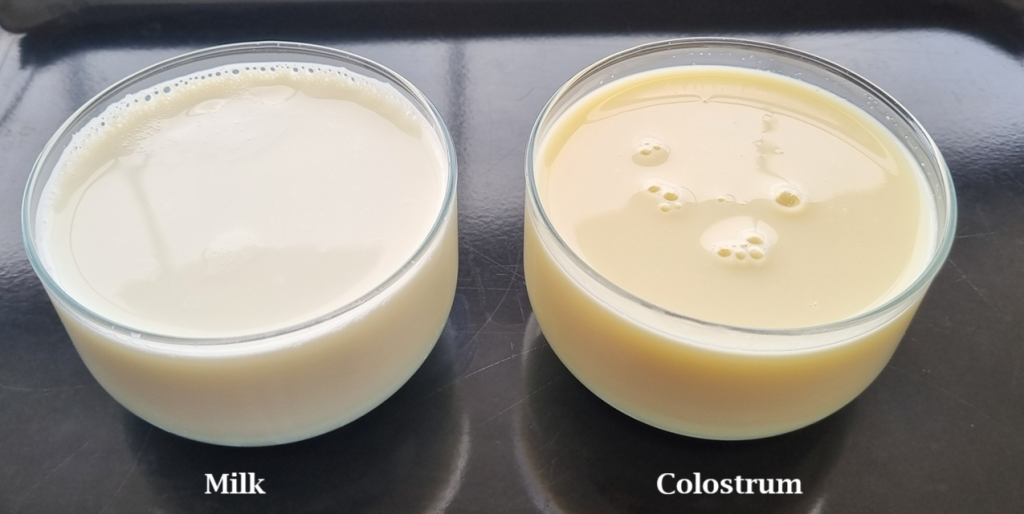
The colostrum in the picture was obtained by combining the colostrums milked during the first 4 days. The colostrum milked on the first day is quite thick and more yellow. Its consistency and color return to normal as the days go by. The milk is UHT milk produced by a commercial brand.
Finding colostrum in large cities can be difficult. One advantage of living in Bayburt is having easy access to natural foods like this. My sincere thanks to Yahya, who brought the colostrum just one day after I asked for it.
Colostrum contains nutritional molecules such as protein, carbohydrates, fat, vitamins and minerals as well as high amounts of biologically active molecules necessary for the immune and growth functions of the body.
Colostrum contains immunoglobulins, growth factors, antibodies, vitamins, minerals, enzymes, amino acids and other substances that prepare the body to face microorganisms and environmental toxins.
Research shows that newborn mammals need colostrum not only to build immune systems in the first 24 hours of their lives but also to support optimal metabolic functions. It is thought to initiate approximately 50 different processes in infants.
Some bioactive components of bovine colostrum are similar to those in human colostrum. However, this similarity does not mean that bovine colostrum can be used in place of a mother’s colostrum or breast milk for infant feeding (WHO, 2023). The immune and growth factors in bovine colostrum are almost the same as those in human colostrum and immune factors in cow colostrum are 4 times higher than in human colostrum.
Recent studies have found that bovine colostrum contains protease inhibitors that protect immunoglobulins from breakdown by human digestive enzymes. A study conducted in Amsterdam in 1975 reported that bovine colostrum contains glycoproteins that protect it from damage caused by gastric acids.
Composition of Colostrum
Colostrum has more total solids, fat, solids-not-fat, protein and, most importantly, a higher concentration of immunoglobulins (Ig) than milk. While the rate of dry matter in a normal cow’s milk is around 12 %, this ratio is around 22-28 % in colostrum. On the other hand, the lactose ratio is lower than in normal milk.
Colostrum is also a rich source of vitamins A, D, E and B12, as well as minerals. It contains energy sources in the form of fat and sugar that help maintain body temperature, a trypsin inhibitor that prevents the breakdown of immunoglobulins in the intestine, and protein particles that facilitate their absorption.
Comparison of colostrum and milk (gram/liter)
| Component | Colostrum | Milk |
| Dry matter (%) | 14,1-23,9 | 12,6 |
| Fat (%) | 3,9-6,7 | 3,7 |
| Fat-free dry matter (%) | 9,8-16,7 | 9,6 |
| Total protein (%) | 5,1-14,0 | 3,4 |
| Casein (%) | 5,2 | 2,6 |
| Albumin (%) | 1,5 | 0,47 |
| Lactose (%) | 3,3-4,7 | 4,7 |
| Minerals (%) | 0,81-1,03 | 0,74 |
| Ca (%) | 0,26 | 0,13 |
| P (%) | 0,24 | 0,11 |
| Mg (%) | 0,04 | 0,01 |
| K (%) | 0,14 | 0,15 |
| Na (%) | 0,07 | 0,04 |
| Cl (%) | 0,12 | 0,07 |
| Fe (mg/100 g) | 0,20 | 0,01-0,07 |
| Cu (mg/100 g) | 0,06 | 0,01-0,03 |
| Co (mg/100 g) | 0,5 | 0,05-0,06 |
| Mn (mg/100 g) | 0,016 | 0,0003 |
| Vitamin A (mg/g fat) | 42-48 | 8 |
| Vitamin D (IU/g fat) | 0,9-1,8 | 0,6 |
| Vitamin E (mg/g fat) | 100-150 | 20 |
| Thiamine, B1 (mg/100 g) | 60-100 | 40 |
| Riboflavin, B2 (mg/100 g) | 450 | 150 |
| Nicotinic acid, B3 (mg/100 g) | 80-100 | 80 |
| Pantothenic acid, B5 (mg/100 g) | 200 | 350 |
| Biotin, Vitamin H (mg/100 g) | 2-8 | 2 |
| Choline (mg/100 g) | 37-69 | 14 |
| Vitamin B12 (mg/100g) | 1-5 | 0,5 |
| Folic acid (mg/100g) | 0,1-0,8 | 0,1 |
| Ascorbic acid, Vitamin C (mg/100g) | 2,5 | 2 |
The highest-quality colostrum is collected immediately after birth. Its quality gradually decreases with subsequent milkings until mature milk is produced. Although the timing varies between animals, this transition generally takes place within 24–48 hours.
The two most important components in colostrum are immune and growth factors.
Immune Factors
Immune factors are substances that reduce the effect of bacteria, viruses, fungi, protozoa, and microorganisms that cause some diseases, protect the body from diseases and help the body.
While some immune factors have very specific functions, such as promoting a particular process or stimulating the production of an active substance in the body, others protect the entire immune system or an important part of it.
It is the only food ingredient that provides these preventive and protective factors. The most important and common immune factors found in colostrum are immunoglobulins and antibodies.
Immunoglobulins; are the primary active ingredients in bovine colostrum. Immunoglobulins provide superior protection in both the treatment and prevention of viral and bacterial infections and allergies.
There are 5 types of immunoglobulins in colostrum; IgA, IgD, IgE, IgG and IgM. Bovine colostrum contains mostly IgG and small amounts of IgA, IgD, IgE and IgM. While human colostrum contains 2% of IgG in immunoglobulins, cow colostrum contains 38%.
Immunoglobulin concentration (gram/liter)
| Immunoglobulins | Colostrum | Milk |
|---|---|---|
| IgG1 | 52,0-87,0 | 0,31-0,40 |
| IgG2 | 1,6-2,1 | 0,03-0,08 |
| IgA | 3,2-6,2 | 0,04-0,06 |
| IgM | 3,7-6,1 | 0,03-0,06 |
IgG; is used in the treatment of diseases such as infectious diarrhea, anemia, chicken pox, chronic fatigue syndrome, hepatitis, multiple sclerosis, neutropenia and systemic lupus.
Antibodies; it is stated in the literature that colostrum contains specific antibodies against more than 192 pathogens such as Rotavirus, H.pylori, Cryptosporidium, Salmonella, Candida, Streptococcus, Staphylococcus and E.coli.
Proline-Rich Polypeptide PRP; supports the weakened immune system and helps regulate the thymus gland, which produces T-cells. It also has a critical role in autoimmune disorders by supporting the immune system defense and softening the reaction that defines these disorders.
Lactoferrin; is an iron-binding protein and has natural antibacterial and antiviral effects. It protects the body against candida, cancer, chronic fatigue syndrome, HIV, herpes and other infections.
Cytokines; although cytokines are cancer-fighting agents, they are substances that have antiviral properties and regulate the duration and intensity of the immune response.
Glycoproteins and Trypsin Inhibitors; glycoproteins and trypsin inhibitors protect immune and growth factors in colostrum from damage in the intestinal tract and gastric juice.
Oligosaccharides and Glycoconjugates; these sugars bind to various pathogens and act against them, preventing the pathogens from entering and affecting the intestinal mucous membrane.
Other immune factors found in bovine colostrum; Lysozymes that protect the body from bacterial infections, -2-AP glycoprotein, – 1 antitrypsin, -1- fetoprotein, -2-macroglobulin albumin, lactoglobulin, -2-microglobulin, C3, C4, enzymes, hemopexin, haptoglobin, lactoperoxidase, orosomucoids, orotic acid and prealbumin.
Growth Factors
The primary effects of growth factors are;
– Increasing the healing effect by building,
– Protecting and repairing bone, muscles, nerves and cartilage,
– Stimulating fat metabolism,
– Balancing blood sugar levels and
– Helping to regulate brain chemicals that control mood.
Growth factors also help slow the signs of aging, reduce wrinkles and make the skin look younger.
Growth factors concentration (µg/L)
| Growth Factor | Colostrum | Milk |
|---|---|---|
| IGF I | 50-2000 | <10 |
| IGF II | 200-600 | <10 |
| TGF 1 | trace | 4,3 |
| TGF 2 | trace | trace |
| EGF | trace | <2 |
Insulin-like Growth Factors I and II; IGF I and IGF II are the most abundant growth factors in colostrum. These factors are effective in how the body uses fat, protein and sugar to stimulate the immune system, support cell regeneration and help regulate blood sugar and cholesterol levels.
Transforming Growth Factor (TGF); Helps repair tissues and supports the progression of intestinal development. It shows promising results in bones and the treatment of wounds.
Epidermal Growth Factor EGF; is a protein substance used in the formation, protection and maintenance of the skin.
Fibroblast Growth Factor FGF; fulfills its auxiliary function by increasing the binding ability of insulin-like growth factors by 60-70%.
Other growth factors found in colostrum; these include mammary-derived growth factors, erythropoietin, taurine, ethanolamine and interferon.
Health Benefits of Colostrum
Due to the nutritional and improving properties of colostrum on offspring, as well as the immune and growth factors it contains, it can be used by people who are very young or old, have AIDS, cancer, candida, respiratory diseases and weakened immune systems.
The consumption of colostrum as a natural healing agent dates back to ancient times. Thousands of years ago, doctors and holy men in India were using cow colostrum for both physical and spiritual healing.
In America, it was used because of its natural antibiotic properties before the emergence of antibiotics. In the 1950s, doctors were frequently using colostrum in the treatment of rheumatoid arthritis.
Albert Sabin, who discovered the polio vaccine, isolated anti-polio antibodies from cow colostrum and developed a successful vaccine in 1962. After these initial studies, many studies have been conducted around the world. Studies have given a lot of information about the healing effect of colostrum, its composition and its ability to fight diseases.
Although more research is needed in the area of cancer prevention, numerous studies show promising results in the use of these agents against cancer.
In human life, after youth, the secretion of growth hormones produced by the body, which is necessary for cell reproduction and survival, decreases. It is stated that the use of colostrum together with a nutritious diet, regular exercise, reduction of stress and a regular lifestyle that includes other healthy habits protects individuals against aging and also has an effect on the reduction of skin wrinkles.
Athletes are the individuals who benefit most from colostrum. It is used by athletes in sports that require heavy training and muscle development is extremely necessary.
Colostrum is commercially available in capsule, powder, tablet and liquid form, especially in the United States, Canada, Japan and European Union countries. In addition, it can be added to kefir, yogurt and protein-containing foodstuffs.
Although there is no industrial production of bovine colostrum forms in Turkey, they can be imported. Apart from this, it is consumed locally by making desserts at calf births.
As a result, it makes us feel good, destroys disease-causing microorganisms such as viruses and bacteria, accelerates healing, helps to burn fat, increases the performance of athletes and provides immunity.
Colostrum, which is a natural food for humans, can be used successfully and reliably in the treatment of many diseases and the elimination of symptoms.
Some researchers state that humans should not consume colostrum because calves need colostrum. It should not be forgotten that a cow can produce between 28 and 42 liters of colostrum after birth. Studies have shown that the calf needs about 14 liters for healthy growth. When viewed from this angle, a cow can produce sufficient levels of colostrum in terms of both the calf’s health and its use as human food.
Colostrum is a type of milk that does not tolerate heat very well. When heated, it curdles, solidifies and cannot be poured into a glass and drunk. In addition, the fact that colostrum has a heavier taste and aroma than milk also limits its consumption. Anatolia has 2-3 different methods of preparing colostrum for consumption. The most widely known and done of these is to cook it after adding sugar. For a recipe explaining how to cook colostrum, see How to Cook Colostrum?
References
Metin, M. (2014). Süt Teknolojisi: Sütün Bileşimi ve İşlenmesi (13. baskı). Ege Üniversitesi Basımevi.
Üçüncü, M. (2024). Süt ve Mamülleri Teknolojisi (8. baskı). Sidas Medya.
Bodyfelt, F. W., Tobias, J., & Trout, G. M. (1988). The Sensory Evaluation of Dairy Products. Van Nostrand Reinhold.
Henderson, D. R., & Mitchell, D. (2000). Colostrum: Nature’s Healing Miracle. CNR Publications.
Yıldız, G. (2001). Buzağı besleme ilkeleri. İçinde A. Ergün ve Ş. D. Tuncer (Ed.), Hayvan Besleme ve Beslenme Hastalıkları (1. baskı, s. 129). Medipres.
Bayarer, M., Karagözlü, C., & Akbulut, N. (2006). İnsan beslenmesinde kolostrumun önemi ve kullanım olanakları. Harran Üniversitesi Ziraat Fakültesi Dergisi, 10(3–4), 11–21.
Elfstrand, L., Lindmark-Månsson, H., Paulsson, M., Nyberg, L., & Åkesson, B. (2002). Immunoglobulins, growth factors and growth hormone in bovine colostrum and the effects of processing. International Dairy Journal, 12(11), 879–887.
Florén, C.-H., Chinenye, S., Elfstrand, L., Hagman, C., & Ihse, I. (2006). ColoPlus, a new product based on bovine colostrum, alleviates HIV-associated diarrhoea. Scandinavian Journal of Gastroenterology, 41(6), 682–686.
Yu Huaning, Li Yunfei, Ardil Abdukerim, & Long Weiyun. (2011). Effects of low temperature spray drying conditions on physical properties of bovine colostrum powders. ASABE Annual International Meeting, Louisville, Kentucky (Paper No. 1110891).
Uruakpa, F. O., Ismond, M. A. H., & Akobundu, E. N. T. (2002). Colostrum and its benefits: a review. Nutrition Research, 22(6), 755–767.
Pakkanen, R., & Aalto, J. (1997). Growth factors and antimicrobial factors of bovine colostrum. International Dairy Journal, 7(5), 285–297.
Arslan, A., Kaplan, M., Duman, H., Bayraktar, A., Ertürk, M., Henrick, B. M., Frese, S. A., & Karav, S. (2021). Bovine Colostrum and Its Potential for Human Health and Nutrition. Frontiers in Nutrition, 8, 651721.
Hajihashemi, P., Haghighatdoost, F., Kassaian, N., Rahim Khorasani, M., Hoveida, L., Nili, H., Tamizifar, B., & Adibi, P. (2024). Therapeutics effects of bovine colostrum applications on gastrointestinal diseases: a systematic review. Systematic Reviews, 13, 76.
World Health Organization. (2023). Early initiation of breastfeeding to promote exclusive breastfeeding.

Halil İbrahim Akgül
Halil Ibrahim Akgul, Ph.D., is an Assistant Professor of Food Engineering at Bayburt University, where he works in the Division of Food Sciences within the Faculty of Engineering. He received his B.Sc. in Food Engineering from Akdeniz University in 2010, followed by an M.Sc. and a Ph.D. in Food Engineering from Atatürk University in 2015 and 2020, respectively. His formally recognised academic fields are Food Sciences and Engineering, Food Technologies, Dairy and Dairy Products Technology, and Food Microbiology.
Dr. Akgul has more than fifteen years of professional, research, and academic experience in food science. Between 2011 and 2013, he worked as the food engineer responsible for operations at the Pilot Dairy and Bread Factory of Atatürk University’s Directorate of Agricultural Enterprises. This industrial experience, combined with his subsequent academic research, gave him extensive practical and scientific knowledge of milk processing, dairy production, food quality, hygiene, and product development.
His research is primarily focused on milk and dairy products, dairy microbiology, starter cultures, lactic acid bacteria, exopolysaccharides, butter technology, and the physicochemical, microbiological, sensory, and nutritional properties of foods. His studies have examined the quality and fatty-acid composition of traditional butter, aroma formation in butter produced with different starter cultures, raw-milk quality, the characterisation and antioxidant activity of bacterial exopolysaccharides, traditional dairy products such as çökelek and karın kaymağı, colostrum powder, and the use of fruit-derived ingredients in ice cream production.
His academic record includes peer-reviewed research articles published in national and international journals, including Mljekarstvo, Acta Scientiarum Technology, the Journal of Food Safety and Food Quality, the International Journal of Food Engineering, the Atatürk University Journal of Agricultural Faculty, and ATA Food Journal. Four of the research articles currently listed in his university profile were published in SCI-Expanded-indexed journals. He has also contributed to twelve national and international conference papers and presentations covering dairy products, food microbiology, butter quality, fatty-acid composition, starter cultures, exopolysaccharide-producing bacteria, colostrum, traditional foods, and functional ice-cream formulations.
Dr. Akgul has participated as a researcher or adviser in eleven completed scientific and applied research projects. These projects have addressed the modernisation of pilot dairy-processing facilities; the production and quality characteristics of colostrum powder; the physicochemical and microbiological quality of butter and raw milk; the identification of exopolysaccharide-producing lactic acid bacteria; the development and production optimisation of starter cultures for mould-ripened cheese; the standardisation of traditional dairy products; and the use of sloe berry and persimmon fibre in ice-cream production.
His teaching experience spans undergraduate, associate-degree, and graduate education. The courses he has taught include Food Chemistry, Analytical Chemistry, General Chemistry, Organic Chemistry, Fermented Dairy Products Technology, Butter Production and Processing Technology, Healthy Living and Nutrition, Organic Agriculture and Food, Popular Science, Digital Literacy, and Information Technologies. Through these courses, he combines fundamental food chemistry and engineering principles with dairy technology, nutrition, scientific literacy, and the practical communication of scientific knowledge.
He is the founder and Editor-in-Chief of Gıda ve Sağlık, a multilingual digital publication devoted to food, nutrition, health, food chemistry, food microbiology, and culinary science. Through this platform, he draws upon his academic background, teaching experience, research activity, and practical knowledge of food production to present scientifically grounded information in a detailed and accessible form for an international readership.