
Over the past 150 years, nearly 50,000 scientific publications on lactic acid bacteria have appeared in SCI-indexed journals, including 3,453 articles published in 2023 alone (Web of Science, 2024). Today, thousands of scientists continue to study the subject intensively, and important discoveries are still being made.
Given that the global starter culture market, in which lactic acid bacteria play a central role, is worth billions, the importance of this group of microorganisms becomes clear.
Unfortunately, a definitive definition and family-level classification of lactic acid bacteria are difficult to establish. Recent taxonomic developments and accumulated genetic data suggest that they represent ancient Bacillus-like soil organisms that adapted to new, nutrient-rich ecological environments.
Although they lost many metabolic activities during adaptation, their fermentation systems, acid production and acid tolerance have enabled lactic acid bacteria to compete effectively with other microorganisms.
According to the biological classification;
LABs are members of;
- Bacteria kingdom,
- Firmicutes phylum,
- Bacilli class,
- Lactobacillales order.
The image below shows the traditional family and genus classification of these bacteria, together with some of their distinguishing characteristics.
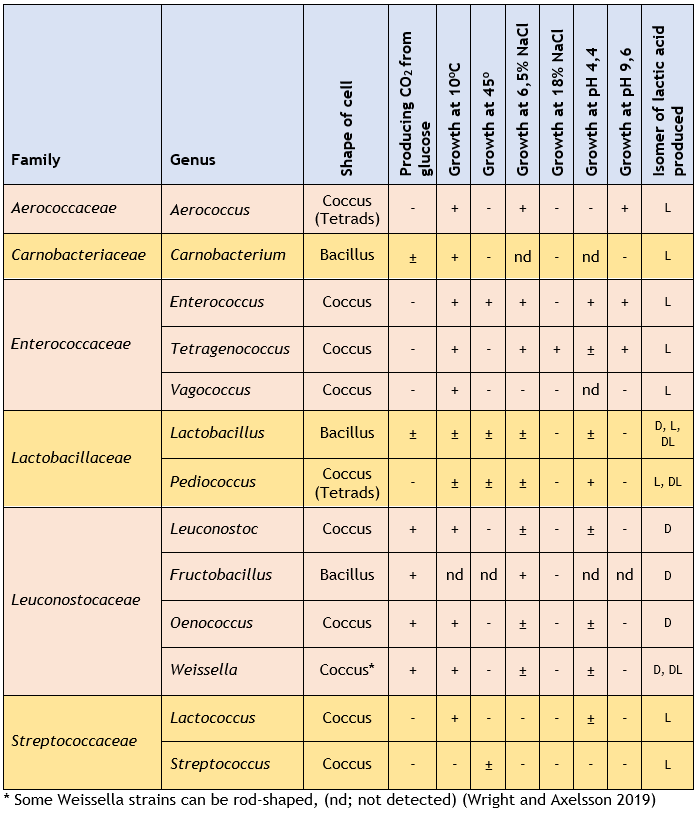
Changes in the Classification of Lactic Acid Bacteria Since 2020
The image above reflects a classification of lactic acid bacteria that was used for many years. As genome sequencing advanced, it became clear that the species grouped under Lactobacillus were more diverse than their shared name suggested. Zheng and colleagues (2020) reorganized the former broad genus into 25 genera: the redefined Lactobacillus, the previously described Paralactobacillus, and 23 new genera proposed in their study.
These changes also affect the species names encountered later in this article. The species formerly known as Lactobacillus casei and L. rhamnosus are now called Lacticaseibacillus casei and Lacticaseibacillus rhamnosus, respectively. Likewise, L. plantarum became Lactiplantibacillus plantarum, L. brevis became Levilactobacillus brevis, and L. reuteri became Limosilactobacillus reuteri.
Lactobacillus kefir, found in kefir, was renamed Lentilactobacillus kefiri in the 2020 taxonomic revision. The two species used as examples in the discussion of genome size, L. sanfranciscensis and L. parakefiri, are now named Fructilactobacillus sanfranciscensis and Lentilactobacillus parakefiri. Other species, including Lactobacillus acidophilus, L. delbrueckii, L. helveticus, L. johnsonii, and Lactobacillus kefiranofaciens, remain in Lactobacillus. In other words, the genus name did not change for every species once placed there.
The revision went beyond genus names. Leuconostocaceae, shown as a separate family in the image, was incorporated into an expanded Lactobacillaceae in the 2020 classification. The image’s Lactobacillus row also represents the genus in its former broad sense. Its characteristics should therefore not be read as traits shared by every species now assigned to different genera.
A further change to the genus Lactococcus followed in 2021. Li and colleagues elevated Lactococcus lactis subsp. cremoris to species rank as Lactococcus cremoris. This is separate from Zheng and colleagues’ 2020 revision and does not change the names Lactococcus lactis subsp. lactis or Leuconostoc mesenteroides subsp. cremoris. These revisions explain why older scientific publications still use the previous names.
| Former name | Current name |
| Lactobacillus casei | Lacticaseibacillus casei |
| Lactobacillus plantarum | Lactiplantibacillus plantarum |
| Lactobacillus rhamnosus | Lacticaseibacillus rhamnosus |
| Lactobacillus brevis | Levilactobacillus brevis |
| Lactobacillus reuteri | Limosilactobacillus reuteri |
| Lactobacillus kefir | Lentilactobacillus kefiri |
| Lactobacillus sanfranciscensis | Fructilactobacillus sanfranciscensis |
| Lactobacillus parakefiri | Lentilactobacillus parakefiri |
| Lactococcus lactis subsp. cremoris | Lactococcus cremoris |
Sources: Zheng et al. (2020), https://doi.org/10.1099/ijsem.0.004107; Li et al. (2021), https://doi.org/10.1099/ijsem.0.004727.
Some Characteristics of Lactic Acid Bacteria
Lactic acid bacteria from the genera Carnobacterium, Enterococcus, Lactobacillus (dairy, meat, vegetable and cereal products), Lactococcus (dairy products), Leuconostoc (vegetables and dairy products), Oenococcus (wine), Pediococcus (vegetables and meat products), Streptococcus and Weissella (dairy products) are commonly used as starter cultures in the food industry.
Lactic acid bacteria are generally non-spore-forming, heterotrophic, anaerobic, microaerophilic, Gr (+), immobile, rod or spherical-shaped bacteria with relatively high acid resistance. The G+C ratio in their DNA is below 55%. LAB genomes are characterized by small sizes ranging from 1.23 Mb (Lactobacillus sanfranciscensis) to 4.91 Mb (Lactobacillus parakefiri).
By fermenting carbohydrates in a homofermentative or heterofermentative way, they can produce acetic acid, formic acid, ethanol and CO2, although the main product is lactic acid. According to optimum growth temperatures, LAB can be divided into mesophilic and thermophilic.
Mesophilic LAB can grow optimally at 20-30oC, while thermophilic LAB can grow optimally between 30-45oC. This is probably why products from Western and Northern European countries have predominantly mesophilic LABs, while products from subtropical countries have thermophilic LAB.
Milk and plants (vegetables, fruits and grains) form the natural habitats of lactic acid bacteria. However, they can also be found naturally on warm-blooded animals’ mucosal surfaces, such as the oral cavity, intestine and colon.
A LAB strain can be isolated from many different environments, including humans, plants, animals and dairy products. This reflects the wide distribution and strong adaptability of LAB. Despite their GRAS (Generally Recognized As Safe) status, increasing antibiotic resistance and the potential transfer of this resistance to pathogenic bacteria pose a risk that should not be overlooked.
Since lactic acid bacteria lack cytochrome and electron transport proteins, they cannot obtain energy through aerobic respiration. Therefore, substrate-level phosphorylation reactions during glycolysis are the primary source of ATP.
Although there are significant differences in how some genera and species use and metabolize certain carbohydrates, lactic acid bacteria generally lack metabolic diversity. Lactic acid bacteria can ferment carbohydrates in two ways.
Homofermentative LABs metabolize the carbon source via the Embden-Meyerhof-Parnas (EMP) pathway, producing 2 moles of ATP and 2 moles of pyruvate per mole of hexose. Pyruvate is then reduced to lactate by lactate dehydrogenase, converting over 90% of the initial hexose to lactic acid.
Heterofermentative LAB metabolize carbohydrates through the pentose phosphate, Leloir and phosphoketolase pathways, producing 1 mole of ATP, at least 50% lactic acid, and 30–50% ethyl alcohol and/or acetic acid, together with CO2.
LABs are well adapted to using lactose as a source of energy and carbon and using casein as a nitrogen source. Lactic acid bacteria, which cannot use inorganic nitrogen, can metabolize proteins and peptides to meet their amino acid requirements.
Lactic acid bacteria have highly efficient systems that break casein subfractions into smaller fragments, supplying the amino acids needed for growth. In addition to supporting growth, their proteolytic activity has a strong influence on ripening and flavor, particularly in cheese production.
In general, lactic acid bacteria have very low lipolytic activity, mainly acting on mono- and diglycerides. In some cheeses and in butter, a limited degree of lipolysis may be desirable to increase the concentration of volatile fatty acids and develop the characteristic taste and aroma.
Although citrate metabolism leading to diacetyl (butter aroma) and acetoin/2,3-butanediol is common in many LAB, the genera Lactococcus and Leuconostoc are particularly important technologically.
Citrate metabolism is the most important factor in forming aroma and flavor in dairy products. Citrate metabolism requires large amounts of pyruvate relative to the NAD+ regeneration requirement.
The needed pyruvate is provided by the breakdown of citrate naturally found in milk (~1.5 mg/mL). The important point here is that the pH of the environment must be lower than 6.0 for citrate to be taken into the cell.
LAB contribute to aroma formation in fermented products through three main metabolic pathways: glycolysis, lipolysis and proteolysis. Lactate is the main product of lactose conversion, while some of the intermediate pyruvate is converted through alternative routes into compounds such as diacetyl, acetoin, acetaldehyde or acetic acid.
LAB contributes relatively little to lipolysis, but proteolysis is the key biochemical pathway for flavor formation. The degradation of caseins by rennet enzymes and cell envelope proteinases and peptidases produces small peptides and free amino acids.
For specific flavor development, these amino acids can also be converted to various alcohols, aldehydes, acids, esters and sulfur compounds.
Lactic acid bacteria species used as starter culture in dairy products are given in the table below;
| Species | Dairy Product | Role | Reference |
| Lactococcus lactis ssp. lactis | butter, cheese, and buttermilk | acidity, bacteriocin production | Akgül (2020), Broome et al. (2003), Wouters et al. (2002) |
| Lactococcus lactis ssp. lactis biovar diacetylactis | butter, gouda, edam, sour cream, buttermilk | acidity and aroma | Akgül (2020), Wood (1997), Leroy and De Vusyt (2004) |
| Lactococcus cremoris | butter, some cheese types, buttermilk | acidity | Akgül (2020), Weerkamp et al. (1996) |
| Streptococcus thermophilus | yogurt, some hard and semi-hard cheese types, | acidity | Broome et al. (2003), Beresford et al. (2001) |
| Lactobacillus acidophilus | yogurt, kefir, butter, and some cheese types | probiotic character | Erkaya et al. (2015), Briggiler-Marcó et al. (2007) |
| Lactobacillus delbrueckii ssp. bulgaricus | yogurt, grana, emmental, mozzarella, taiogga, kefir | acidity | Slattery et al. (2010), Accolas and Auclair (1983), Dellaglio et al. (1994), Kılıç (2014) |
| Lactobacillus delbrueckii ssp. lactis | some cheese types | acidity | Broome et al. (2003), Giraffa et al. (2010) |
| Lactobacillus helveticus | cheddar, kefir | aroma | Slattery et al. (2010) |
| Lacticaseibacillus casei | some cheese types, kefir | probiotic character | Minelli et al (2004), Kongo (2013) |
| Lactiplantibacillus plantarum | yogurt, some cheese types | probiotic character | Leroy and De Vusyt (2004) |
| Lacticaseibacillus rhamnosus | butter, some cheese types | probiotic character, exopolysaccharide production | Akgül (2020), Coppola et al. (2005) |
| Levilactobacillus brevis | feta, kefir | aroma | Terzić-Vidojević et al. (2015), Leroy and De Vuyst (2004) |
| Limosilactobacillus reuteri | cheddar | exopolysaccharide production | Lynch et al. (2014) |
| Lactobacillus johnsonii | yogurt | probiotic character | Leroy and De Vusyt (2004) |
| Lentilactobacillus kefiri | kefir | probiotic character | Leroy and De Vusyt (2004) |
| Lactobacillus kefiranofaciens | kefir | probiotic character | Leroy and De Vusyt (2004) |
| Leuconostoc mesenteroides ssp. cremoris | butter, sour cream, some cheese types, edam, gouda, kefir | aroma | Akgül (2020), Weerkamp et al. (1996) Slattery et al. (2010) |
| Enterococcus faecium | some cheese types, Izmir tulum cheese | aroma, probiotic character | Terzić-Vidojević et al. (2015), Yerlikaya and Akbulut (2019) |
| Enterococcus faecalis | Iran UF cheese, cebreiro | aroma, probiotic character | Pirouzian et al. (2012), Centeno et al. (1999) |
| Enterococcus durans | Izmir tulum cheese | probiotic character | Yerlikaya and Akbulut (2019) |
| Weissella cibaria | cheddar | exopolysaccharide production | Lynch et al. (2014) |
References
Akgül, H. İ. (2020). Tereyağlarından ekzopolisakkarit (EPS) üreten laktik asit bakterilerinin izolasyonu ve tereyağı üretiminde starter kültür olarak kullanılabilirliğinin araştırılması. Atatürk Üniversitesi, Fen Bilimleri Enstitüsü.
Erkmen, O. (Ed.). (2021). Gıda Mikrobiyolojisi (6. baskı). Efil Yayınevi.
Ray, B., & Bhunia, A. (2021). Temel Gıda Mikrobiyolojisi (5. baskıdan çeviri; D. Heperkan, Çev. Ed.). Nobel Akademik Yayıncılık.
Kılıç, S. (2014). Süt Endüstrisinde Laktik Asit Bakterileri (3. baskı). Ege Üniversitesi Basımevi.
Wood, B. J. B. (Ed.). (1997). Microbiology of Fermented Foods (2nd ed.). Blackie Academic & Professional.
Broome, M. C., Powell, I. B., & Limsowtin, G. K. Y. (2003). Starter cultures: Specific properties. In H. Roginski, J. W. Fuquay, & P. F. Fox (Eds.), Encyclopedia of Dairy Sciences (pp. 269–275). Academic Press.
Dellaglio, F., de Roissart, H., Torriani, S., Curk, M. C., & Janssens, D. (1994). Caractéristiques générales des bactéries lactiques. In H. de Roissart & F. M. Luquet (Eds.), Bactéries lactiques (Vol. 1, pp. 25–70). Lorica.
Kongo, J. M. (2013). Lactic Acid Bacteria as Starter-Cultures for Cheese Processing: Past, Present and Future Developments. In J. M. Kongo (Ed.), Lactic Acid Bacteria—R & D for Food, Health and Livestock Purposes. IntechOpen.
Wouters, J. T. M., Ayad, E. H. E., Hugenholtz, J., & Smit, G. (2002). Microbes from raw milk for fermented dairy products. International Dairy Journal, 12(2–3), 91–109.
Beresford, T. P., Fitzsimons, N. A., Brennan, N. L., & Cogan, T. M. (2001). Recent advances in cheese microbiology. International Dairy Journal, 11(4–7), 259–274.
Leroy, F., & De Vuyst, L. (2004). Lactic acid bacteria as functional starter cultures for the food fermentation industry. Trends in Food Science & Technology, 15(2), 67–78.
Weerkamp, A. H., Klijn, N., Neeter, R., & Smit, G. (1996). Properties of mesophilic lactic acid bacteria from raw milk and naturally fermented raw milk products. Netherlands Milk and Dairy Journal, 50(2), 319–332.
Erkaya, T., Ürkek, B., Doğru, Ü., Çetin, B., & Şengül, M. (2015). Probiotic butter: Stability, free fatty acid composition and some quality parameters during refrigerated storage. International Dairy Journal, 49, 102–110.
Briggiler-Marcó, M., Capra, M. L., Quiberoni, A., Vinderola, G., Reinheimer, J. A., & Hynes, E. (2007). Nonstarter Lactobacillus strains as adjunct cultures for cheese making: In vitro characterization and performance in two model cheeses. Journal of Dairy Science, 90(10), 4532–4542.
Slattery, L., O’Callaghan, J., Fitzgerald, G. F., Beresford, T., & Ross, R. P. (2010). Invited review: Lactobacillus helveticus—A thermophilic dairy starter related to gut bacteria. Journal of Dairy Science, 93(10), 4435–4454.
Accolas, J. P., & Auclair, J. (1983). Thermophilic lactic starters. Irish Journal of Food Science and Technology, 7(1), 27–38.
Giraffa, G., Chanishvili, N., & Widyastuti, Y. (2010). Importance of lactobacilli in food and feed biotechnology. Research in Microbiology, 161(6), 480–487.
Bertazzoni Minelli, E., Benini, A., Marzotto, M., Sbarbati, A., Ruzzenente, O., Ferrario, R., Hendriks, H., & Dellaglio, F. (2004). Assessment of novel probiotic Lactobacillus casei strains for the production of functional dairy foods. International Dairy Journal, 14(8), 723–736.
Coppola, R., Succi, M., Tremonte, P., Reale, A., Salzano, G., & Sorrentino, E. (2005). Antibiotic susceptibility of Lactobacillus rhamnosus strains isolated from Parmigiano Reggiano cheese. Le Lait, 85, 193–204.
Terzić-Vidojević, A., Tonković, K., Leboš Pavunc, A., Beganović, J., Strahinić, I., Kojić, M., Veljović, K., Golić, N., Kos, B., Čadež, N., Gregurek, L., Šušković, J., Raspor, P., & Topisirović, L. (2015). Evaluation of autochthonous lactic acid bacteria as starter cultures for production of white pickled and fresh soft cheeses. LWT—Food Science and Technology, 63(1), 298–306.
Lynch, K. M., McSweeney, P. L. H., Arendt, E. K., Uniacke-Lowe, T., Galle, S., & Coffey, A. (2014). Isolation and characterisation of exopolysaccharide-producing Weissella and Lactobacillus and their application as adjunct cultures in Cheddar cheese. International Dairy Journal, 34(1), 125–134.
Yerlikaya, O., & Akbulut, N. (2019). Potential use of probiotic Enterococcus faecium and Enterococcus durans strains in Izmir Tulum cheese as adjunct culture. Journal of Food Science and Technology, 56(4), 2175–2185.
Rasouli Pirouzian, H., Hesari, J., Farajnia, S., Moghaddam, M., & Ghiassifar, Sh. (2012). Effects of Enterococcus faecalis and Enterococcus faecium, Isolated from Traditional Lighvan Cheese, on Physicochemical and Sensory Characteristics of Iranian UF White Cheese. Journal of Agricultural Science and Technology, 14(5), 1023–1034.
Centeno, J. A., Menéndez, S., Hermida, M., & Rodríguez-Otero, J. L. (1999). Effects of the addition of Enterococcus faecalis in Cebreiro cheese manufacture. International Journal of Food Microbiology, 48(2), 97–111.
Zheng, J., Wittouck, S., Salvetti, E., Franz, C. M. A. P., Harris, H. M. B., Mattarelli, P., O’Toole, P. W., Pot, B., Vandamme, P., Walter, J., Watanabe, K., Wuyts, S., Felis, G. E., Gänzle, M. G., & Lebeer, S. (2020). A taxonomic note on the genus Lactobacillus: Description of 23 novel genera, emended description of the genus Lactobacillus Beijerinck 1901, and union of Lactobacillaceae and Leuconostocaceae. International Journal of Systematic and Evolutionary Microbiology, 70(4), 2782–2858.
Li, T. T., Tian, W. L., & Gu, C. T. (2021). Elevation of Lactococcus lactis subsp. cremoris to the species level as Lactococcus cremoris sp. nov. and transfer of Lactococcus lactis subsp. tructae to Lactococcus cremoris as Lactococcus cremoris subsp. tructae comb. nov.. International Journal of Systematic and Evolutionary Microbiology, 71(3), 004727.
Clarivate. (n.d.). Web of Science Core Collection.
LPSN. (n.d.). Order Lactobacillales. Leibniz Institute DSMZ.
IUBMB. (n.d.). EC 1.1.1.27: L-lactate dehydrogenase.
Here’s an article that might interest you; Starter Cultures; History, Definition and Classification

Halil İbrahim Akgül
Halil Ibrahim Akgul, Ph.D., is an Assistant Professor of Food Engineering at Bayburt University, where he works in the Division of Food Sciences within the Faculty of Engineering. He received his B.Sc. in Food Engineering from Akdeniz University in 2010, followed by an M.Sc. and a Ph.D. in Food Engineering from Atatürk University in 2015 and 2020, respectively. His formally recognised academic fields are Food Sciences and Engineering, Food Technologies, Dairy and Dairy Products Technology, and Food Microbiology.
Dr. Akgul has more than fifteen years of professional, research, and academic experience in food science. Between 2011 and 2013, he worked as the food engineer responsible for operations at the Pilot Dairy and Bread Factory of Atatürk University’s Directorate of Agricultural Enterprises. This industrial experience, combined with his subsequent academic research, gave him extensive practical and scientific knowledge of milk processing, dairy production, food quality, hygiene, and product development.
His research is primarily focused on milk and dairy products, dairy microbiology, starter cultures, lactic acid bacteria, exopolysaccharides, butter technology, and the physicochemical, microbiological, sensory, and nutritional properties of foods. His studies have examined the quality and fatty-acid composition of traditional butter, aroma formation in butter produced with different starter cultures, raw-milk quality, the characterisation and antioxidant activity of bacterial exopolysaccharides, traditional dairy products such as çökelek and karın kaymağı, colostrum powder, and the use of fruit-derived ingredients in ice cream production.
His academic record includes peer-reviewed research articles published in national and international journals, including Mljekarstvo, Acta Scientiarum Technology, the Journal of Food Safety and Food Quality, the International Journal of Food Engineering, the Atatürk University Journal of Agricultural Faculty, and ATA Food Journal. Four of the research articles currently listed in his university profile were published in SCI-Expanded-indexed journals. He has also contributed to twelve national and international conference papers and presentations covering dairy products, food microbiology, butter quality, fatty-acid composition, starter cultures, exopolysaccharide-producing bacteria, colostrum, traditional foods, and functional ice-cream formulations.
Dr. Akgul has participated as a researcher or adviser in eleven completed scientific and applied research projects. These projects have addressed the modernisation of pilot dairy-processing facilities; the production and quality characteristics of colostrum powder; the physicochemical and microbiological quality of butter and raw milk; the identification of exopolysaccharide-producing lactic acid bacteria; the development and production optimisation of starter cultures for mould-ripened cheese; the standardisation of traditional dairy products; and the use of sloe berry and persimmon fibre in ice-cream production.
His teaching experience spans undergraduate, associate-degree, and graduate education. The courses he has taught include Food Chemistry, Analytical Chemistry, General Chemistry, Organic Chemistry, Fermented Dairy Products Technology, Butter Production and Processing Technology, Healthy Living and Nutrition, Organic Agriculture and Food, Popular Science, Digital Literacy, and Information Technologies. Through these courses, he combines fundamental food chemistry and engineering principles with dairy technology, nutrition, scientific literacy, and the practical communication of scientific knowledge.
He is the founder and Editor-in-Chief of Gıda ve Sağlık, a multilingual digital publication devoted to food, nutrition, health, food chemistry, food microbiology, and culinary science. Through this platform, he draws upon his academic background, teaching experience, research activity, and practical knowledge of food production to present scientifically grounded information in a detailed and accessible form for an international readership.