
Biopolymers are polymers that can be produced or biodegraded by a living thing. Exopolysaccharides, as the name suggests, are polysaccharide (carbohydrate) biopolymers secreted out of the cell. Only some living things have the ability to produce exopolysaccharides.
Exopolysaccharides (EPS) can be imagined as “a sticky ball of wool” produced inside the microorganism cell and secreted outside.
This secreted structure gives the microorganism different abilities such as protection against drying, resistance to high pressure, protection from the attacks of other microorganisms, protection from antibiotics or toxins and recognition of each other.
Generally, these biopolymers are not used as an energy source by the producer microorganism, but they provide effective protection of microbial cell integrity in an ecosystem with harsh environmental conditions.
From this perspective, the ability to secrete EPS gives a microorganism substantial advantages.
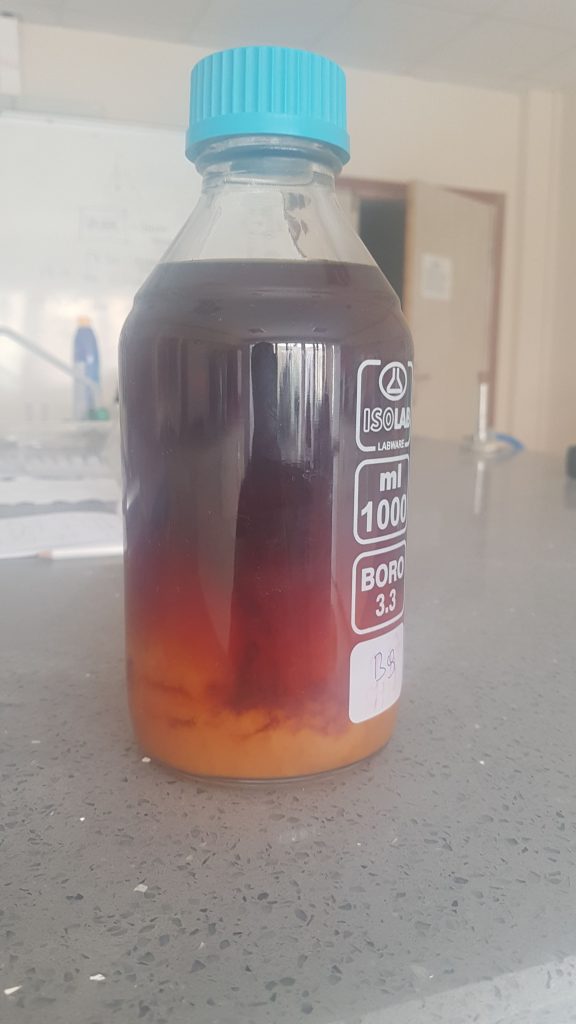
(This photograph shows the growth in liquid culture of a Lactobacillus rhamnosus strain that I isolated and identified from traditionally produced butter samples during my doctoral research. In general, a non-EPS-producing strain appears as sediment at the bottom, together with turbidity. EPS-producing strains may instead have a lightly cotton-like appearance at the bottom. However, this strain produced so much EPS that it formed a large, cloud-like mass in the broth.)
Two reasons make exopolysaccharides very attractive to humans. The first of these is the realization that EPS secreted by some microorganisms can be highly beneficial for human health.
The second is that EPS improve the structural properties of the foods in which they are present.
Today, exopolysaccharides are used in the food, pharmaceutical and cosmetic industries and their use is becoming more common day by day. It has been discovered that exopolysaccharides have antioxidant, antibacterial, cholesterol-lowering, immunoregulatory functions, anticarcinogen, antitumor, anticoagulant and antiviral effects in terms of human health.
Exopolysaccharides also play a role in biofilm formation and the ability of bacteria to attach to a surface. In this way, it is easier for bacteria to colonize an environment. This effect of EPS may contribute to the probiotic properties of the bacteria.
In other words, probiotic bacteria, which can produce EPS, can pass through the intestines more easily, adhere and grow more easily. It is reported that EPS can also show a prebiotic effect.
In food technology, EPS can improve properties such as gel formation, thickening, emulsification and water binding.
Therefore, the structural properties of fermented food containing an EPS-producing microorganism can be increased without adding any food additives thanks to EPS. This is very evident in yogurt.
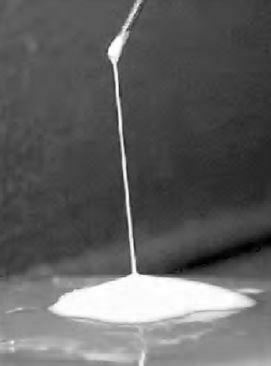
If yogurt contains an EPS-producing microorganism, it develops a creamy consistency and releases less whey. In this respect, the presence of EPS in yogurt can be identified by observation.
In the presence of EPS, yogurt has a creamy consistency and forms strands when lifted with a spoon. In this way, EPS improve the appearance of yogurt and increase its health benefits.
Of course, the EPS-producing microorganism species that can be used in fermented food production must be safe for use in food. Lactic acid bacteria and bifidobacteria stand out in terms of microorganisms that can be used in foods.
Most LAB, particularly bacteria in the genera Fructilactobacillus, Lacticaseibacillus, Lactiplantibacillus, Lactobacillus, Lactococcus, Latilactobacillus, Lentilactobacillus, Leuconostoc, Limosilactobacillus, Pediococcus, Streptococcus and Weissella, are capable of synthesizing EPS.
However, this does not mean that all species of a genus can produce EPS. Even within a species, the ability to produce EPS can vary. For example, one Streptococcus thermophilus strain can produce EPS, while another Streptococcus thermophilus strain cannot produce EPS.
On the other hand, to date, no Weissella strains have been recognized as “generally recognized as safe” (GRAS) by the US Food and Drug Administration. Likewise, bacteria of the genus Weissella have not been given Qualified Presumption of Safety (QPS) status by the European Food Safety Authority, even though they are common in Europe.
In this context, a group of scientists, including myself, is looking for lactic acid bacteria that can produce EPS in local fermented foods.
By investigating these bacteria and the properties of the EPS they produce, we are exploring their possible uses in foods.
The aim is to discover strains with desirable properties, use them as starter cultures, and improve the properties and health benefits of fermented foods without adding food additives.
Structure and Classification of Exopolysaccharides
It was previously stated that exopolysaccharides, as their name suggests, are in the form of carbohydrates. However, the term exopolysaccharide should not be taken to imply a single, uniform structure.
The structure of EPS varies according to which bacterial strain it is produced by. The structure of EPS to be secreted by a bacterium is encoded in its DNA.
EPS structure can also change according to the nutrient medium in which the microorganism is located. A bacterium can produce EPS of different structures in different nutrient media. Likewise, the amount of EPS secreted may vary greatly depending on the species and the environmental conditions.
Naturally, EPSs of different structures have different benefits both to the structure of the food and to health.
Exopolysaccharides may contain varying proportions of sugars and sugar derivatives such as galactose, glucose, mannose, rhamnose, ribose, xylose, fructose, fucose, arabinose, galacturonic acid, glucuronic acid, glucosamine and galactosamine.
Exopolysaccharides with only one type of monosaccharide in their structure are called homopolysaccharides (HoPS) and those consisting of different monosaccharides are called heteropolysaccharides (HePS).
However, HoPS and HePS differ not only according to the monomers that make up their structures but also according to the chain lengths, degree of branching and sugar linkages.
HoPS is usually composed of glucose or fructose units that form glucans or fructans. The most common of these are α-glucans. The two general subgroups of fructans are the levan-type and inulin-type polysaccharides.
Most EPS produced by LAB are HePS. The repeating units are usually D-glucose, D-galactose and L-rhamnose and in some cases N-acetylglucosamine, N-acetylgalactosamine or glucuronic acid.
In general, exopolysaccharides are classified as follows;
1.) Homopolysaccharides
1.1.) Glucans
a)α Glucans
a.1.) Dextran
a.2.) Mutan
a.3.)Reuteran
a.4.) Alternan
b) β Glucans
1.2.) Fructans
a) Levans
b) Inulin-type polysaccharides
2.) Heteropolysaccharides
2.1.) According to the type of monosaccharide it contains
2.2.) According to repeating units
2.3) According to the chain structure; branched or straight chain
2.4.) According to the modification
Biochemical Characteristics and Biosynthesis of Exopolysaccharides
The enzymes involved in EPS production by lactic acid bacteria can be divided into two main groups.
The first group includes proteins necessary to synthesize essential sugar nucleotides used by other cellular pathways. These proteins are not specific to EPS.
The other group comprises EPS-specific proteins involved in monomer transfer, polymerization, secretion and regulation of the overall process, including glycosyltransferases and acetyltransferases. However, the biological functions of some EPS-specific proteins remain unknown.
EPS-specific enzymes are regulated by certain genes. The genes encoding EPS biosynthesis in LAB are typically arranged in a cluster and are usually chromosomal (genophore) in thermophilic strains, but can also be located on plasmids in mesophilic LAB. In the latter case, the ability to produce EPS may be highly unstable and bacteria may lose their EPS production potential without selective pressure.
From a biochemical point of view, HoPS synthesis is a relatively simple process and since there are no active transport steps in the synthetic pathway, there is no energy expenditure other than the biosynthesis of essential extracellular enzymes.
The mechanism of HePS synthesis is a more complex and energy-intensive process.
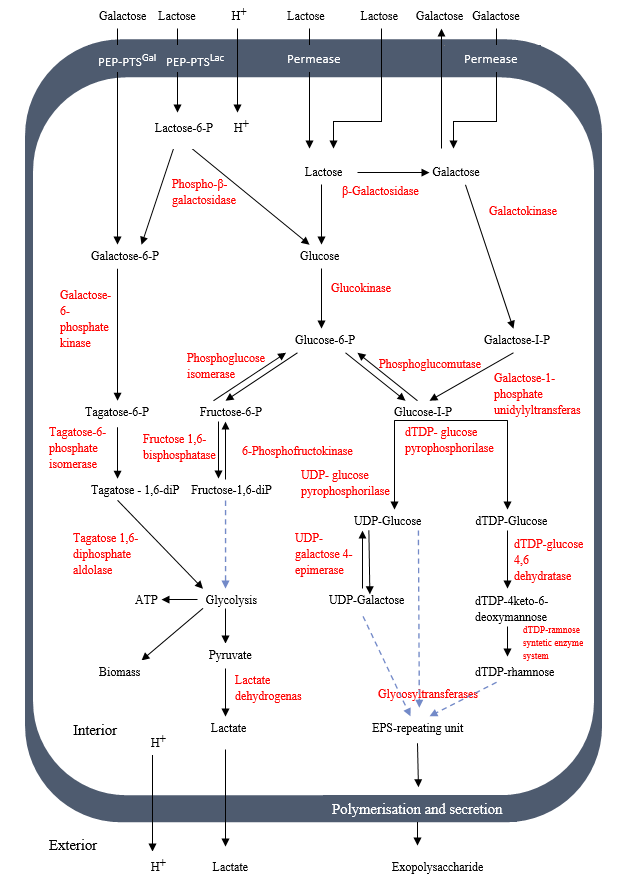
Biosynthesis of exopolysaccharides (adapted from Welman and Maddox, 2003)
EPS production by different lactic acid bacterial strains ranges from 10 mg/L to 400 mg/L under different conditions. Much greater amounts can be produced when ideal conditions for growth and production are provided.
References
Akgül, H. İ. (2020). Tereyağlarından ekzopolisakkarit (EPS) üreten laktik asit bakterilerinin izolasyonu ve tereyağı üretiminde starter kültür olarak kullanılabilirliğinin araştırılması. Atatürk Üniversitesi, Fen Bilimleri Enstitüsü.
Erkmen, O. (Ed.). (2021). Gıda Mikrobiyolojisi (6. baskı). Efil Yayınevi.
Welman, A. D., & Maddox, I. S. (2003). Exopolysaccharides from lactic acid bacteria: perspectives and challenges. Trends in Biotechnology, 21(6), 269–274.
Ruas-Madiedo, P., & de los Reyes-Gavilán, C. G. (2005). Invited review: methods for the screening, isolation, and characterization of exopolysaccharides produced by lactic acid bacteria. Journal of Dairy Science, 88(3), 843–856.
Zhou, Y., Cui, Y., & Qu, X. (2019). Exopolysaccharides of lactic acid bacteria: Structure, bioactivity and associations: A review. Carbohydrate Polymers, 207, 317–332.
Korcz, E., & Varga, L. (2021). Exopolysaccharides from lactic acid bacteria: Techno-functional application in the food industry. Trends in Food Science & Technology, 110, 375–384.
Yadav, M. K., Song, J. H., Vasquez, R., Lee, J. S., Kim, I. H., & Kang, D.-K. (2024). Methods for Detection, Extraction, Purification, and Characterization of Exopolysaccharides of Lactic Acid Bacteria—A Systematic Review. Foods, 13(22), 3687.

Halil İbrahim Akgül
Halil Ibrahim Akgul, Ph.D., is an Assistant Professor of Food Engineering at Bayburt University, where he works in the Division of Food Sciences within the Faculty of Engineering. He received his B.Sc. in Food Engineering from Akdeniz University in 2010, followed by an M.Sc. and a Ph.D. in Food Engineering from Atatürk University in 2015 and 2020, respectively. His formally recognised academic fields are Food Sciences and Engineering, Food Technologies, Dairy and Dairy Products Technology, and Food Microbiology.
Dr. Akgul has more than fifteen years of professional, research, and academic experience in food science. Between 2011 and 2013, he worked as the food engineer responsible for operations at the Pilot Dairy and Bread Factory of Atatürk University’s Directorate of Agricultural Enterprises. This industrial experience, combined with his subsequent academic research, gave him extensive practical and scientific knowledge of milk processing, dairy production, food quality, hygiene, and product development.
His research is primarily focused on milk and dairy products, dairy microbiology, starter cultures, lactic acid bacteria, exopolysaccharides, butter technology, and the physicochemical, microbiological, sensory, and nutritional properties of foods. His studies have examined the quality and fatty-acid composition of traditional butter, aroma formation in butter produced with different starter cultures, raw-milk quality, the characterisation and antioxidant activity of bacterial exopolysaccharides, traditional dairy products such as çökelek and karın kaymağı, colostrum powder, and the use of fruit-derived ingredients in ice cream production.
His academic record includes peer-reviewed research articles published in national and international journals, including Mljekarstvo, Acta Scientiarum Technology, the Journal of Food Safety and Food Quality, the International Journal of Food Engineering, the Atatürk University Journal of Agricultural Faculty, and ATA Food Journal. Four of the research articles currently listed in his university profile were published in SCI-Expanded-indexed journals. He has also contributed to twelve national and international conference papers and presentations covering dairy products, food microbiology, butter quality, fatty-acid composition, starter cultures, exopolysaccharide-producing bacteria, colostrum, traditional foods, and functional ice-cream formulations.
Dr. Akgul has participated as a researcher or adviser in eleven completed scientific and applied research projects. These projects have addressed the modernisation of pilot dairy-processing facilities; the production and quality characteristics of colostrum powder; the physicochemical and microbiological quality of butter and raw milk; the identification of exopolysaccharide-producing lactic acid bacteria; the development and production optimisation of starter cultures for mould-ripened cheese; the standardisation of traditional dairy products; and the use of sloe berry and persimmon fibre in ice-cream production.
His teaching experience spans undergraduate, associate-degree, and graduate education. The courses he has taught include Food Chemistry, Analytical Chemistry, General Chemistry, Organic Chemistry, Fermented Dairy Products Technology, Butter Production and Processing Technology, Healthy Living and Nutrition, Organic Agriculture and Food, Popular Science, Digital Literacy, and Information Technologies. Through these courses, he combines fundamental food chemistry and engineering principles with dairy technology, nutrition, scientific literacy, and the practical communication of scientific knowledge.
He is the founder and Editor-in-Chief of Gıda ve Sağlık, a multilingual digital publication devoted to food, nutrition, health, food chemistry, food microbiology, and culinary science. Through this platform, he draws upon his academic background, teaching experience, research activity, and practical knowledge of food production to present scientifically grounded information in a detailed and accessible form for an international readership.