
Energy metabolism has two aspects: the production of energy from food and all the activities through which the body expends energy. This article explains how the body produces energy from nutrients.
One of the main reasons we eat is to supply the body with energy. Food is first digested, and the resulting building blocks enter the bloodstream and reach cells throughout the body, where they are used for cellular activities.
When the building blocks are used for energy production, the energy released is transferred to the produced adenosine triphosphate (ATP) molecules. ATP can be thought of as energy-carrying packets and ATP is used in all energy-requiring activities.
The body can provide energy from carbohydrates, proteins and fats. The primary source used to meet the energy need is glucose, a carbohydrate monomer. While approximately 80% glucose is obtained from the carbohydrates consumed, 20% is composed of other carbohydrate monomers (fructose, galactose, mannose).
Although fructose is also a carbohydrate monomer, it must first undergo certain processes in the liver before it can supply energy. It is therefore less readily used for energy than glucose. Public-health concerns about the use of corn syrup arise from this situation.
The body stores glucose by joining it into the polymer glycogen, which provides an energy source ready for use when needed. Approximately 300 grams of glycogen is stored in this way, and it takes about half an hour of intense exertion to deplete it.
Amino acids, the building blocks of proteins, are mainly used as structural materials in the body. Except during intense exertion or inadequate nutrition, they are rarely used for energy. Before energy can be obtained from an amino acid, its amino group (–NH2) must be removed from the carbon chain.
This process occurs in the liver (deamination) and muscles (transamination). The remaining carbon chain can provide energy; however, the leaving amino group (urea) must be immediately removed from the body. Urea is diluted with large amounts of water and excreted in the urine. This causes a large amount of water loss from the body and the body’s need for water increases.
Fat monomers are used as building blocks in the body and another important function of fat is to be the body’s main energy store.
During intense exertion, cells first use blood glucose. Glycogen is then broken down and the released glucose is used. Once glycogen is depleted, triglycerides stored within cells and adipose tissue begin to break down. The released glycerol and fatty acids are oxidized to provide energy.
The body can produce energy from nutrients in two different ways: aerobic and anaerobic respiration.
1. Energy production; Aerobic Respiration
Aerobic respiration releases energy from the building blocks of carbohydrates, fats and proteins through oxidation using oxygen. It takes place in three stages and produces water, carbon dioxide and ATP. These stages are:
– Preparation of nutrients for the Krebs cycle,
– Krebs cycle,
– The electron transport system (ETS).
While ATP production in the first two stages is carried out by “substrate-level phosphorylation,” ATP production in the third stage, the electron transport system, is carried out by “oxidative phosphorylation”. The amount of ATP produced by oxidative phosphorylation is much greater.
In aerobic respiration, oxygen is used as a hydrogen scavenger in the electron transport system. It would be more beneficial to explain the stages of aerobic respiration under their headings.
1.1. Preparation of nutrients for the Krebs cycle
Essentially, the Krebs cycle begins with the Acetyl CoA molecule. Glucose, amino acids, glycerol and fatty acids are prepared in specific ways and included in certain parts of the Krebs cycle.
Once glucose is taken into the cell, it is broken down into pyruvate in the cytoplasm. This reaction is called “glycolysis.” The glycolysis reaction is given below;
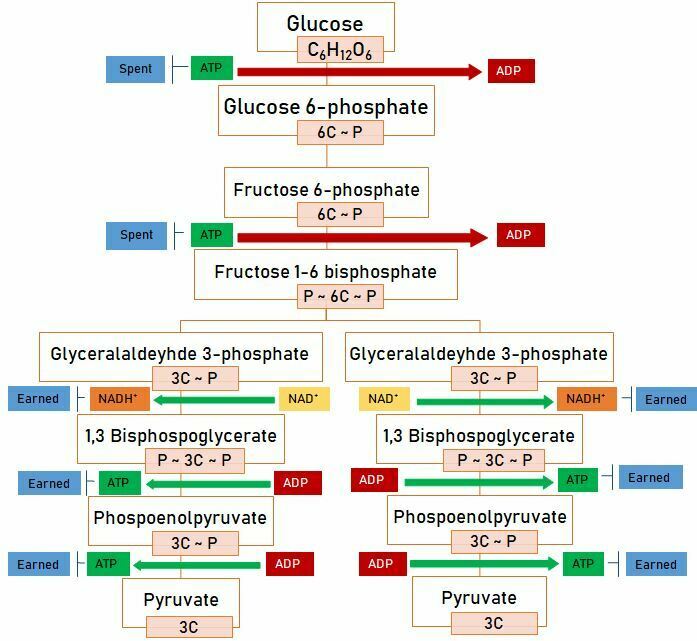
As a result of glucose undergoing glycolysis, two pyruvates, net 2 ATP and 2 NADH+ are produced. ATPs produced as a result of this reaction are obtained by substrate-level phosphorylation. The NADH+ produced is converted to ATP in the electron transport system.
Breaking glucose down to pyruvate is not enough to prepare it for the Krebs cycle. The two pyruvate molecules are transported from the cytoplasm into the mitochondrial matrix, where pyruvate dehydrogenase converts them to two-carbon acetyl-CoA through the loss of carbon dioxide.
The reaction in which pyruvate is converted to Acetyl CoA is given below;
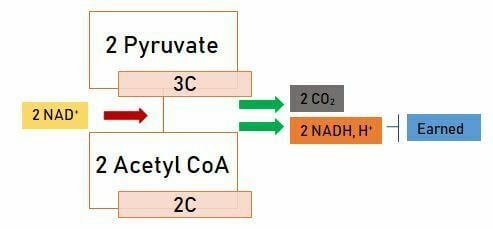
Two acetyl-CoA molecules are obtained from two pyruvate molecules. This reaction also produces 2 NADH+, which are transferred to the electron transport system. Glucose has now been broken down to acetyl-CoA and prepared for the Krebs cycle.
When a fat molecule (triglyceride) is used to provide energy, first of all, the fat molecule is broken down in the adipose tissue. As a result of this breakdown, one glycerol and three fatty acid molecules are released and given to the blood to be delivered to the cells.
Depending on the structure of the triglyceride, the three released fatty acids may all be the same or may consist of two or three different fatty acids. Their chain length affects the amount of energy produced.
The amount of energy produced from butyric acid, which is 4 carbon fatty acid, and the amount of energy produced from stearic acid, which is 18 carbon fatty acid, are naturally not the same.
To return to the subject again, glycerol, which is released due to the destruction of a fat molecule, enters the glycolysis reaction just like glucose. As a result, pyruvate is produced. Pyruvate is also broken down into Acetyl CoA and in this way, glycerol is made ready for the Krebs cycle.
Fatty acids are subjected to “β-oxidation” in the mitochondria and as a result of this reaction, fatty acids are broken down and converted to Acetyl CoA. In this way, fatty acids are prepared for the Krebs cycle.
The important thing here is that oxygen is needed for the oxidation of fatty acids, as the name suggests. If there is not enough oxygen, fatty acids cannot be converted to Acetyl CoA.
As mentioned earlier, amino acids must first lose their amino groups before they can be used for energy. They undergo deamination in the liver and transamination in the muscles for this purpose.
The amino group is removed from the body; the remaining carbon chain is given to the blood and delivered to the cells. Since the molecular structures of amino acids are different from each other, there is no standard procedure for all of them in the cell.
Some amino acid carbon chains undergo glycolysis, some are converted directly to acetyl-CoA, and others enter at different points in the Krebs cycle.
1.2. Krebs Cycle (Tricarboxylic acid (TCA) cycle, Citric acid cycle)
In the process up to this stage, the building blocks of nutrients have been converted to Acetyl CoA. Other names for the Krebs cycle are the tricarboxylic acid (TCA) cycle and the citric acid cycle. The diagram of the Krebs cycle is given below;

Acetyl CoA combines with 4-carbon oxaloacetate through the enzyme “citrate synthase” to form citrate and this is how the Krebs cycle begins. As a result of the cycle, 1 ATP, 3 NADH+, and 1 FADH2 are produced from one Acetyl CoA molecule. The produced NADH+ and FADH2 molecules are sent to the electron transport system.
It has been previously stated that 2 Acetyl CoA molecules are formed from 1 glucose molecule. 2 Krebs cycles are performed for one glucose molecule. Therefore, the incoming and outgoing products in the diagram must be multiplied by 2.
1.3. Electron Transport System (ETS)
Elements of the electron transport system are located in the inner membrane of the mitochondria and energy production is carried out in the inner membrane folds known as “cristae.”
There are two main operations in ETS. The first is the separation of the hydrogen ions in the NADH+ and FADH2 molecules obtained in the process up to this stage and the combining of the separated hydrogen ions with oxygen.
The second process converts the potential energy created by the hydrogen-ion concentration difference across the membrane into chemical energy. This is described by the chemiosmotic hypothesis.
NADH+ and FADH2 molecules are separated from the H+ ions they contain and the free NAD and FAD molecules are returned to the system for reuse. The oxygen taken from the lungs with aerobic respiration is responsible for keeping the H+ ions here, resulting in H2O; that is, water is formed. If there is not enough oxygen, the Electron Transport System will not work.
The chemiosmotic hypothesis explains energy production by the electron transport system. It was not accepted when first proposed in 1961, but supporting evidence from later studies led to its acceptance by the scientific community. Its author received the Nobel Prize in Chemistry in 1978.
According to the chemiosmotic hypothesis, H+ ions separated from NADH+ and FADH2 accumulate on the outer side of the inner mitochondrial membrane, creating an ion-concentration difference across the membrane.
This concentration difference represents potential energy, which ATP synthase converts to chemical energy in the form of ATP. ATP production in the ETS occurs through oxidative phosphorylation.
In this system, each mole of NADH+ can produce 2.5 moles of ATP, while each mole of FADH2 can produce 1.5 moles of ATP.
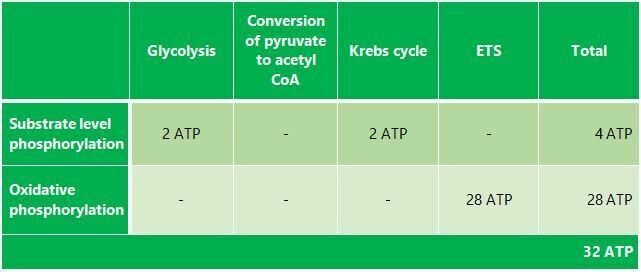
A total of 10 NADH+ and 2 FADH2 are obtained during glycolysis from one glucose molecule, conversion from pyruvate to Acetyl CoA and the Krebs cycle. As a result of using these molecules in ETS, a total of 28 ATPs are produced.
2. Energy production; Anaerobic Respiration
Energy production by anaerobic respiration occurs in the muscles during intense physical activity. The energy efficiency is relatively low; however, it is essential to meet urgent energy needs.
Glucose is burned by anaerobic respiration and as a result, 2 moles of ATP and 2 moles of lactic acid are released. The reason why anaerobic respiration is called lactic acid fermentation is that lactic acid is released due to the reaction. Fatigue during physical activity is due to the accumulation of lactic acid.
Amount of Energy Production
As a result of aerobic respiration, a total of 32 moles of ATP is produced from 1 mole of glucose (180 grams). The table regarding the production is given below. Essentially, there is the potential to produce about 85 moles of ATP from 1 mole of glucose; however, the amount produced is 32 moles and the remaining energy is released as heat.
Aerobic oxidation of 1 mole of glycerol, a building block of triglycerides, produces 19 moles of ATP. As noted earlier, the amount of energy released by fatty acids varies with the number of carbon atoms they contain.
As a result of burning 1 mole of stearic acid, 148 moles of ATP are produced. Depending on the nature of a triglyceride, 50 – 580 moles of ATP can be produced per mole of triglyceride.
For proteins, the breakdown of one amino acid molecule produces an average of 40 ATP.
Although the energy unit is ATP in terms of cell chemistry, different energy units express the energy amounts of foods in daily life. The first of these units is “calorie.” A calorie is the amount of energy required to raise the temperature of one gram of water from 15oC to 16oC and is denoted by “cal.”
Another energy unit used to indicate the energy value of foods is the “joule.” One joule is the amount of energy required to carry a kilogram of weight one meter with a force of one newton and is denoted by “j.” 1000 calories (cal) equals 1 kilocalorie (kcal). 1 kcal is 4.184 kJ. 1 mole of ATP provides 7.3 kcal of energy.
The calorie unit is actually universally misused. The amount we express as calories in daily life is actually kilocalories. For example, when it is said that “an apple contains 100 calories”, it actually means that it contains 100 kilocalories.
This is comparable to saying “I bought 2 grams of tomatoes from the greengrocer.” This misuse led to another confusing expression: the calorie came to be called the “small calorie,” much like calling a gram a “small gram.” Food labels use calories as an energy unit, but show the symbol kcal.
As a result, the energy amount of foods is expressed by “how many calories a gram contains.” Experimentally, 1 gram of carbohydrate gives 4.1 kcal, 1 gram of protein provides 5.6 kcal and 1 gram of fat gives 9.3 kcal of energy.
However, efficiency in the experimental environment cannot be achieved in metabolism. In metabolism, 1 gram of carbohydrate gives 4 kcal, 1 gram of protein 4 kcal and 1 gram of fat provides 9 kcal of energy. If the amount of nutrients contained in a food is known, the total energy that that food will provide can be easily calculated based on these data.
For example, let’s say that 100 grams of a food contain 20 grams of carbohydrates, 12 grams of fat and 17 grams of protein. The energy that 100 grams of this food will give;
For carbohydrates; 20 x 4 = 80 kcal
For fat: 12 × 9 = 108 kcal
For protein; 17 x 4 = 68 kcal
TOTAL; = 256 kcal
One hundred grams of the food in the example gives 256 kcal of energy. Components such as water, vitamins, or minerals are not considered in the energy calculation. As a matter of fact, nothing gives energy except carbohydrates, fats and proteins.
Regarding carbohydrates, it should be noted that indigestible dietary fibers do not provide energy either. Alcohol is out of scope.
References
Raymond, J. L., & Morrow, K. (2023). Krause ve Mahan Besin ve Beslenme Bakım Süreci (16. baskı; G. Akbulut, Çev. Ed.). Nobel Tıp Kitabevleri.
Aksoy, M. (Ed.). (2022). Beslenme Biyokimyası (7. baskı). Ankara Nobel Tıp Kitabevleri.
Gökalp, H. Y., Nas, S., & Certel, M. (2002). Biyokimya-I: Temel Yapılar ve Kavramlar. Pamukkale Üniversitesi Mühendislik Fakültesi.
Saldamlı, İ. (Ed.). (2021). Gıda Kimyası. Hacettepe Üniversitesi Yayınları.
Bilişli, A. (2012). Gıda Kimyası. Sidas Medya.
Food and Agriculture Organization of the United Nations. (2003). Food energy: Methods of analysis and conversion factors. FAO. FAO Food and Nutrition Paper, 77.
Mitchell, P. (1978). David Keilin’s Respiratory Chain Concept and Its Chemiosmotic Consequences. Nobel Lecture, December8,1978. The Nobel Foundation.
Here’s an article that might interest you; Energy Metabolism – II: Energy Expended by the Body

Halil İbrahim Akgül
Halil Ibrahim Akgul, Ph.D., is an Assistant Professor of Food Engineering at Bayburt University, where he works in the Division of Food Sciences within the Faculty of Engineering. He received his B.Sc. in Food Engineering from Akdeniz University in 2010, followed by an M.Sc. and a Ph.D. in Food Engineering from Atatürk University in 2015 and 2020, respectively. His formally recognised academic fields are Food Sciences and Engineering, Food Technologies, Dairy and Dairy Products Technology, and Food Microbiology.
Dr. Akgul has more than fifteen years of professional, research, and academic experience in food science. Between 2011 and 2013, he worked as the food engineer responsible for operations at the Pilot Dairy and Bread Factory of Atatürk University’s Directorate of Agricultural Enterprises. This industrial experience, combined with his subsequent academic research, gave him extensive practical and scientific knowledge of milk processing, dairy production, food quality, hygiene, and product development.
His research is primarily focused on milk and dairy products, dairy microbiology, starter cultures, lactic acid bacteria, exopolysaccharides, butter technology, and the physicochemical, microbiological, sensory, and nutritional properties of foods. His studies have examined the quality and fatty-acid composition of traditional butter, aroma formation in butter produced with different starter cultures, raw-milk quality, the characterisation and antioxidant activity of bacterial exopolysaccharides, traditional dairy products such as çökelek and karın kaymağı, colostrum powder, and the use of fruit-derived ingredients in ice cream production.
His academic record includes peer-reviewed research articles published in national and international journals, including Mljekarstvo, Acta Scientiarum Technology, the Journal of Food Safety and Food Quality, the International Journal of Food Engineering, the Atatürk University Journal of Agricultural Faculty, and ATA Food Journal. Four of the research articles currently listed in his university profile were published in SCI-Expanded-indexed journals. He has also contributed to twelve national and international conference papers and presentations covering dairy products, food microbiology, butter quality, fatty-acid composition, starter cultures, exopolysaccharide-producing bacteria, colostrum, traditional foods, and functional ice-cream formulations.
Dr. Akgul has participated as a researcher or adviser in eleven completed scientific and applied research projects. These projects have addressed the modernisation of pilot dairy-processing facilities; the production and quality characteristics of colostrum powder; the physicochemical and microbiological quality of butter and raw milk; the identification of exopolysaccharide-producing lactic acid bacteria; the development and production optimisation of starter cultures for mould-ripened cheese; the standardisation of traditional dairy products; and the use of sloe berry and persimmon fibre in ice-cream production.
His teaching experience spans undergraduate, associate-degree, and graduate education. The courses he has taught include Food Chemistry, Analytical Chemistry, General Chemistry, Organic Chemistry, Fermented Dairy Products Technology, Butter Production and Processing Technology, Healthy Living and Nutrition, Organic Agriculture and Food, Popular Science, Digital Literacy, and Information Technologies. Through these courses, he combines fundamental food chemistry and engineering principles with dairy technology, nutrition, scientific literacy, and the practical communication of scientific knowledge.
He is the founder and Editor-in-Chief of Gıda ve Sağlık, a multilingual digital publication devoted to food, nutrition, health, food chemistry, food microbiology, and culinary science. Through this platform, he draws upon his academic background, teaching experience, research activity, and practical knowledge of food production to present scientifically grounded information in a detailed and accessible form for an international readership.