
Functions of carbohydrates in the body
There are two types of carbohydrates: digestible and indigestible. The body obtains energy from digestible carbohydrates. Indigestible carbohydrates, known as dietary fiber, do not give energy to the body but positively affect digestion.
In short, carbohydrates have three main functions in the body.
- First and foremost, they are the body’s primary source of energy.
- Secondly, they are used as structural components in all tissues and cells of the body in the form of glycoproteins and glycolipids.
- Thirdly, indigestible carbohydrates—known as dietary fibers—have positive effects on digestion.
The compound that we can call the body’s primary fuel is glucose. Glucose is the most common carbohydrate building block. (For detailed information about carbohydrate types, see Carbohydrates; Monosaccharides, Disaccharides and Polysaccharides).
Our body can obtain glucose from the foods we consume, and it also has the ability to convert proteins and fats into glucose. If carbohydrate intake is insufficient, the body begins to meet its energy needs from proteins and fats.
Thus, while it may be argued that carbohydrates are not an “essential nutrient” that must be externally supplied, this is not a very consistent perspective. If there is an excess of fat tissue in the body, this mechanism may even be beneficial for weight loss. However, when reserves are low, the body will try to meet its energy requirements by consuming available proteins and fats, which can prevent these macronutrients from performing their primary roles.
Additionally, producing energy from proteins and fats is not as straightforward as producing it from glucose and may lead to waste products that must be quickly eliminated from the body. (For more detailed information on obtaining energy from nutrients, see Energy Metabolism I; Energy Production in The Body)
For these reasons, carbohydrates are considered important for both their structural roles and their contribution to energy metabolism.
In this context, the idea that “carbohydrates should be completely eliminated from the diet” is generally seen as an inconsistent and flawed approach—particularly for healthy individuals. In fact, such a notion is as illogical as saying, “A gasoline-powered car should be fueled with diesel, because gasoline is highly flammable.”
Glucose is the body’s primary energy source, and we obtain glucose mainly from carbohydrate-containing foods.
The fact that proteins and fats can be converted into glucose does not mean carbohydrates can be excluded from the diet. In general, a healthy diet includes all nutrients in a balanced and measured way. Of course, this evaluation provides a general framework for healthy individuals; in the presence of any medical condition, nutrition advice from a physician or dietitian should be followed.
According to general nutritional literature, approximately 50% of daily energy intake can come from carbohydrates.
For instance, someone who expends 2,000 calories per day is advised to obtain about half of that energy from carbohydrates. Considering that 1 gram of carbohydrate provides 4 calories, a daily intake of around 250 grams may be appropriate. Although this amount might seem high, it should be noted that the brain alone needs about 140 grams of glucose daily just to function properly. (For more detailed information on obtaining energy from nutrients, see Energy Metabolism II; Energy Expended in the Body)
The amount of carbohydrates contained in foods
Animal-based foods, with a few exceptions, are quite low in carbohydrates. For example;
- Meat and meat products generally contain no carbohydrates.
- Liver contains about 6% carbohydrates in the form of glycogen.
- Honey consists of approximately 75% carbohydrates, mainly fructose.
- Milk contains about 4.7% carbohydrates in the form of lactose.
The primary sources of carbohydrates are plant-based foods. For instance;
- One slice of bread contains about 20 grams of carbohydrates,
- 100 grams of cooked pasta contains about 25 grams.
- 100 grams of cooked rice contains about 30 grams.
- Table sugar can be considered 100% pure carbohydrate. Although sugar has a history spanning over 2,000 years, modern perspectives generally support reducing refined sugar intake.
Furthermore, it is believed that choosing carbohydrate sources rich in fiber and micronutrients—such as whole wheat bread—may be more beneficial for health.
The table below shows the amount of carbohydrates some foods contain;

Dietary fibers
The third key function of carbohydrates in the body is performed by dietary fibers.
Dietary fiber is a general term for carbohydrates such as cellulose, pectin, hemicellulose, and lignin, which are indigestible and cannot be used as an energy source by the body.
Although dietary fibers do not provide energy, they promote a feeling of fullness and help regulate digestion and absorption. Moreover, they have a prebiotic effect by supporting the gut microbiota in the colon, thereby contributing to intestinal health.
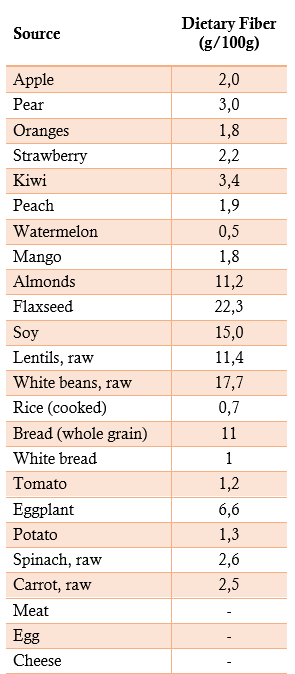
Dietary fibers are not found in animal-based foods. The most important sources of dietary fiber are legumes, nuts, cereal products, vegetables, and fruits. It is believed that consuming between 20–27 grams of dietary fiber per day can be beneficial for health.
However, excessive intake of fiber may impair the absorption of certain vitamins and minerals, potentially leading to health issues. Therefore, maintaining daily fiber intake in the range of 20–27 grams is generally considered beneficial, while intakes of 50 grams or more may have adverse effects in some individuals.
The amount of dietary fiber contained in some foods is given in the table below;
Note: This article is intended solely for general informational purposes. It does not constitute medical advice or personalized nutritional guidance. Nutritional needs may vary from person to person. Always consult a healthcare professional or a registered dietitian before making any dietary changes.
References
Raymond, J. L., & Morrow, K. (2023). Krause ve Mahan Besin ve Beslenme Bakım Süreci (16. baskı; G. Akbulut, Çev. Ed.). Nobel Tıp Kitabevleri.
Aksoy, M. (Ed.). (2022). Beslenme Biyokimyası (7. baskı). Ankara Nobel Tıp Kitabevleri.
Sencer, E., & Orhan, Y. (2005). Beslenme. İstanbul Medikal Yayıncılık.
Saldamlı, İ. (Ed.). (2021). Gıda Kimyası. Hacettepe Üniversitesi Yayınları.
Bilişli, A. (2012). Gıda Kimyası. Sidas Medya.
World Health Organization. (2023). Carbohydrate intake for adults and children: WHO guideline. World Health Organization.
Reynolds, A., Mann, J., Cummings, J., Winter, N., Mete, E., & Te Morenga, L. (2019). Carbohydrate quality and human health: a series of systematic reviews and meta-analyses. The Lancet, 393(10170), 434–445.

Halil İbrahim Akgül
Halil Ibrahim Akgul, Ph.D., is an Assistant Professor of Food Engineering at Bayburt University, where he works in the Division of Food Sciences within the Faculty of Engineering. He received his B.Sc. in Food Engineering from Akdeniz University in 2010, followed by an M.Sc. and a Ph.D. in Food Engineering from Atatürk University in 2015 and 2020, respectively. His formally recognised academic fields are Food Sciences and Engineering, Food Technologies, Dairy and Dairy Products Technology, and Food Microbiology.
Dr. Akgul has more than fifteen years of professional, research, and academic experience in food science. Between 2011 and 2013, he worked as the food engineer responsible for operations at the Pilot Dairy and Bread Factory of Atatürk University’s Directorate of Agricultural Enterprises. This industrial experience, combined with his subsequent academic research, gave him extensive practical and scientific knowledge of milk processing, dairy production, food quality, hygiene, and product development.
His research is primarily focused on milk and dairy products, dairy microbiology, starter cultures, lactic acid bacteria, exopolysaccharides, butter technology, and the physicochemical, microbiological, sensory, and nutritional properties of foods. His studies have examined the quality and fatty-acid composition of traditional butter, aroma formation in butter produced with different starter cultures, raw-milk quality, the characterisation and antioxidant activity of bacterial exopolysaccharides, traditional dairy products such as çökelek and karın kaymağı, colostrum powder, and the use of fruit-derived ingredients in ice cream production.
His academic record includes peer-reviewed research articles published in national and international journals, including Mljekarstvo, Acta Scientiarum Technology, the Journal of Food Safety and Food Quality, the International Journal of Food Engineering, the Atatürk University Journal of Agricultural Faculty, and ATA Food Journal. Four of the research articles currently listed in his university profile were published in SCI-Expanded-indexed journals. He has also contributed to twelve national and international conference papers and presentations covering dairy products, food microbiology, butter quality, fatty-acid composition, starter cultures, exopolysaccharide-producing bacteria, colostrum, traditional foods, and functional ice-cream formulations.
Dr. Akgul has participated as a researcher or adviser in eleven completed scientific and applied research projects. These projects have addressed the modernisation of pilot dairy-processing facilities; the production and quality characteristics of colostrum powder; the physicochemical and microbiological quality of butter and raw milk; the identification of exopolysaccharide-producing lactic acid bacteria; the development and production optimisation of starter cultures for mould-ripened cheese; the standardisation of traditional dairy products; and the use of sloe berry and persimmon fibre in ice-cream production.
His teaching experience spans undergraduate, associate-degree, and graduate education. The courses he has taught include Food Chemistry, Analytical Chemistry, General Chemistry, Organic Chemistry, Fermented Dairy Products Technology, Butter Production and Processing Technology, Healthy Living and Nutrition, Organic Agriculture and Food, Popular Science, Digital Literacy, and Information Technologies. Through these courses, he combines fundamental food chemistry and engineering principles with dairy technology, nutrition, scientific literacy, and the practical communication of scientific knowledge.
He is the founder and Editor-in-Chief of Gıda ve Sağlık, a multilingual digital publication devoted to food, nutrition, health, food chemistry, food microbiology, and culinary science. Through this platform, he draws upon his academic background, teaching experience, research activity, and practical knowledge of food production to present scientifically grounded information in a detailed and accessible form for an international readership.