
Carbohydrates are organic molecules consisting of carbon (C), hydrogen (H) and oxygen (O). Plants produce carbohydrates by using carbon dioxide and water through photosynthesis.
While some of the carbohydrates produced are converted into protein, fat and other organic compounds, some are turned into polysaccharides for storage.
Carbohydrates are consumed by organisms that cannot photosynthesize, primarily to obtain energy. Although carbohydrates occur naturally in foods, some are also added as gelling agents, stabilizers and thickeners.
The general structural formula of monosaccharides, their building blocks, is CnH2nOn, but some monosaccharides do not fit this formula. Another name for carbohydrates is sugars. The name comes from the Greek word “gluco” meaning “sweet.”
Classification of Carbohydrates
Carbohydrates are divided into three groups according to their size;
1. Monosaccharides,
2. Disaccharides,
3. Polysaccharides
The smallest building blocks of carbohydrates are monosaccharides. Disaccharides are carbohydrates formed by the joining of two monosaccharides. Polysaccharides are carbohydrates formed by the combination of a higher number of monosaccharides.
Some sources use the term oligosaccharide for carbohydrates composed of 2–10 monosaccharide units, while others use it for those composed of 2–20 units.
1. Monosaccharides
Monosaccharides are the smallest building blocks of carbohydrates. When monosaccharides are broken down, a smaller carbohydrate is not formed. They generally consist of a single, unbranched carbon chain. Chain lengths usually range between 2 and 8 carbons.
Oxygen is attached to one of the carbons in the chain with a double bond (C=O). The other carbon atoms are bonded to –OH groups. If the carbon bonded to the oxygen by a double bond is at the end of the chain, such monosaccharides are called “aldoses;” if the carbonyl carbon is located elsewhere in the chain, these monosaccharides are called “ketoses.”
For example, glucose is an aldose while fructose is a ketose. Therefore, while the molecular formulas of the two compounds are the same (C6H12O6), their structures, physical and chemical properties are different from each other.
Monosaccharides are also named according to the number of carbon atoms in their chains. To put it briefly;
- 3-carbon monosaccharides are called “trioses”; glyceraldehyde and dihydroxyacetone are trioses.
- 4-carbon monosaccharides are called “tetroses”; erythrose and erythrulose are tetroses.
- 5-carbon monosaccharides are called “pentoses”; ribose, ribulose, arabinose and xylose are pentoses.
- 6-carbon monosaccharides are called “hexoses”; glucose, fructose, galactose, mannose and sorbose are all hexoses.
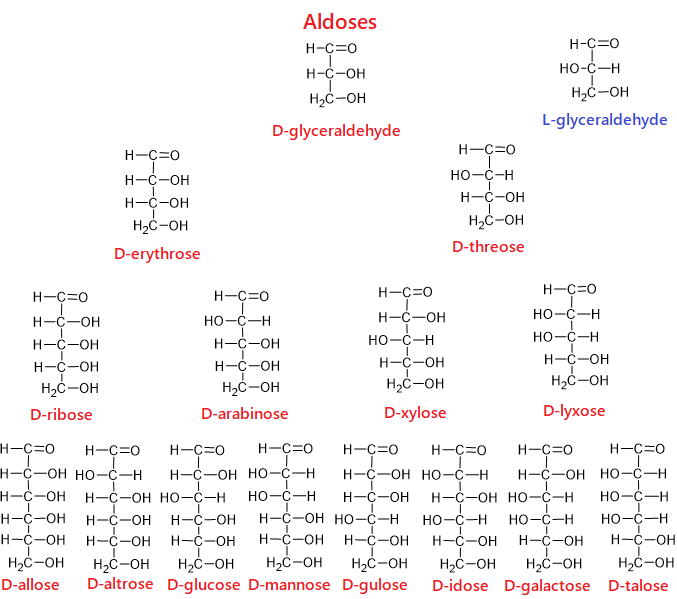
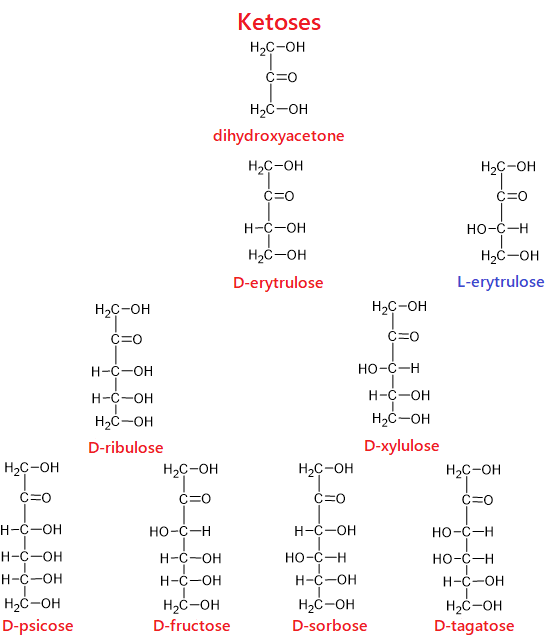
The molecular structure of monosaccharides and the topic of isomerism in monosaccharides are quite detailed subjects. Therefore, these topics are explained in detail in a separate article. In order to fully understand the subject of carbohydrates, I strongly recommend reading the article titled “Ring Structure, Conformations, and Isomerism in Monosaccharides.”
Common monosaccharides;
Ribose; is included in the structure of nucleotides, nucleic acids, vitamin B2 and enzymes. 2-deoxyribose, a derivative of ribose, is found in the structure of DNA.
Arabinose; is one of the building blocks of gums used as food additives. It is found in apples, figs, grapefruit and some grape varieties.
Glucose (Dextrose, blood sugar, grape sugar); is the most common monosaccharide in nature. It is found in free form in ripe fruits, honey and blood. It also occurs mainly as a constituent of disaccharides and polysaccharides.
Fructose (Levulose, fruit sugar); is found in free form in sweet fruits and honey. It is the carbohydrate with the highest degree of sweetness among all carbohydrates. The intestinal absorption of fructose is slower than that of glucose.
Galactose: It is not found in free form in nature; It is located in the structures of disaccharides and polysaccharides. Its main sources are milk and dairy products containing lactose. Galactose is the building block of galactolipids found in the brain and nerve cells.
Mannose; It is not found free in nature. It is the building block of glycolipids, glycoproteins and serum albumins in animal tissues.
2. Disaccharides
Disaccharides form when two monosaccharides are joined by a glycosidic bond. They cannot be used directly by the body; they are broken down into their monomers in the digestive tract and the resulting monosaccharides are absorbed in the intestines.
Common disaccharides;
Sucrose; Sucrose consists of one glucose and one fructose molecule. Sucrose is found in all plants, but quantities suitable for commercial production are found in sugar beet and sugar cane.
Granulated sugar that we use as table sugar consists of sucrose crystals obtained from refining sugar cane and sugar beet.
Lactose (Milk sugar); It is found in nature only in the structure of milk. It is formed due to the combination of one molecule of glucose and one molecule of galactose.
Lactose is broken down into glucose and galactose by the enzyme lactase in the digestive tract. The absence or very low activity of lactase in the digestive system prevents lactose from being digested. This leads to a condition called “lactose intolerance,” which causes abdominal bloating, pain, cramps, gas and diarrhea.
Maltose: It is a disaccharide rarely found in free form in nature and generally obtained through the hydrolysis of starch. It has two glucose molecules in its structure.
3. Polysaccharides
Structures formed due to the combination of many monosaccharides are called polysaccharides. There are polysaccharides consisting of 20 monosaccharides, as well as polysaccharides formed by the combination of 15,000 monosaccharides. Polysaccharides generally contain 200-3,000 monosaccharides.
Common polysaccharides;
Starch; Starch produced by plants to store energy is generally found in high concentrations in structures such as seeds, fruits and roots. In addition to being an important energy source, starch is also used as a food additive in the food industry due to its properties, such as gelling and thickening.
Although there is only glucose as a building block in starch, glucose chains exist in 2 different forms: straight-chain (amylose) and branched-chain (amylopectin). The number of glucose units in starch varies depending on the plant that produces it; some plants produce starch molecules consisting of 3 million glucose units.
Glycogen; Glycogen consists of polysaccharides made up of glucose and is produced to store energy in animal and human tissues. It is not found in plant foods. While it is almost absent in the meat consumed, it can be found in the liver at a rate of about 6%.
Cellulose; Cellulose, which is found in the structure of cell walls in plants, consists of a very high amount of glucose. The importance of cellulose in human nutrition is that it is an excellent dietary fiber. This is because cellulose cannot be digested by humans. Although cellulose cannot be digested, it is a molecule that helps digestion as dietary fiber. (For more detailed information on the starch and dietary fibre content of different breads, see World Bread Atlas; Varieties, Nutrition and Culture.)
On the other hand, it is a raw material for paper and is widely used in industry.
References
Saldamlı, İ. (Ed.). (2021). Gıda Kimyası. Hacettepe Üniversitesi Yayınları.
Bilişli, A. (2012). Gıda Kimyası. Sidas Medya.
Gökalp, H. Y., Nas, S., & Certel, M. (2002). Biyokimya-I: Temel Yapılar ve Kavramlar. Pamukkale Üniversitesi Mühendislik Fakültesi.
Aksoy, M. (Ed.). (2022). Beslenme Biyokimyası (7. baskı). Ankara Nobel Tıp Kitabevleri.
Alberts, B., Hopkin, K., Johnson, A. D., Morgan, D., Raff, M., Roberts, K., & Walter, P. (2023). Essential Cell Biology (6th ed.). W. W. Norton & Company.
Raymond, J. L., & Morrow, K. (2023). Krause ve Mahan Besin ve Beslenme Bakım Süreci (16. baskı; G. Akbulut, Çev. Ed.). Nobel Tıp Kitabevleri.
International Union of Pure and Applied Chemistry. (2025). Carbohydrates. IUPAC Compendium of Chemical Terminology (Gold Book) (5th ed.; online version 5.0.0). IUPAC.
Here’s an article that might interest you: Carbohydrates; Functions in the Body and Daily Needs

Halil İbrahim Akgül
Halil Ibrahim Akgul, Ph.D., is an Assistant Professor of Food Engineering at Bayburt University, where he works in the Division of Food Sciences within the Faculty of Engineering. He received his B.Sc. in Food Engineering from Akdeniz University in 2010, followed by an M.Sc. and a Ph.D. in Food Engineering from Atatürk University in 2015 and 2020, respectively. His formally recognised academic fields are Food Sciences and Engineering, Food Technologies, Dairy and Dairy Products Technology, and Food Microbiology.
Dr. Akgul has more than fifteen years of professional, research, and academic experience in food science. Between 2011 and 2013, he worked as the food engineer responsible for operations at the Pilot Dairy and Bread Factory of Atatürk University’s Directorate of Agricultural Enterprises. This industrial experience, combined with his subsequent academic research, gave him extensive practical and scientific knowledge of milk processing, dairy production, food quality, hygiene, and product development.
His research is primarily focused on milk and dairy products, dairy microbiology, starter cultures, lactic acid bacteria, exopolysaccharides, butter technology, and the physicochemical, microbiological, sensory, and nutritional properties of foods. His studies have examined the quality and fatty-acid composition of traditional butter, aroma formation in butter produced with different starter cultures, raw-milk quality, the characterisation and antioxidant activity of bacterial exopolysaccharides, traditional dairy products such as çökelek and karın kaymağı, colostrum powder, and the use of fruit-derived ingredients in ice cream production.
His academic record includes peer-reviewed research articles published in national and international journals, including Mljekarstvo, Acta Scientiarum Technology, the Journal of Food Safety and Food Quality, the International Journal of Food Engineering, the Atatürk University Journal of Agricultural Faculty, and ATA Food Journal. Four of the research articles currently listed in his university profile were published in SCI-Expanded-indexed journals. He has also contributed to twelve national and international conference papers and presentations covering dairy products, food microbiology, butter quality, fatty-acid composition, starter cultures, exopolysaccharide-producing bacteria, colostrum, traditional foods, and functional ice-cream formulations.
Dr. Akgul has participated as a researcher or adviser in eleven completed scientific and applied research projects. These projects have addressed the modernisation of pilot dairy-processing facilities; the production and quality characteristics of colostrum powder; the physicochemical and microbiological quality of butter and raw milk; the identification of exopolysaccharide-producing lactic acid bacteria; the development and production optimisation of starter cultures for mould-ripened cheese; the standardisation of traditional dairy products; and the use of sloe berry and persimmon fibre in ice-cream production.
His teaching experience spans undergraduate, associate-degree, and graduate education. The courses he has taught include Food Chemistry, Analytical Chemistry, General Chemistry, Organic Chemistry, Fermented Dairy Products Technology, Butter Production and Processing Technology, Healthy Living and Nutrition, Organic Agriculture and Food, Popular Science, Digital Literacy, and Information Technologies. Through these courses, he combines fundamental food chemistry and engineering principles with dairy technology, nutrition, scientific literacy, and the practical communication of scientific knowledge.
He is the founder and Editor-in-Chief of Gıda ve Sağlık, a multilingual digital publication devoted to food, nutrition, health, food chemistry, food microbiology, and culinary science. Through this platform, he draws upon his academic background, teaching experience, research activity, and practical knowledge of food production to present scientifically grounded information in a detailed and accessible form for an international readership.