
This study is the first in the literature to show a significant relationship between fatty acids and butter color and to say that fatty acids can affect the color of butter.
Halil Ibrahim AKGUL1, Mustafa SENGUL2
1Bayburt University, Food Engineering Department, Bayburt, Turkey
2Ataturk University, Food Engineering Department, Erzurum, Turkey
3rd International Conference on Advanced Engineering Technologies, 19-21 September 2019
Abstract
This study examined the physicochemical properties and fatty acid profiles of 30 butter samples and investigated their relationships with butter color. Statistically significant correlations were found between color and dry matter, fat and salt content, peroxide value, Polenske value, and the fatty acids C6:0, C8:0, C10:0, C14:0, C14:1, C18:0, C18:1 and C18:2.
Keywords: butter color, fatty acids, statistics
Introduction
The natural yellow color of butter is mainly due to carotene dissolved in its fat, which originates from the feed, together with the characteristic microstructure of well-worked butter [1]. Yellow butter is associated by consumers with fresh-grass feeding [2, 3].
Previous studies [1, 4–9] have suggested that factors such as vitamin A and E content, season, processing, storage time and storage conditions can affect butter color. As studies on butter color remain limited, this study examined its relationships with other butter properties and explored whether color could serve as an indicator of those properties.
Material and method
Material
Thirty butter samples were collected from districts of Trabzon, Turkey, and transported under refrigerated conditions to the laboratory of the Food Engineering Department at Atatürk University. The samples were stored in sterile, closed plastic containers at 4 °C until analysis. Portions of each sample were stored at −20 °C until fatty acid analysis.
Methods
Dry matter, fat and salt content, melting point, peroxide value, iodine value, saponification value, Reichert–Meissl number and Polenske value were determined using the methods of Kurt et al. [10]. Sample pH was measured with a digital pH meter (pH 211, Hanna Instruments, Italy) according to Kosikowski [11]. Titratable acidity, expressed as lactic acid percentage, was determined according to Metin [12]. Water activity (aw) was measured using a LabMaster-aw instrument (Novasina AG, Switzerland).
Butter color was measured with a Minolta colorimeter on the Hunter scale, according to Elgün et al. [13].
Fatty acid methyl esters (FAME) were prepared as described by Erkaya et al. [14] and Metcalfe and Schmitz [15]. A 50 mg portion of each butter sample was weighed into a glass tube. After adding 1.5 mL of 2 M NaOH solution, the tubes were filled with nitrogen and heated at 80 °C for 1 h. After cooling, 2 mL of BF3 solution (25%, w/v, in methanol) was added, and the tubes were heated again at 80 °C for 30 min. Then, 1 mL of hexane and 1 mL of ultra-distilled water were added, and the tubes were vortexed. The upper layers were transferred to GC vials. The esters were injected into a GC system (Agilent 6890N, HP, USA) equipped with a flame ionization detector (Agilent Tech. Inc.) at 200 °C and a DB-23 column (60 m × 0.25 mm × 0.25 mm).
Helium was used as the carrier gas and C19:0 was used as the internal standard.
Correlation analyses were performed using SPSS statistical software, version 17.0 (SPSS Inc., Chicago, IL, USA).
Results
Table 1 shows the relationships between butter properties and color values. Pearson correlation coefficients between L*, a* and b* values and the measured butter properties revealed several statistically significant correlations.

Statistically significant correlations were found between butter color and dry matter (L*, P < 0.01; a*, P < 0.05), fat content (L*, P < 0.05; a*, P < 0.05), salt content (L*, P < 0.01; a*, P < 0.01), peroxide value (L*, P < 0.05), melting point (L*, P < 0.01; a*, P < 0.01) and Polenske number (L*, P < 0.05; b*, P < 0.05).
Table 2 shows the relationships between butter fatty acids and color values. Significant correlations were found between L* and the fatty acids C6:0 (P < 0.01), C8:0 (P < 0.05) and C10:0 (P < 0.05), consistent with the relationship between the Polenske number and L*.
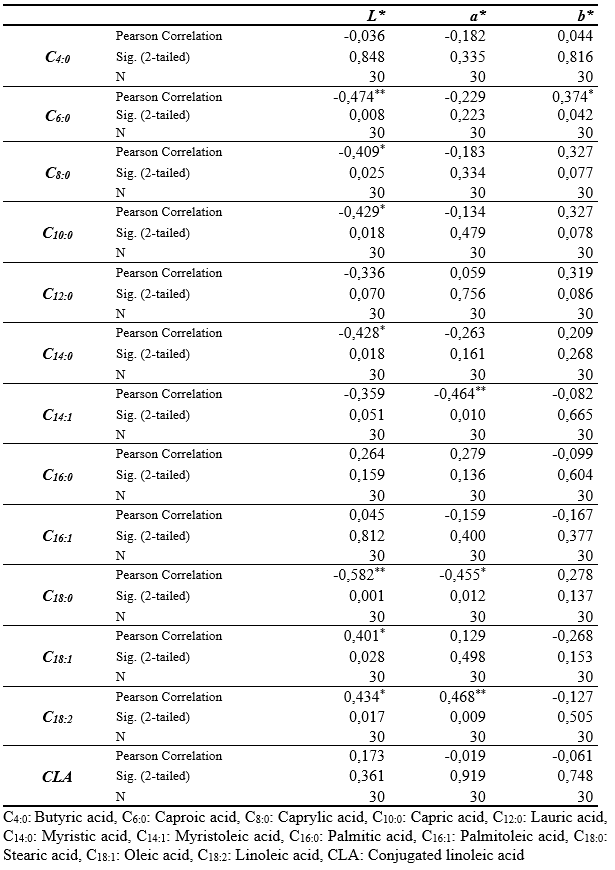
C18:0, C18:1 and C18:2 were also significantly correlated with L* and a*. Similarly, Gonzalez et al. [16] reported that butter with a high C18:1 content had a higher L* value than the control butter.
O’Callaghan et al. [3] reported no significant differences in butter L* and a* values between different cow-feeding systems and trans-β-carotene contents, although b* differed significantly. In this study, significant relationships were found between fatty acids and L* and a* values.
Conclusion
As expected, dry matter, fat and salt content, and peroxide value were statistically related to butter color. The Polenske number and fatty acid composition were also significantly correlated with color values. These results show that fatty acids can affect butter color. However, further research is needed.
References
[1] Göktürük, S., Sezgin, E., Yildirim, Z., & Atamer, M. (2002). Effects of season on vitamins A and E contents and colour of Turkish butter. Nahrung-Food, 46, 54–55.
[2] Prache, S., Priolo, A., Tournadre, H., Jailler, R., Dubroeucq, H., Micol, D., Martin, B., Durand, J., Emile, J., & Huyghe, C. (2002). Traceability of grass-feeding by quantifying the signature of carotenoid pigments in herbivores meat, milk and cheese. Proceedings of the 19th General Meeting of the European Grassland Federation, La Rochelle. Multi-Function Grasslands: Quality Forages, Animal Products, and Landscapes, pp. 592–593.
[3] O’Callaghan, T. F., Faulkner, H., McAuliffe, S., O’Sullivan, M. G., Hennessy, D., Dillon, P., Kilcawley, K. N., Stanton, C., & Ross, R. P. (2016). Quality characteristics, chemical composition, and sensory properties of butter from cows on pasture versus indoor feeding systems. Journal of Dairy Science, 99, 9441–9460.
[4] Frede, E. (2011). Butter and other milk products, properties and analysis. Encyclopedia of Dairy Sciences, 2nd ed., pp. 506–51.
[5] Krause, A. J., Miracle, R. E., Sanders, T. H., Dean, L. L., & Drake, M. A. (2008). The effect of refrigerated and frozen storage on butter flavor and texture. Journal of Dairy Science, 91, 455–465.
[6] Samet-Bali, O., Ayadi, M. A., & Attia, H. (2009). Traditional Tunisian butter: Physicochemical and microbial characteristics and storage stability of the oil fraction. Food Science and Technology, 42, 899–905.
[7] Kaya, A. (2000). Properties and stability of butter oil from milk and yogurt. Nahrung, 44, 126–129.
[8] Méndez-Cid, F. J., Centeno, J. A., Martínez, S., & Carballo, J. (2017). Changes in the chemical and physical characteristics of cow’s milk butter during storage: Effects of temperature and addition of salt. Journal of Food Composition and Analysis, 63, 121–132.
[9] Kashaninejad, M., Razavi, S. M. A., Tehrani, M. M., & Kashaninejad, M. (2017). Effect of extrusion conditions and storage temperature on texture, color, and acidity of butter. International Journal of Dairy Technology, 70(1), 102–109.
[10] Kurt, A., Çakmakçı, S., & Çağlar, A. (1993). Süt ve Mamülleri Muayene ve Analiz Metodları Rehberi. Atatürk Üniversitesi Ziraat Yayınları No. 18, pp. 106–124.
[11] Kosikowski, F. V. (1982). Cheese and Fermented Milk Foods. F. V. Kosikowski and Associates, New York.
[12] Metin, M. (2009). Süt ve Mamulleri Analiz Yöntemleri. Ege Üniversitesi, Ege Meslek Yüksekokulu Yayınları No. 24, İzmir.
[13] Elgün, A., Ertugay, Z., Certel, M., & Kotancilar, H. G. (2002). Guide book for analytical quality control and laboratory for cereal and cereal products.
[14] Erkaya, T., Urkek, B., Doğru, U., Çetin, B., & Şengül, M. (2015). Probiotic butter: Stability, free fatty acid composition, and some quality parameters during refrigerated storage. International Dairy Journal, 49, 102–110.
[15] Metcalfe, L. D., & Schmitz, A. (1961). The rapid preparation of fatty acid esters for gas chromatographic analysis. Analytical Chemistry, 33, 363–364.
[16] Gonzalez, S., Duncan, S. E., O’Keefe, S. F., Sumner, S. S., & Herbein, J. H. (2003). Oxidation and textural characteristics of butter and ice cream with modified fatty acid profiles. Journal of Dairy Science, 86, 70–77.
You can cite this study as; Akgul, HI and Sengul, M 2019. “Relationship between some parameters and color in butter.” 3rd International Conference on Advanced Engineering Technologies (ICADET 2019). Proceedings book p.p. 1770 – 1773. (see the conference website)

Halil İbrahim Akgül
Halil Ibrahim Akgul, Ph.D., is an Assistant Professor of Food Engineering at Bayburt University, where he works in the Division of Food Sciences within the Faculty of Engineering. He received his B.Sc. in Food Engineering from Akdeniz University in 2010, followed by an M.Sc. and a Ph.D. in Food Engineering from Atatürk University in 2015 and 2020, respectively. His formally recognised academic fields are Food Sciences and Engineering, Food Technologies, Dairy and Dairy Products Technology, and Food Microbiology.
Dr. Akgul has more than fifteen years of professional, research, and academic experience in food science. Between 2011 and 2013, he worked as the food engineer responsible for operations at the Pilot Dairy and Bread Factory of Atatürk University’s Directorate of Agricultural Enterprises. This industrial experience, combined with his subsequent academic research, gave him extensive practical and scientific knowledge of milk processing, dairy production, food quality, hygiene, and product development.
His research is primarily focused on milk and dairy products, dairy microbiology, starter cultures, lactic acid bacteria, exopolysaccharides, butter technology, and the physicochemical, microbiological, sensory, and nutritional properties of foods. His studies have examined the quality and fatty-acid composition of traditional butter, aroma formation in butter produced with different starter cultures, raw-milk quality, the characterisation and antioxidant activity of bacterial exopolysaccharides, traditional dairy products such as çökelek and karın kaymağı, colostrum powder, and the use of fruit-derived ingredients in ice cream production.
His academic record includes peer-reviewed research articles published in national and international journals, including Mljekarstvo, Acta Scientiarum Technology, the Journal of Food Safety and Food Quality, the International Journal of Food Engineering, the Atatürk University Journal of Agricultural Faculty, and ATA Food Journal. Four of the research articles currently listed in his university profile were published in SCI-Expanded-indexed journals. He has also contributed to twelve national and international conference papers and presentations covering dairy products, food microbiology, butter quality, fatty-acid composition, starter cultures, exopolysaccharide-producing bacteria, colostrum, traditional foods, and functional ice-cream formulations.
Dr. Akgul has participated as a researcher or adviser in eleven completed scientific and applied research projects. These projects have addressed the modernisation of pilot dairy-processing facilities; the production and quality characteristics of colostrum powder; the physicochemical and microbiological quality of butter and raw milk; the identification of exopolysaccharide-producing lactic acid bacteria; the development and production optimisation of starter cultures for mould-ripened cheese; the standardisation of traditional dairy products; and the use of sloe berry and persimmon fibre in ice-cream production.
His teaching experience spans undergraduate, associate-degree, and graduate education. The courses he has taught include Food Chemistry, Analytical Chemistry, General Chemistry, Organic Chemistry, Fermented Dairy Products Technology, Butter Production and Processing Technology, Healthy Living and Nutrition, Organic Agriculture and Food, Popular Science, Digital Literacy, and Information Technologies. Through these courses, he combines fundamental food chemistry and engineering principles with dairy technology, nutrition, scientific literacy, and the practical communication of scientific knowledge.
He is the founder and Editor-in-Chief of Gıda ve Sağlık, a multilingual digital publication devoted to food, nutrition, health, food chemistry, food microbiology, and culinary science. Through this platform, he draws upon his academic background, teaching experience, research activity, and practical knowledge of food production to present scientifically grounded information in a detailed and accessible form for an international readership.